
There is no shortage of books promising a “roadmap” to sustainability, but most retreat quickly into either abstraction or advocacy. What distinguishes Dr Atul Bora’s effort in his book Roadmap for a Sustainable World, even judged from its architecture alone, is the sheer discipline of its ambition. This is not a book content to gesture at crisis and virtue; it sets out to build an entire governance philosophy from first principles and then test it against some of the thorniest, most geopolitically loaded terrain on the planet — and it largely appears to follow through on that promise.
A genuinely systemic mind at work
The book’s real achievement is structural. Bora resists the temptation, so common in sustainability writing, to leap straight from diagnosis to prescription. Instead, he takes the reader through a careful sequence: first mapping the forces reshaping the twenty-first century, then drawing a sobering historical parallel through the collapse of ancient civilisations, and only then — a good third of the way into the book — arriving at his own theoretical apparatus. The “Systemic-Precautionary-Sustainable” framework that emerges from this slow build is a genuinely interesting piece of conceptual architecture.
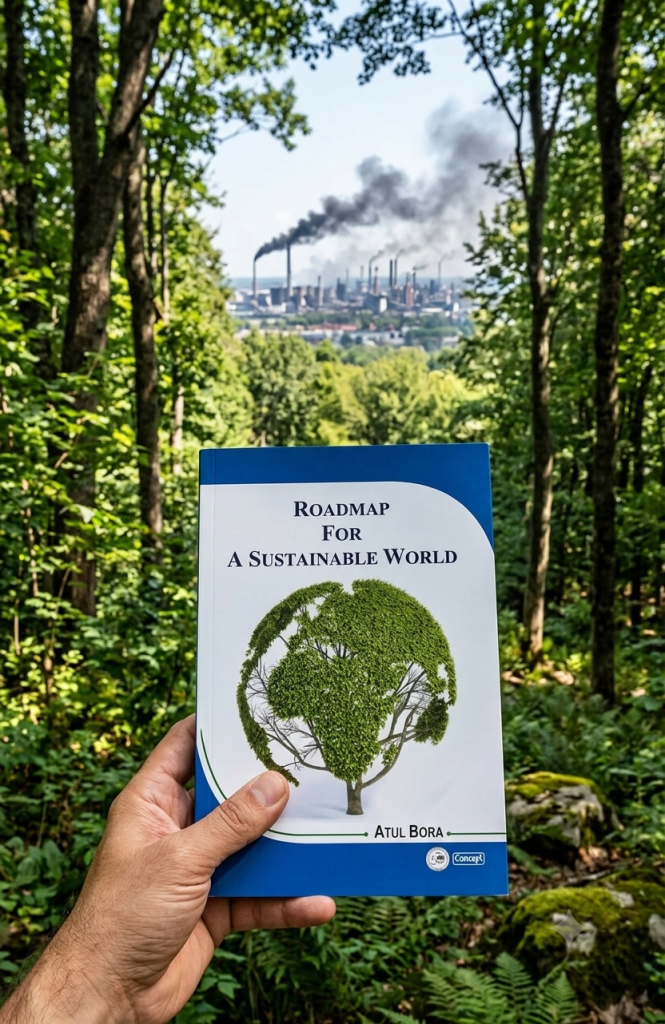
Rather than accepting the well-worn and increasingly contested language of “sustainable development,” Bora reframes the goal as a world that is simultaneously safe, healthy and just — a formulation with real ethical clarity, and one that gives the rest of the book a consistent measuring stick rather than a vague aspiration to gesture back to.
The strength of specificity
What could easily have remained a work of abstraction is redeemed by Bora’s evident willingness to get his hands dirty in a specific, difficult case. The chapter on transboundary river-system governance — sprawling across some 150 pages, easily the book’s centre of gravity — is where the book’s intellectual seriousness is most visible. Rather than treating South Asia–China water governance as one illustrative example among many, Bora gives it the space a subject of this complexity actually requires: the hydrological and geopolitical leverage China holds, the human security consequences that ripple from it, the patchwork of global conventions and customary law, and the delicate diplomatic history between India and China distilled through the Panchsheel principles. This is clearly a domain the author knows intimately, and it shows in the granularity of the subsections — ten separate strands within the harmonisation discussion alone. Rather than diluting the book’s universal claims, this depth lends the whole project credibility: here is a “roadmap” willing to be tested against one of the most intractable governance puzzles in the world, rather than staying safely general.
A framework that earns its keep
It would have been easy for a book of this scope to state its governance paradigms once in Chapter 3 and then simply gesture at them thereafter. Instead, the systemic-precautionary-sustainable framework is visibly put to work across ecosystems, river systems, and human settlements in turn — each domain treated with the same underlying logic of recognising natural and social infrastructure, harmonising fragmented policy regimes, and redesigning governance from first principles rather than patching existing failures. That consistency of method across very different subject matter is not a small thing to pull off across 570 pages.
Ending where it matters
The decision to close on education, rather than on policy recommendations or a summary of crises, is the book’s most quietly humane choice. Having spent six chapters diagnosing failure and redesigning institutions, Bora turns finally to the generational question — how the “laws of ecology” might be planted in early childhood, how school-level vision might be linked to national and world vision, and how India’s National Education Policy measures up against the sustainability standard the book has been building throughout. It is the right place to end: institutions and treaties can only carry a sustainable world so far without a citizenry raised to sustain it.
Conclusion
This is a book written by someone unwilling to separate theory from the hard specifics of implementation, and unwilling to let sustainability remain a comfortable abstraction. Its architecture alone — the patient build from diagnosis to framework to applied governance to education — reflects a rare kind of intellectual seriousness in a genre often satisfied with slogans. For readers interested in South Asian and Sino-Indian water governance in particular, the river-systems chapter looks to be an exceptionally rich resource in its own right, worth the book’s price alone.

