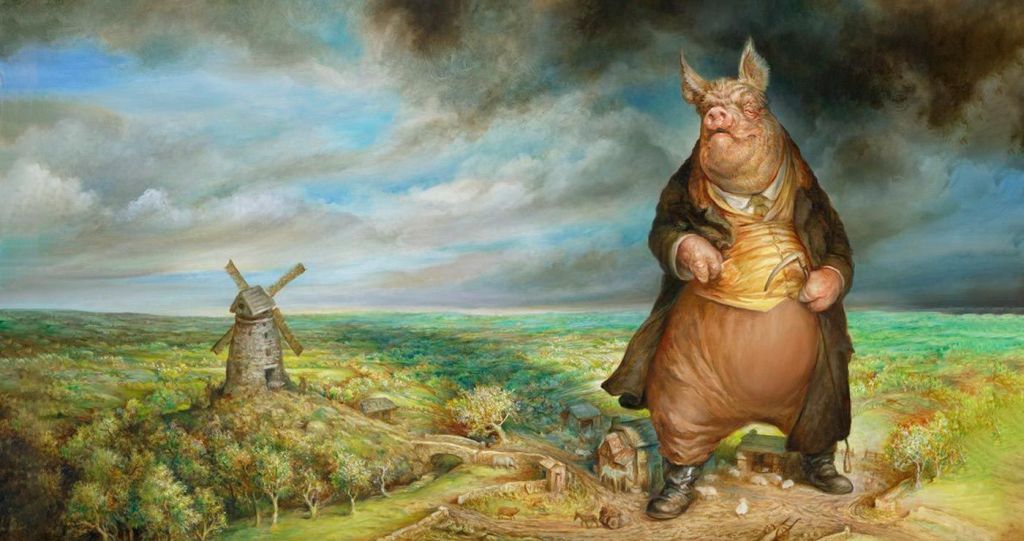
Published in 1945, George Orwell’s Animal Farm is one of the most quietly devastating political allegories ever written. It takes less than a couple of hours to read and tells the story of a group of farm animals who overthrow their human farmer, Mr. Jones, in a revolution driven by the promise of equality, freedom, and abundance. Within a generation, the pigs who lead the revolution have become indistinguishable — and then worse — than the humans they replaced. The final image of the novel is scary in its simplicity: the other animals look through the farmhouse window at the pigs and the men, and “already it was impossible to say which was which.”
Orwell wrote the book as a direct satire of Stalinist Russia and the Soviet Union, a warning to the Western left that revolutionary movements could be — and often were — co-opted by those hungry for power. Yet Animal Farm endures not because it captured one historical moment, but because it captured something timeless about political power: its tendency to corrupt, to revise history, to silence dissent, and to dress oppression in the language of liberation. In 2026, the book reads less like history and less like allegory — and more like a live dispatch from a dozen nations at once.
The Story: A Summary
The animals of Manor Farm are roused to revolution by Old Major, an elderly, respected boar who delivers a stirring speech about the tyranny of Man and the dream of a world where animals govern themselves. His philosophy — Animalism — holds that all animals are comrades, that Man is the enemy, and that the fruits of labor should be shared equally among all. Old Major dies shortly after delivering this vision, but the pigs, led by the clever and eloquent Napoleon and the idealistic Snowball, carry the revolution forward. When Mr. Jones neglects to feed the animals one too many times, the revolution happens spontaneously, and Manor Farm becomes Animal Farm.
The early days are heady. The Seven Commandments of Animalism are painted on the barn wall:
- Whatever goes upon two legs is an enemy.
- Whatever goes upon four legs, or has wings, is a friend.
- No animal shall wear clothes.
- No animal shall sleep in a bed.
- No animal shall drink alcohol.
- No animal shall kill any other animal.
- All animals are equal.
But the rot begins almost immediately. The pigs reserve the apples and milk for themselves under the justification that their brain-work requires it. Snowball and Napoleon compete for power; Napoleon eventually drives Snowball out of the farm using a pack of attack dogs he has privately raised since they were puppies. He then rewrites history, blaming all failures on Snowball’s supposed sabotage. A propagandist pig named Squealer serves as the regime’s mouthpiece, convincing the animals through a combination of lies, statistics, and fear that things are better than they were under Jones — and that any doubt is tantamount to inviting Jones back.
The commandments are revised one by one, always slightly, always with plausible justifications the animals can barely remember to refute:
- “No animal shall sleep in a bed” becomes “No animal shall sleep in a bed with sheets.”
- “No animal shall drink alcohol” becomes “No animal shall drink alcohol to excess.”
- “No animal shall kill any other animal” becomes “No animal shall kill any other animal without cause.”
Until, at last, all seven commandments have been erased and replaced with a single, monstrous sentence: “All animals are equal, but some animals are more equal than others.”
The pigs walk on two legs. They carry whips. They trade with humans. And the animals, worn down by labor and propaganda and fear, can barely remember what they once believed — or whether things were ever different at all.
The Core Political Mechanisms Orwell Identified
Before turning to contemporary examples, it is worth naming the specific mechanisms Orwell anatomized, because they are the tools we should be watching for in the real world.
1. The Revision of History. Napoleon’s regime constantly rewrites the past to justify the present. Snowball, who was genuinely heroic during the Battle of the Cowshed, is retroactively declared a traitor. Production statistics are falsified. The animals’ own memories become unreliable weapons turned against them. Orwell understood that controlling the past is the first step to controlling the future.
2. The Incremental Erosion of Principles. The commandments are not abolished all at once — they are chipped away, slowly, with each change so small it can be rationalized. This gradualism is far more effective than overt tyranny: it leaves the population confused rather than outraged.
3. The Loyal Propagandist. Squealer does not merely lie — he manages perception. He uses fear (“Surely you don’t want Jones to come back?”), false statistics, and appeals to loyalty to neutralize dissent before it forms. He is more dangerous than Napoleon in some ways, because he makes oppression feel reasonable.
4. Controlled Opposition and Show Trials. Napoleon stages public confessions in which animals “admit” to working with Snowball, then have their throats torn out by the dogs. This spectacle is not about justice — it is about terror and compliance.
5. The Betrayal of the Working Class. Boxer, the enormous, tireless horse who embodies the working class, gives everything to the farm. His motto is “I will work harder” and “Napoleon is always right.” When he collapses from exhaustion, Napoleon sells him to the knacker’s yard for money to buy whiskey. Squealer tells the animals Boxer died in a hospital, surrounded by care. The tragedy is not just Boxer’s death — it is the others’ willingness to believe.
6. Populist Beginnings, Oligarchic Ends. The revolution begins with genuine grievances and genuine idealism. It is co-opted not by enemies, but by leaders who believe, at first, that they deserve more — and then that they deserve everything.
Real-World Resonances in Today’s Political Climate
Russia and the Post-Soviet Oligarchy
Orwell wrote Animal Farm explicitly about Stalinist Russia, but its patterns have persisted and evolved in post-Soviet Russia under Vladimir Putin. The revolutionary energy of 1991 — the collapse of the Soviet Union, the promise of democracy, the genuine popular hope — was gradually consolidated by a class of oligarchs and security-state veterans. Putin himself rose as a seemingly technocratic reformer, a stabilizing force after the chaos of the Yeltsin years.
The Squealer dynamic is visible in the Kremlin’s media ecosystem: state television shapes narratives so thoroughly that large portions of the Russian population genuinely believe they are defending Russia from Western aggression in Ukraine, that Soviet history was a glorious project, and that dissidents like Alexei Navalny were foreign agents rather than reformers. Navalny’s imprisonment and subsequent death in a remote Arctic penal colony in 2024 — for crimes that the international community widely regarded as fabricated — is the Boxer moment: the regime removing the most dangerous kind of opponent, not the armed rebel, but the honest worker who simply wanted the commandments to mean what they said.
History is continuously revised. Soviet-era monuments return; the word “war” in reference to Ukraine is criminalised; textbooks are rewritten. The commandments change, but Squealer is always there to explain why this was always what they meant.
Venezuela and the Bolivarian Revolution
Few modern stories track the arc of Animal Farm more precisely than Venezuela. Hugo Chávez came to power in 1999 on a wave of genuine populist energy, promising to redistribute oil wealth from a corrupt oligarchy to the poor majority. The early Chávez years produced real reductions in poverty, expanded literacy programs, and land redistribution. Old Major’s dream seemed, briefly, attainable.
But the structures of accountability were dismantled alongside the structures of inequality. The courts were packed, the press was pressured, the military was brought under direct personal loyalty to the president. When Chávez died in 2013 and Nicolás Maduro took over, the scaffolding of revolution was all that remained — and behind it, a ruling class that controlled food distribution, state contracts, and foreign currency while ordinary Venezuelans waited in lines for bread. By the late 2010s, Venezuela had one of the highest inflation rates in human history, and millions had fled the country.
The Seven Commandments had been rewritten. The revolution, it turned out, was for the pigs.
China and the Memory of Tiananmen
Xi Jinping’s consolidation of power in China over the past decade offers a textbook example of Orwell’s mechanisms operating at civilizational scale. The revision of history is institutionalised: the Tiananmen Square massacre of 1989 is effectively erased from Chinese internet searches, textbooks, and public discourse. The “tank man” photograph — one of the most recognized images of the 20th century — cannot be found on Chinese platforms. An entire generation has grown up with no accessible account of what happened.
The incremental erosion of principles is visible in Hong Kong. The “one country, two systems” framework promised to Hong Kong in 1997 had a 50-year guarantee. By 2020, the National Security Law had effectively ended that autonomy. Each step was justified on its own terms; each step made the next step easier. The barn wall commandments were repainted so quietly that many people could not be sure what they originally said.
Xi’s removal of presidential term limits in 2018 — achieved through a rubber-stamp legislature with near-unanimous votes — mirrors Napoleon’s consolidation of power exactly. The animals voted. They always vote. The vote always goes one way.
The United States and the Crisis of Democratic Norms
The United States is not, by any serious measure, an authoritarian state. But Animal Farm is not only a story about authoritarianism — it is a story about the fragility of shared principles and the mechanisms by which they erode. Those mechanisms are visible in American politics in ways that deserve honest acknowledgment.
The revision of history has become a feature of partisan politics. Legislative votes are recharacterised within days of being cast; video evidence is dismissed as misleading; events witnessed live by millions are subsequently disputed not on factual grounds but on tribal ones. Squealer does not need state television when social media algorithms serve the same function, feeding each population the narrative that confirms what it already believes.
The incremental erosion of norms — in judicial appointments, in executive power claims, in the treatment of oversight institutions — follows exactly the pattern Orwell described: each step is individually defensible; cumulatively, they rewrite the commandments. Each party, when it holds power, discovers new reasons why this particular norm was always more flexible than it appeared.
The Boxer dynamic — the loyal base that works harder, gives more, and trusts completely — is visible across the political spectrum, in supporters who absorb economic policies that harm them directly because the narrative of loyalty is more powerful than the reality of material conditions.
Hungary, Turkey, and the Playbook of Electoral Authoritarianism
Political scientists have described a new pattern they call “competitive authoritarianism” or “democratic backsliding”: leaders who come to power through free elections and then systematically modify the rules to make losing an election increasingly unlikely. Viktor Orbán in Hungary and Recep Tayyip Erdoğan in Turkey are the most-cited European examples.
Orbán was elected in 2010 on a platform of economic renewal. Within his first term, his government had rewritten the constitution, packed the constitutional court, gerrymandered electoral districts, concentrated media ownership among allies, and redesigned election rules in ways that gave his party structural advantages. None of this required violence. It required Squealer — the careful, continuous explanation that each change was necessary, legal, and temporary. By the time the cumulative effect was clear, the mechanisms of reversal had been largely dismantled.
This is perhaps the most unsettling contemporary lesson from Animal Farm: the revolution does not need to arrive on horseback. It can arrive at the ballot box, with excellent poll numbers, and simply never leave.
Orwell’s Deepest Warning: The Animals Who Forget
The most heartbreaking characters in Animal Farm are not Napoleon or Squealer. They are the animals who forget, who doubt their own memories, who work harder when they should ask harder questions. The sheep, trained to bleat “Four legs good, two legs bad” — and later “Four legs good, two legs better” — whenever debate threatens to become inconvenient. The hens and cows who distrust Snowball because Napoleon has told them to. Clover, who can sense that something has gone terribly wrong but lacks the literacy to read the commandments for herself and confirm it.
Orwell’s warning is not ultimately about dictators. They are almost a constant in human history. His warning is about the rest of us — about the conditions under which ordinary people surrender their critical faculties, accept revisions to shared reality, and find reasons not to remember what they used to know.
The antidote, Orwell believed, was found in what he called “democratic socialism” — but more broadly in the habits of a free citizenry: independent journalism, literacy, the preservation of institutional memory, and the willingness to say clearly what one sees even when Squealer is standing right there with the statistics to prove you wrong.
Conclusion
Animal Farm is 80 years old and has never been more contemporary. Its power lies not in the specificity of its Soviet allegory — which is historically settled — but in the universality of its mechanics. Every generation discovers that power corrupts, that revolutions can be hijacked, that propaganda works, and that the hardest thing in politics is not defeating an obvious enemy but recognizing the slow rewriting of the commandments you thought you had memorised.
The lesson is not cynicism. Orwell was not saying that revolution is always wrong, or that no reform is possible, or that all politicians are pigs. He was saying: watch the barn wall. Remember what it said before. Read it yourself, and do not wait for Squealer to explain it to you.
The animals who suffered most in the end were not those who opposed the revolution. They were those who trusted it completely, worked for it devotedly, and never thought to check whether the words on the wall still meant what they once had.
“All animals are equal.”
It was such a beautiful commandment.
It would have been worth keeping.

