
When I picked up Sanjena Sathian’s novel Goddess Complex, I noticed a couple of mentions of it being a gothic tale on the back cover. At first (I mean, for at least a hundred pages or so), I couldn’t understand why—it didn’t seem right. But then I reached the second half of the book, and it all began to make sense. What begins as a work of modern literary fiction, laced with humour and Sathian’s brilliant prose, suddenly takes a darker turn and pulls you into an entirely different world. How does that shift happen? Let me take you on a short journey through this novel.
ABCD and their Cultural Dissonance
“ABCD” is a term often used to describe American-Born Confused Desis. No, the author hasn’t used it, but one can see certain connections here. The protagonist, Sanjana (yes, that’s her name—but more on that later), embodies the complexities and contradictions faced by this group, especially second-generation immigrants like herself.
What makes the ABCD situation so complicated? On one hand, they grow up very much American, with values shaped by the culture around them. But at home, they have parents who, while they may not be especially fond of India themselves (after all, they left it), still expect their children to live a certain kind of life—one that includes excelling in studies, securing stable jobs, getting married, and having children.
So when Sanjana’s mother says, “You do such things without even being boyfriend-girlfriend. With anyone, everyone,” it sounds funny—but it also reveals the deep disconnect in cultural expectations.
Not easy to understand their situation, right? It’s probably for the same reason that Sanjana switches from a white therapist to an Asian-American one.
Even language becomes a space of confusion: should you call someone by their first name or by their relation? Such small details brilliantly reflect the cultural confusion that one might experience.
Navigating Millennial Motherhood
Coming to the story…
Sanjana meets Killian, a struggling actor, and the two eventually get married. Happily ever after? Not really. Their relationship was never perfect—and both of them knew it. When Sanjana gets an opportunity to travel to India for her fellowship, Killian is eager to join her. He, too, has an Indian connection: his father, apparently an Indian man, once had a brief relationship with Killian’s hippie mother, which resulted in his birth. That’s one version of motherhood—accidental, unplanned, and unacknowledged.
But there are others. Sanjana’s own mother had dreams of a different life and never really wanted children, yet ended up settling into family life in the US. That’s another kind of motherhood. This one comes more from the traditional role of a woman in a conservative society. “Duty” is the word her mother uses to describe that experience.
Then there’s her sister, or her friend who’s expecting—a more modern, perhaps even aspirational model of motherhood. In this case, there is a lot of planning as well as care involved.
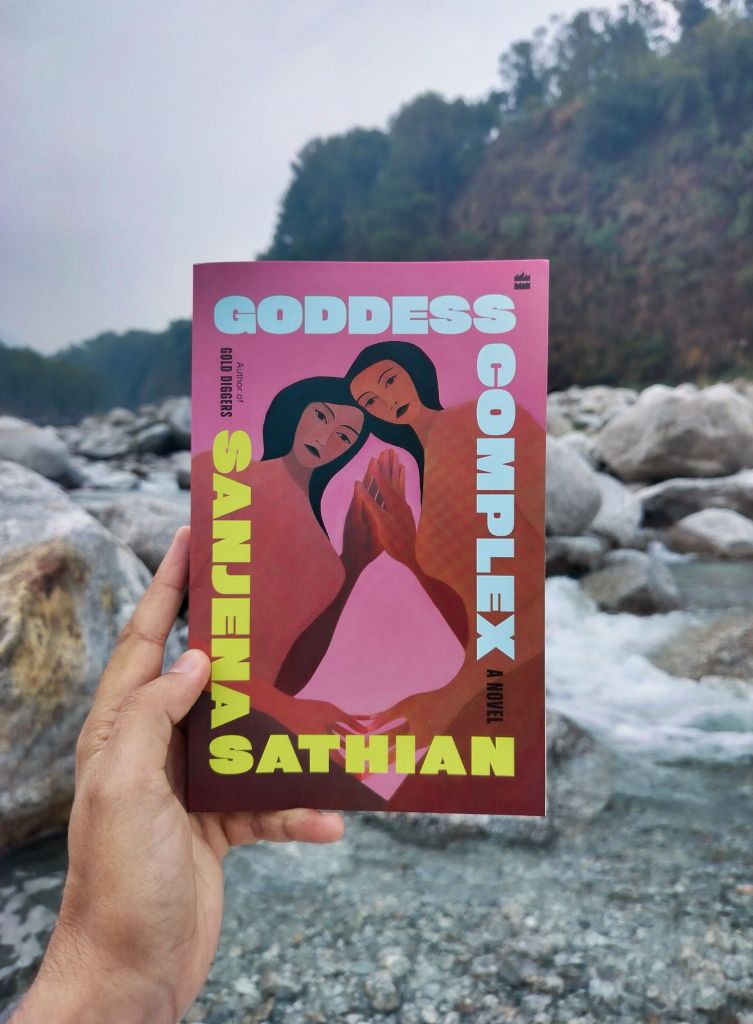
These varied examples begin to shape Sanjana’s own understanding of what it means to be a mother. That exploration—personal, cultural, and eventually conflicted—sits at the heart of the novel. Sanjana’s thoughts on motherhood aren’t clear-cut; they’re shaped by ambivalence, inherited expectations, and quiet questions she can’t always articulate. And the novel doesn’t try to offer easy answers either—it allows those complexities to unfold slowly, in layers.
Eventually, Sanjana’s marriage begins to fall apart after she chooses to have an abortion. Sanjana returns to the US, while Killian decides to stay back in India. And that’s where a brilliant twist comes.
Mirror in the Shakti Centre
The story takes a surreal turn when Sanjana starts receiving messages congratulating her on a pregnancy—one that she had already terminated. At first, it’s baffling. Then she realises the messages aren’t meant for her, but for another woman named Sanjena—someone who not only shares a nearly identical name but also looks uncannily like her. Though stranger to her, Sanjena is now involved with Killian.
Puzzled and unsettled, Sanjana travels back to India, partly out of curiosity, partly in search of closure. Her search leads her to the Shakti Centre, a mysterious fertility clinic where Sanjena has become a central figure. What unfolds there is more than just a confrontation with another woman—it becomes a confrontation with a different version of herself.
A lot follows next. There’s a cult-like atmosphere, with certain other-worldly practices from mirroring to womb regression. The most interesting part is when Sanjana meets Sanjena; it’s like a meeting of conscious with unconscious. Sanjana is forced to reckon with the life she could have lived, the choices she didn’t make, and the parts of herself she may have ignored or repressed. The writing style might feel a bit mystical in this part, but you can easily sense the psychological dimension that the author has explored here.
Final thoughts on the book
Goddess Complex is a layered and provocative exploration of identity, agency, and the invisible weight of societal expectations—especially those placed on modern women. At its core, the novel follows Sanjana’s inner and outer journeys as she navigates the murky terrain of womanhood in a world where every choice (be it career, relationships, or motherhood) is loaded with meaning, guilt, and consequence. What makes this novel stand out is not just its themes, but the way Sathian handles them, with both wit and emotional honesty.
Sanjana, in no way, is an idealised protagonist. She is messy, conflicted, often unsure of what she wants—but she’s trying to figure it out in real time, much like many millennial women today. The novel becomes a mirror held up to the contradictions of contemporary life: the desire for independence alongside the longing for connection, the push for professional achievement balanced against the quiet, sometimes taboo yearning for a child, and (add to that) the ways in which capitalism and social media have turned motherhood itself into a performance or a brand.
By blending realism with elements of surrealism, Sathian uses literature to explain the depths of reality. This approach differs slightly from that of Salman Rushdie, who blends surreal elements into reality; in contrast, Sathian treats reality as objective. She uses the tools of speculative fiction to ask real questions: Who are we when we refuse to fit into the roles society sets for us? What parts of ourselves get buried in order to belong? And what might it look like to meet the version of you who made the opposite choices?
In doing so, Goddess Complex offers more than just a plot—it becomes a philosophical meditation on identity, motherhood, and the freedom to choose without shame. It’s a novel that doesn’t preach or resolve too neatly, but instead opens a space for readers to sit with discomfort, ambiguity, and truth. It resonates because it refuses to simplify what it means to be a woman in the modern world.

