Note: Check out this newsletter that I recently published on Sindhi literature along with some interesting stories.
The word ‘Sindhi’ is an adjective, meaning ‘of’ or ‘belonging to Sindh’. For those of you who don’t know, Sindh is a province in south-eastern Pakistan, known for its rich cultural heritage, historical significance and the fertile plains of the Indus River. Yes, it’s here that the famous Indus Valley Civilisation flourished.
Just like the region and its culture, the Sindhi language is quite ancient. The word ‘Sindhi’ is found recorded first time in rock inscriptions around 2500 years ago. What about Sindhi literature? Well, unfortunately, there is not much of written record before the Arab conquest of Sindh, which took place in the 8th century. But if we start our journey from the Arab period, then we find a number of literary gems.
Let’s start, then.
Sindhi literature across various periods
1. Arab period
An unknown Sindhi scholar, more than 1000 years ago, wrote in Sindhi language a prose version of the Mahabharata. It was translated into Arabic, as mentioned in the writings of Al-Beruni and Abu Saleh. The said Mahabharata may be regarded as the earliest work of Sindhi prose.
But, it wasn’t just one book.
In this period, Sindh emerged as a cultural melting pot where scholars conversed fluently in Sindhi, Sanskrit, Arabic, Persian, and delved into the realms of Mathematics and Astrology. The Arab travellers of the 8th and 9th centuries, such as Jahiz, Istakhri, Ibn-e-Nadeem, Bashari-al-Maqdisi, and Al-Bairuni, paint a vivid picture of an academic oasis in the region.

Their records also unveil an intriguing milestone—the translation of the Holy Quran into Sindhi in the 9th century. At the behest of a non-Muslim ruler of Kashmir, an Iraqi scholar, steeped in Sindhi language and poetry, undertook this monumental task. Although the specimen of this translation is lost to the sands of time, it marks Sindh as the first foreign language in which the Arabic text of the Quran found linguistic resonance.
2. Soomra period
The Soomra period (1024-1351), often relegated to the shadows, bears witness to ‘Dodo Chanesar’. It is considered as the earliest piece of poetry from this era. Let me briefly tell you about the story of this semi-historical narrative.
Dodo Bin Bhongar was a king with two wives, and his sons were Chanesar and Dodo II. After Dodo I’s death, there was a disagreement about who should be the next ruler. Despite Chanesar’s brother Bhaagi trying to make him the king, the nobles chose Dodo II because of his noble birth. Angry, Chanesar sought help from Alauddin Khilji in Delhi to fight his brother, leading to a battle where both Dodo and the Sindhi armies fell. Even in death, Dodo held onto his sword, taunting Chanesar.
Moreover, in the same period, we find the mystic poetry of Pir Nooruddin, affectionately known as ‘Pir Satgur Noor’. An Ismaili-sect luminary, his verses resonate in Khojki script, carrying the essence of Islamic mysticism, Vedantic thought, and Bhagti teachings. Pir Nooruddin’s literary legacy survives, safeguarded by Ismaili families across Pakistan and India.
3. Samma period
Transitioning through the pages of history, we arrive at the Samma period (1336-1524). The period was marked not only by political dynamics but also by the emergence of poets like Sheikh Hamad Jamali, Darvesh Raju, and Ishaak Ahangar. Amidst tales of love and valour, these poets became architects of the Sindhi literary milieu.
Since the Sammas were native to Sindh, their rule witnessed more development of Sindhi poetry and prose. The ‘Seven Sages’, known as ‘Mamui Faqirs’ and their riddles are associated with this period. These are prophesies composed in ‘Doha’ and ‘Sortha’ forms.
4. Kalhora period
The Kalhora period (1701-1783) unfurled like a ‘Golden Age,’ its zenith marked by the trinity of classical Sindhi poets—Shah Abdul Latif Bhittai, Sachal Sarmast, and Sami. Shah Abdul Latif Bhittai, a legend unsurpassed, casted a mystic spell transcending the boundaries of language and culture. And when you mention the word Bhittai, the first thing that comes to mind is ‘Shah Jo Risalo‘.
‘Shah Jo Risalo’ consists of mystical verses expressing the themes of divine love, spirituality, and the human quest for union with the divine. Bhittai’s poetic work is celebrated for its profound insights into the human condition and its influence on Sufi thought, making it a cornerstone of Sindhi literature and a source of inspiration for generations.
5. The British Raj
The British Raj (1843-1947), with its colonial imprints, unfolded a new chapter in Sindhi literature. When Sir Bartle Frere formalised the Perso-Arabic-Sindhi script in 1853, it led to a massive production of Sindhi literature. Some prolific names such as Ghulam Mohammad Shah “Gada,” Mir Abdul Hussain Khan “Sangi,” and Shamsuddin “Bulbul” painted the literary canvas with Persianised forms, bridging the chasm between tradition and modernity.
The confluence with the West became palpable during the British rule, as Sindhi literature embraced foreign translations and modern literary developments. The Sindhi language, granted formal script, evolved dynamically, engaging in a dialogue with English and European literature. Ghazal, Qasido, Rubai, Marthio, Mathnavi, and Musadas became common genres, signalling a synthesis of indigenous and foreign literary influences.
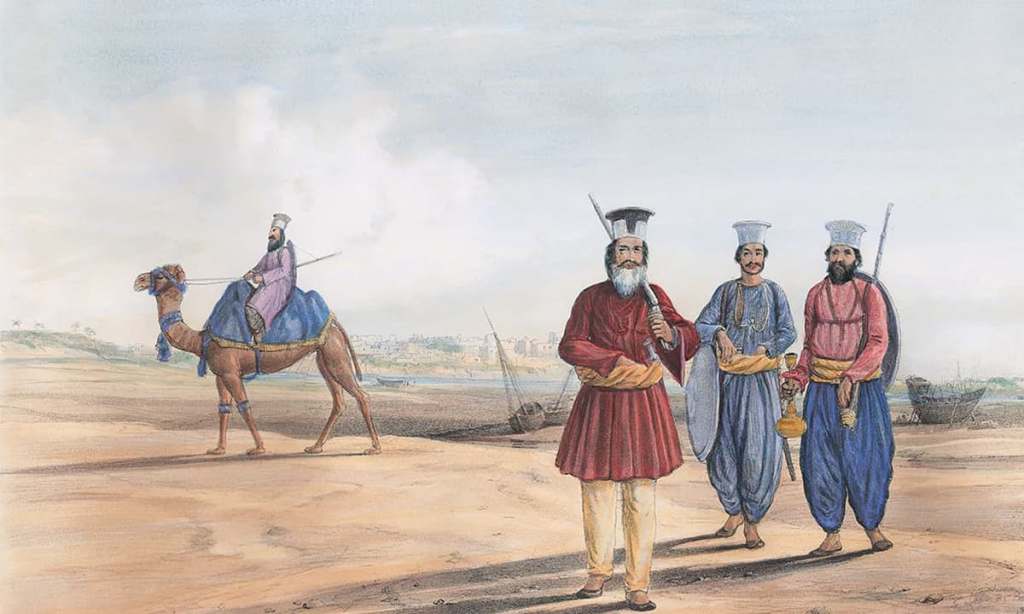
Ghulam Mohammad Shah “Gada,” a luminary of this era, contributed significantly to religious literature in Arabic, Persian, and Sindhi. Amidst this literary renaissance, Akhund Lutufullah emerged as a master in poetic prose style, setting the stage for the development of prose writing in Sindhi.
The early prose works in Sindhi, regarded as the Nandiram Age, exhibited a subtle blend of translations and adaptations. The translation of ‘Tarikh-e-Masoomi’ by Diwan Nandiram exemplified the Sindhi prose of the early British period. Vibrant and colloquial, the language extended its lexical horizons, borrowing from Arabic, Persian, Hindi, and Sanskrit.
The introduction of ‘Free Verse’ during British rule ushered in a revolutionary shift in Sindhi poetry. Divan Dayaram Gidumal pioneered this movement with ‘Mann-a-Ja Chahbuk,’ a massive volume of philosophic verse that resonated with the evolving taste of thoughtful Sindhi youth. The winds of change swept through Sindhi literature, setting the stage for a new era that extends beyond colonial boundaries.
Final thoughts on Sindhi literature
Considering its history and development, Sindhi literature grew like a living entity, absorbing diverse influences across the ages. From the ancient scholar’s quill to the mystic verses of Pir Nooruddin, the triumphant crescendo of Shah Abdul Latif Bhittai, the prophetic ballads of the Talpur era, and the dynamic shifts during British rule—the narrative intertwines with the ebb and flow of cultural tides.
As we traverse this literary landscape, each epoch, like a brushstroke, leaves an indelible mark on the canvas of Sindhi literature. The folk tales, mystic verses, and Persianised forms coalesce, creating a continuum that echoes through the corridors of time. Sindhi literature, much like the river that flows through the region, carries the sediment of centuries, shaping a narrative that is both timeless and evolving.
Reference book
Sindhi Language and Literature by Anwar Pirzada
 Kalampedia