Cricket started in English countryside before it found devotees, followers and lovers in all of the far-flung reaches of the old British Empire. That’s why, we (in India), often associate it with the legacy of the Empire, although we do maintain that now it is as much Indian as British. (Like the English language, perhaps? Or tea?) Cricket is full of stories, and within the larger narrative of the game, there are many other going on, especially in terms of its power dynamics. And who better than a cricket historian to discuss these stories with?
Duncan Stone, a British cricket historian interested in the social and cultural machinations of sport, has been bringing out the lesser-known aspects of cricket. He argues that English cricket has long been essentially dominated by white, upper-class, public-school men who have ensured that the game does not become so popular that they would need to relinquish control. In his book Different Class he demonstrates how the “quintessentially English” game has done more to divide, rather than unite, the English.
I spoke with Dr Stone about his book and, of course, cricket in general. Below is the full text of our exchange.
Could you give our readers a brief background of your book?
When at university, studying for a Masters in the sociology of sport, I became interested in why the North and South of England had two diametrically opposite cricket cultures.
The limitations of a Masters dissertation notwithstanding, I found the stereotypes of a ‘competitive’ North and a ‘genteel’ South did have some validity. But this was not, strictly speaking, evident within county cricket.
I then completed a PhD on the matter (this time in history). And it is this that forms the basis of the book.
Crucially – unlike previous books – I examine English cricket from the bottom-up. That is, from the recreational rather than first-class (professional) perspective. Moreover, I place the game within its true socioeconomic context.
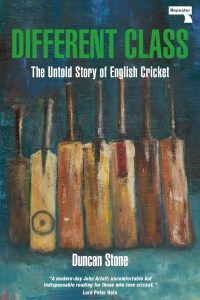
This is important because it explains how cricket, and the culture of English cricket, was designed to divide, rather than unite, the English at every level of the game. Indeed, the history of recreational cricket tells us more about British/English society — and how it works — than any study of the first-class game ever could.
As we say sometimes in India, cricket is an Indian game accidentally invented by the British. But beyond its British connections, we don’t know much about its origins. Could you throw some light on that?
Contrary to the game’s orthodox history, which argues a handful of Aristocratic patrons were central to the game’s transformation into the sport we know today, cricket was a ‘people’s game’.
The earliest reference, circa 1550, emanates from my hometown of Guildford in the county of Surrey (30 miles south of London) and it describes schoolboys playing on a patch of land above the High Street.
The issue, historically speaking, is that these matches would have been played according to oral traditions before the first known ‘Laws’ were written down prior to a challenge match (for a wager) between two aristocrats in 1727. However, these were not an attempt to standardise the rules. They were, in essence, part of a ‘contract’ designed to ensure fair betting.
This basis for arranging games continued among cricketers of all classes until the late nineteenth century when notions of civic pride and more formal forms competition, especially cups and leagues, took over.
What do you think is the most English thing about cricket?
Ha ha ha. Hypocrisy.
Sport is supposed to be the ‘great social leveller’, but English cricket has never been a ‘level playing field’ because the game’s middle and upper-class establishment could not bear to have their social and cultural position challenged.
This is why the ‘gentlemen’ amateurs and the working-class professionals were divided by the amateur professional distinction, and the County Championship (unlike the Football League) remained an idiosyncratic competition, until the 1960s.

Overall, cricket’s history ably demonstrates the extent the elites of Britain detest meritocracy.
In your book you also talk about the class hierarchies throughout the history of cricket. How have these hierarchies evolved, according to you?
Indeed. As I just hinted, the elites’ fear of equal competition led them to adopt an aggressive form of amateurism designed to subjugate, diminish or exclude working class participation in cricket and many other sports.
There were even calls to double entrance fees to county games to discourage working class spectators from coming. But as much as they wished to make cricket an all-amateur or upper-class affair the first-class game was already, to quote one gentleman amateur, “trapped by its own popularity”.
However, at the recreational level in southern England such men were able – via an organisation called the Club Cricket Conference – to ban meritocratic competition altogether following the hiatus caused by the First World War.
This not only led to the different regional identities that instigated my research, I found that clubs that had once represented communities as a whole before the war were taken over by the local middle classes thus forcing the creation of separate working men’s teams within the same village.
Rather than reflect inter-war class conflicts, in the south of England it seems cricket may well have instigated them. While the local working men continued to play competitive league cricket the elite clubs now played non-competitive, or ‘friendly’, cricket that meant they got to pick and choose who they played against.
Did you get a chance to watch the movie Lagaan?
I have seen Lagaan, but it was many, many years ago.
So that is the common impression in India, about how cricket came here. That movie, and many cricket pundits, suggest that excelling at cricket has been Indians’ way to prove that they were better than their colonial masters. Do you see such dynamics at play in history or present?
I’m no expert on cricket in other countries, but as a cricket historian I would suggest the ideological utility of cricket as part of a broader ‘civilising mission’ designed to control the subjects of Empire also applied to the working classes at home in Britain. Cricket’s image as a ‘gentleman’s sport’ has been, I’m afraid, all too successful in this endeavour.
I don’t recall my childhood friends Sunil and Ravi (you can guess can’t you), or their parents, regarding Indian cricket as an expression of anything remotely challenging to the status quo. Indeed, my memory is that Indian and New Zealand sides were the least challenging, culturally speaking, compared to Australia, Pakistan and the West Indies.
Of these, I think it was Australia and the West Indies – via activists like C.L.R. James, Learie Constantine, Clive Lloyd and Viv Richards – took success over the ‘mother country’ as a means for expressing an independent post-colonial identity most seriously.
As a cricket historian and fan yourself, where do you see the test cricket going? Especially when we talk about the test cricket in England.
Ahhh. The billion-dollar question.
Although Test cricket is the zenith of cricket competition, a match lasting five days is a not simply a throwback to the Victorian era, we must recognise matches of this length were an anachronism, ill-suited to an industrialised capitalist society, from their very inception.
While County and Test cricket have never truly reflected modern society, they represent a cultural legacy that many hold dear. Sadly, these ‘traditionalists’ are invariably from an older generation, whereas younger fans prefer one-day or T20 matches.
In England, this is a problem as many within the game and the media will openly say anyone who prefers these shorter forms isn’t a ‘real’ cricket fan. Accordingly, there now exists (in Britain at least) a generation gap – exacerbated by the removal of Test cricket from free-to-air television by the ECB in 2006 – that will be hard to rectify.
There is also, as the failure to sell out the first day of the Lord’s Test against New Zealand demonstrates, a cost issue to deal with. Cricket in England – especially Test cricket – remains expensive and exclusive.
This is not to say Test cricket is going to die – cricket has a strange resilience – but it will become, if it hasn’t already, less important outside of Ashes series. Like it or not, T20 is the future of cricket. In many ways that future has already arrived, but too many refuse to acknowledge that.
Thank you for speaking with us!
Get Duncan Stone’s book on Amazon


