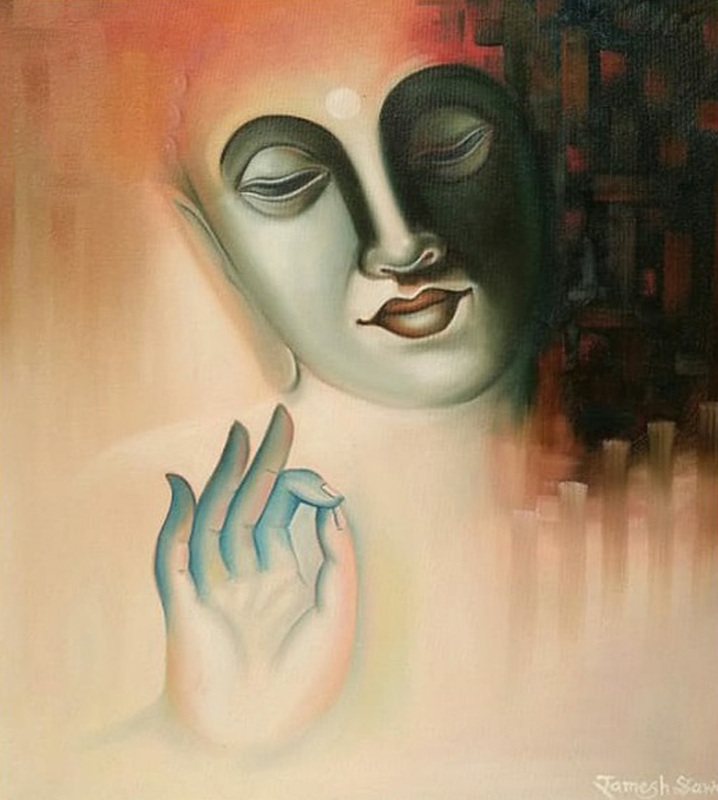
Today let’s focus on the practice of visualisation meditation.
In your attempts to calm and concentrate your mind, you have probably noticed visual images among the many things that distract your attention from the object of meditation. This can include faces of loved ones, your home, other familiar faces and places, memories of films you have watched, even abstract images. Such images arise spontaneously throughput the day but we are often too engrossed in external world to notice them. At night too, our mind creates vivid scenes in which we interact with dream-world.
If we pay close attention, visualisation is a gift. This natural capacity to think in terms of images, not merely words, can be used to deepen our meditative experiences. The two kinds of meditation — calm and insight — are used together in visualisation techniques. We need analytical thought to construct the image and to recall it whenever it is lost during the session. On the other hand, developing a clear visualisation depends primarily on calm meditation. Once the image has been established and we feel comfortable with it, we should hold it with single-pointed attention, not letting our mind be distracted. This ability will grow with practice.
Benefits
- Helps to develop focus
- Brings calm
- Reduces stress and anxiety
- Develops appreciation of art
The practice
- Sit comfortably, with your back straight, and breathe naturally. Spend some time observing the natural rhythms of your breathing to settle your mind.
- When your mind is calm and clear, visualise in the space above your head a sphere of white light, somewhat smaller than the size of your head — pure, transparent, nonmaterial. Spend a few minutes concentrating on the presence of the light. Do not worry if it does not appear sharply, it is enough to feel that it is there.
- Think that the sphere of light represents all universal goodness, love and wisdom. It is the fulfillment of your highest potential.
- Visualise that it decreases in size until it is about one inch in diameter and descends through the top of your head and into your heart.
- From there it begins to expand once more, slowly spreading to fill your entire body. As it does so, all the solid parts of your body dissolve and transform into light — your organs, bones, blood vessels, tissues and skin all become pure, translucent white light.
- Concentrate on the experience of your body as a body of light. Think that all problems, negativities and hindrances have completely vanished, and that you have reached a state of wholeness and perfection. Feel serene and joyful.
- If any thought or distracting object should appear in your mind, let it dissolve too in white light.
- Finish by dedicating the positive energy of the meditation to the benefit of all beings.
The visualisation meditation practice is most helpful for those who think in terms of images. If you are finding it difficult to visualise or focus on an image, you can try other meditations to let your mind settle and come back to it later. Continuing the practice is more important than doing a specific practice. So, continue the good work you have been doing. Cherish this journey!

