
You may not know this, but the Bhagavad Gita is not the only Gita in the Hindu philosophy. This makes sense when you think about the literal meaning of the word Gita, which means song. So, of course, there won’t be just one song in such a profound and diverse philosophical school. There will be many.
The other Gitas
Beyond the Bhagavad Gita, other significant Gitas include the Anu Gita, a conversation between Krishna and Arjuna after the Mahabharata war, delving into the subtle aspects of karma and the path of selfless action. The Avadhuta Gita, attributed to Dattatreya, explores the concept of non-dualism, emphasising the unity of the individual soul with the universal consciousness. The Ribhu Gita, a dialogue between the sage Ribhu and his son, focuses on the importance of self-inquiry and the realisation of one’s true nature.
Among these diverse Gitas, the Ashtavakra Gita stands as a particularly profound and enigmatic text. It is a dialogue between King Janaka, a wise and enlightened ruler, and his deformed yet spiritually enlightened guru, Ashtavakra. Unlike other Gitas, which often present a systematic exposition of spiritual principles, the Ashtavakra Gita employs a more poetic and paradoxical approach, challenging conventional notions of reality and self.
What is the Ashtavakra Gita?
The Ashtavakra Gita delves deep into the nature of consciousness, the illusory nature of the material world, and the ultimate goal of liberation. It presents a non-dualistic perspective, asserting that the individual self is not separate from the ultimate reality. Through its concise and thought-provoking verses, the Ashatvakra Gita invites readers to transcend the limitations of their minds and experience the boundless nature of their true being.
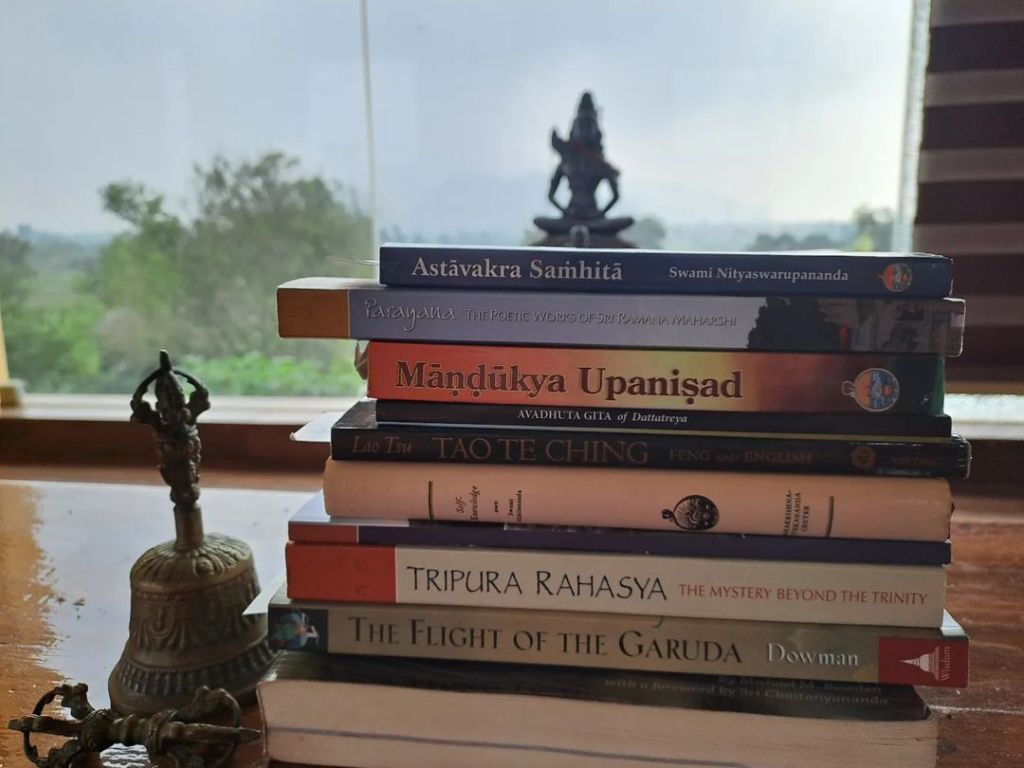
Now, let’s read a view beautiful verses from the Ashtavakra Gita. It presents the idea of awareness (consciousness) as an infinite ocean from which everything else arises, including all the physical reality that we see around us.
Excerpts from the Ashtavakra Gita
Yesterday
I lived bewildered,
In illusion.
But now I am awake,
Flawless and serene,
Beyond the world.
From my lught
The body and the world arise.
So all things are mine,
Or nothing is.
Now I have given up
The body and the world,
I have a special gift.
I see the infinite Self.
As a wave,
Seething and foaming,
Is only water
So all creation
Streaming out of the Self,
Is only the Self.
Consider a piece of cloth.
It is only threads.
Like the sugar
In the juice of the sugarcane,
I am the sweetness
In everything I have made.
When the Self is unknown
The world arises,
Not when it is known.
But you mistake
The rope for the snake.
When you see the rope,
The snake vanishes.
My nature is light,
Nothing but light.
When the world arises
I alone am shining.
When the world arises in me,
It is just an illusion:
Water shimmering in the sun,
A vein of silver in mother-of-pearl,
A serpent in a strand of rope.
From me the world streams out
And in me it dissolves,
As a bracelet melts into gold,
A pot crumbles into clay,
A wave subsides into water.
I adore myself.
How wonderful I am!
I can never die.
The whole world may perish,
From Brahma to a blade of grass,
But I am still here.
Indeed how wonderful!
I adore myself.
For I have taken form
But I am still one.N
Either coming nor going,
Yet I am still everywhere.
I am the infinite ocean.
When thoughts spring up,
The wind freshens, and like waves
A thousand worlds arise.B
But when the wind falls,
The trader sinks with his ship.
On the boundless ocean of my being
He founders,
And all the worlds with him.
But O how wonderful!
I am the unbounded deep
In whom all living things
Naturally arise,
Rush against each other playfully,
And then subside.
Reference books:
 Kalampedia