
There is a peculiar irony at the heart of Hamlet. The play belongs to a genre — the Elizabethan revenge tragedy — defined by momentum, bloodshed, and the swift satisfaction of justice. Its audience would have arrived expecting a familiar arc: a wrong committed, a hero galvanised, retribution delivered. What Shakespeare gave them instead was a man who spends five acts arguing himself out of doing what he knows he must do. The genre promised action. The play delivered thought. And in that substitution lies the entire achievement of the work.
For four centuries, critics have argued over why Hamlet delays. The question is not merely academic. It is the axis on which the play turns, and the reason it has outlasted virtually every other work in the English literary tradition. The delay is not a flaw in the drama’s construction. It is the drama. To understand why Hamlet cannot act is to understand what Shakespeare was actually writing about — and why that subject remains, if anything, more urgent now than it was in 1600.
I.
The surface-level reading of Hamlet’s paralysis is the most charitable to its subject: he is a man of conscience who refuses to act on insufficient evidence. The ghost of his father has accused Claudius of murder, but ghosts, in the theology of Shakespeare’s world, could be demonic agents of deception, dispatched to lure the living into mortal sin. Hamlet is careful rather than cowardly. He devises the play-within-the-play — staging a re-enactment of the murder to observe Claudius’s reaction — because he will not destroy a man on the testimony of an apparition he cannot fully trust. “The play’s the thing,” he declares, “wherein I’ll catch the conscience of the king.” This reading frames Hamlet as a proto-empiricist, a man who demands evidence before judgement. By this account, his delay is epistemically virtuous.
But the play refuses to sustain this reading entirely. There is a scene — one of the most psychologically charged in all of Shakespeare — in which Hamlet discovers Claudius alone and kneeling in prayer, completely unguarded. The moment of vengeance has arrived, apparently delivered by fate itself. Hamlet draws his sword and then sheathes it. His reason: he does not want to send Claudius to heaven by killing him mid-prayer. He will wait for a moment of sin — gambling, cursing, in the act of adultery — to ensure his victim’s damnation. This is not epistemic caution. This is a man constructing, in real time, a reason not to act. The moral scruple theory begins to collapse under its own weight precisely when it is most needed.
II.
The twentieth century offered a different explanation, one that reshaped how the play was read, taught, and performed for decades. Ernest Jones, building on Freudian theory, argued that Hamlet’s paralysis is the product of unconscious identification: Claudius has done what Hamlet himself secretly wished to do — kill his father and possess his mother. To murder Claudius would be to destroy a mirror image, an act psychologically equivalent to self-destruction. The delay is not hesitation but suppression, the symptom of a conflict Hamlet cannot consciously acknowledge.
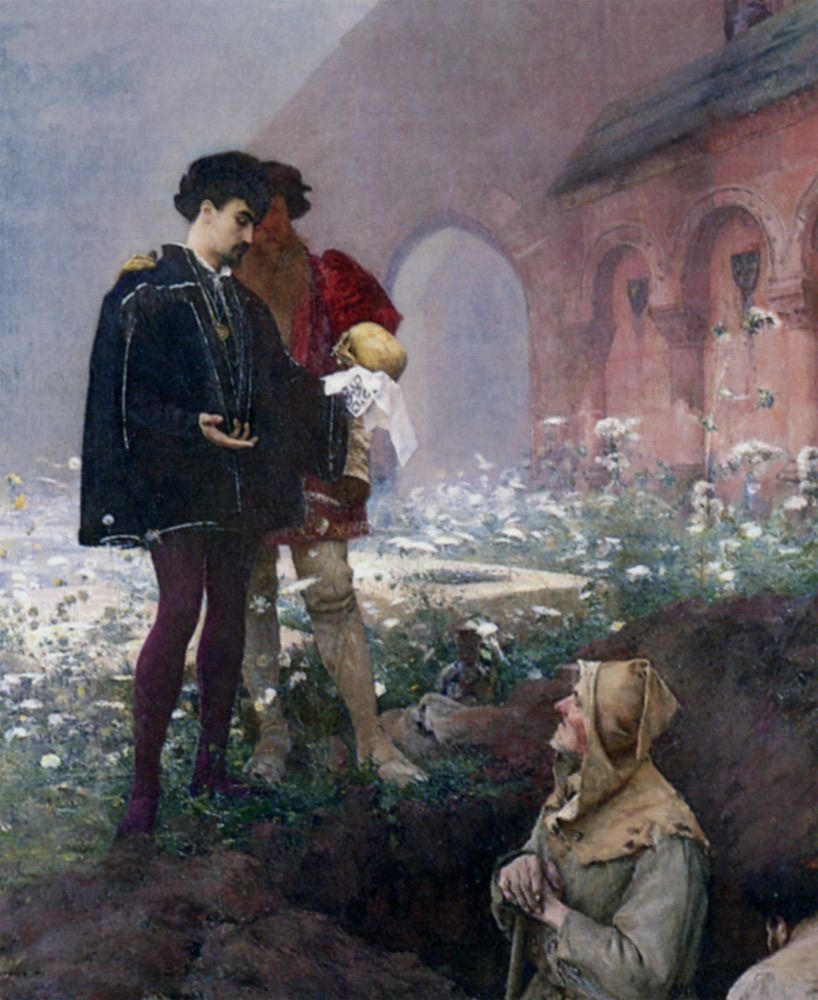
This reading has the virtue of accounting for the intensity of Hamlet’s relationship with Gertrude, which exceeds, by any reasonable measure, the interest a son ought to take in his mother’s remarriage. It also gives directors a productive frame: the charged, claustrophobic scenes between Hamlet and Gertrude have never quite recovered their innocence after Jones. Yet the Freudian interpretation ultimately imposes a twentieth-century diagnostic vocabulary onto a Renaissance mind. It explains Hamlet’s behavior by appeal to a psychological architecture Shakespeare did not know and could not have intended. Whether this constitutes an enrichment of the text or a distortion of it remains genuinely debatable. What it cannot do is fully account for the Hamlet who speaks — the Hamlet of the soliloquies, who is always, first and foremost, a philosopher.
III.
The most persuasive explanation for Hamlet’s paralysis is one that does not require external theoretical frameworks, because Hamlet provides it himself. “The native hue of resolution,” he says, “is sicklied o’er with the pale cast of thought, and enterprises of great pitch and moment with this regard their currents turn awry, and lose the name of action.” He is not describing a psychological condition diagnosed from the outside. He is describing, with total lucidity, the mechanics of his own failure. He thinks too much. Not in the sense of being clever — in the sense of being constitutionally incapable of holding a position without immediately generating its counter-argument. Every time he approaches a decision, he finds another angle from which to view it. Every certainty dissolves under examination. He is, in short, a philosopher operating in a world that requires a soldier.
This is what separates Hamlet from the play’s other bereaved young men, and Shakespeare is deliberate in constructing the contrast. Laertes, who also loses a father to murder, does not pause for a moment. He returns to Denmark in a fury, raises a mob, confronts the king directly, and demands satisfaction. He is all velocity and no reflection — and he is promptly manipulated by Claudius into becoming an instrument of murder, dying as a consequence of his own used weapon. Fortinbras, the Norwegian prince orbiting the play’s edges, offers a third variation: purposeful action, disciplined and outward-directed, unclouded by grief or self-examination. He survives. He inherits Denmark. But his inheritance feels hollow — the windfall of someone else’s tragedy, a conqueror who arrived at the right moment rather than earned his throne.
Shakespeare, by placing these three figures side by side, refuses any of them the role of ideal. Laertes acts and is destroyed by his own rashness. Fortinbras survives through a combination of discipline and luck but never contends with what Hamlet contends with. And Hamlet — who sees everything, understands everything, and cannot translate understanding into action — is the one we cannot look away from. The play’s implicit and uncomfortable argument is that the quality that makes Hamlet most recognizable as a human being — his refusal to simplify, his insistence on seeing all sides — is the very quality that destroys him.
IV.
To read Hamlet purely as a study in indecision, however, is to miss what Shakespeare was building toward at the play’s deepest level. Hamlet is not finally a play about the inability to act. It is a play about the impossibility of authenticity in a world structured by performance.
Elsinore is a court, and courts run on theater. Claudius performs the role of grieving brother and reluctant king. Gertrude performs contentment. Polonius performs wisdom; his aphorisms — “to thine own self be true,” perhaps the most misread line in the canon — are the utterances of a man who has mistaken the sound of wisdom for its substance. Rosencrantz and Guildenstern perform friendship while functioning as spies. The entire social architecture of the play is a system of performances in which the gap between appearance and reality has been not just normalized but institutionalized.
Hamlet sees through all of it. His famous declaration — “I know not ‘seems’” — is an assertion of authenticity against a world of semblance. He will not perform grief because he genuinely feels it. He will not perform acceptance of his father’s replacement because he genuinely rejects it. He is, in this sense, the only character in the play who refuses to dissemble.
But the tragedy is that his very commitment to authenticity becomes, over the course of the play, a new kind of performance. The “antic disposition” he puts on — his strategic madness — begins as a tactic, a mask worn to buy time and obscure his intentions. It ends somewhere less certain. When Ophelia reports his strange behavior, when his own mother cannot tell what is real in him, when even Hamlet seems unsure of the boundary between performed madness and genuine dissolution, the question arises: can a man commit so fully to a performance that it displaces the self it was meant to protect?
This is the trap at the center of the play. Hamlet sets out to expose the performance of others and finds, in the process, that he can no longer be sure of his own. The “To be or not to be” soliloquy is not simply a meditation on suicide and endurance, as it is so often reduced. It is the articulation of a man who can no longer locate a stable self from which to act. To “be” requires knowing what you are. And Hamlet, by the time he delivers that speech, genuinely does not know.
V.
There is a small but crucial moment near the end of the play that illuminates everything that has come before it. Hamlet, dying, stops his friend Horatio from drinking the remaining poison: “If thou didst ever hold me in thy heart, absent thee from felicity a while, and in this harsh world draw thy breath in pain to tell my story.” It is an extraordinary request. Having spent the play paralyzed by the impossibility of certain knowledge and authentic action, Hamlet’s dying wish is for narrative. Not justice — justice has arrived, messily and at catastrophic cost. Not vindication. Story. The only thing that survives, Hamlet seems to understand, is the account that is given of what happened.
Shakespeare is doing something quietly devastating here. He is acknowledging that the play we have just watched — this record of a man’s failure to act, his dissolution, his destruction of everyone he loves — is itself the thing of value. Not the revenge, which was accomplished at such terrible cost that it cannot be straightforwardly celebrated. Not the death of Claudius, whose throne passes immediately to a foreign conqueror. The value is in the witnessing, in the telling, in the record of what consciousness looks like when it is pushed to its outermost edge.
This is why Hamlet has survived. Not because it is old, not because it is canonical, not because it is formally admirable — though it is all of these things. It survives because the experience it describes is inescapable. Every person who has ever been so aware of a problem’s complexity that they could not choose a path; every person who has performed a version of themselves and then lost track of where the performance ended; every person who has tried to act with perfect integrity in a world that runs on compromise and found themselves immobilized — every such person has lived, in some reduced and less eloquent form, the experience that Hamlet articulates.
Shakespeare did not solve the problem. He gave it its most precise and enduring expression. Four centuries later, the problem remains unsolved. We are still, in our way, all of us, Hamlet.

