
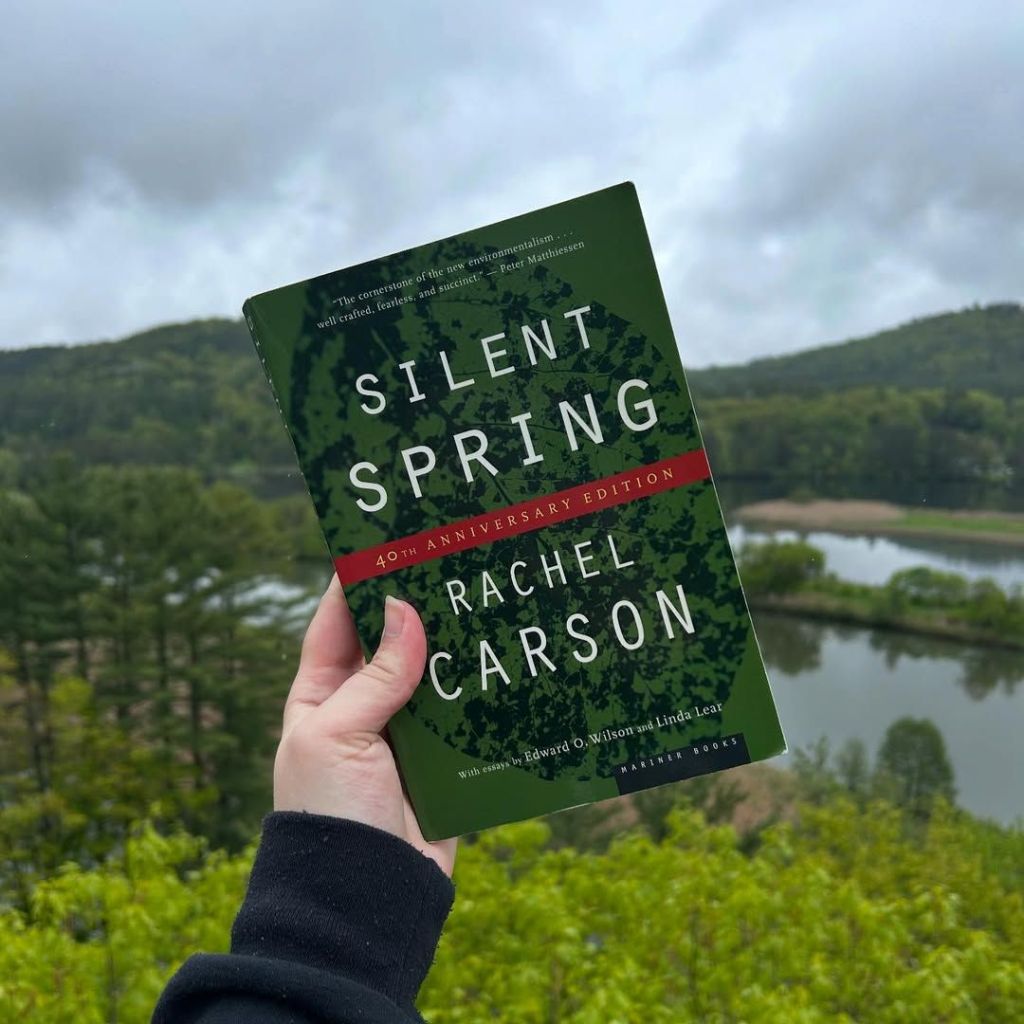
When Rachel Carson published Silent Spring in 1962, she was not writing an environmental manifesto in the modern sense. She was doing something far more unsettling. She was showing how a set of chemicals, designed for convenience and control, had slipped unnoticed into the ordinary texture of life. Into gardens, farms, rivers, milk bottles, birds’ nests, and human bodies.
The book opens with an image. A town where spring arrives without birdsong. No robins, no sparrows, no bees moving through orchards. The silence is not symbolic. It is ecological. Carson begins this way because her argument is experiential. What disappears first, she shows, is not human comfort but the fragile background music of life itself.
At the centre of Silent Spring is a sustained examination of synthetic pesticides, particularly chlorinated hydrocarbons like DDT. Carson traces how these chemicals were promoted as miracles of modern science. They killed insects efficiently. They lasted a long time. They did not require repeated application. These were seen as virtues. Carson shows how each of these virtues was also a danger.
Because these chemicals do not break down easily, they accumulate. They move through soil into plants, from plants into insects, from insects into birds, and from birds into mammals. Carson explains biomagnification in precise, almost patient prose. A trace amount sprayed on crops becomes a concentrated poison by the time it reaches a hawk or an eagle at the top of the food chain. The bird does not die immediately. Instead, its eggshells thin. The chicks fail to hatch. The population declines quietly, generation by generation.
This quietness is one of the most disturbing aspects of the book. Carson is not describing dramatic catastrophe. She is describing slow damage that looks, at first, like normal variation. Fewer birds this year. A poor hatch. A river that seems fine on the surface but no longer supports fish. By the time the pattern is visible, the system has already been altered.
One of Carson’s most important arguments concerns the arrogance embedded in chemical control. She repeatedly returns to the idea that humans have approached nature as something to be dominated rather than understood. In one chapter, she examines large-scale spraying programmes aimed at eradicating specific insects. What follows is never simple success. The target insect adapts. Secondary pests flourish. Natural predators are killed off. Farmers respond by spraying more chemicals. A spiral begins, driven not by malice but by a refusal to accept ecological complexity.
Carson is careful not to reject science. She criticises a particular use of science, one that treats living systems as if they were machines with isolated parts. Her alternative is not romanticism but restraint. She argues for biological control, for working with natural checks and balances, for accepting that not every insect needs to be eliminated for human life to flourish.
Perhaps the most radical aspect of Silent Spring lies in how it reframes harm. Carson insists that poisoning the environment is not separate from poisoning ourselves. She details how pesticide residues appear in food, water, and ultimately, human tissue. As mentioned before, she does not claim immediate mass death. Instead, she raises harder questions about chronic exposure, about cancer risks, about what it means to live inside a chemically altered world without informed consent.
This insistence on connection is what gives the book its enduring power. The spring is silent not because something external has gone wrong, but because human choices have reverberated outward and then returned. The boundary between “environment” and “human life” dissolves under her gaze.
Reading Silent Spring today, when climate change and ecological collapse dominate public discourse, it is striking how modest Carson’s demands are. She does not call for the abandonment of technology. She calls for humility. For listening. For pausing before releasing substances whose long-term effects we do not understand.
The book’s legacy is often summarised in policy outcomes, bans, environmental movements. Those matter. But the deeper lesson is literary and ethical. Carson teaches the reader how to notice. How to pay attention to absence as well as presence. How to hear silence not as peace, but as warning.
In that sense, Silent Spring is not only about pesticides. It is about what happens when efficiency replaces care, and when speed outruns wisdom. It asks a question that remains unanswered: what kind of intelligence is required to live without destroying the conditions that make life possible?
The silence Carson described was preventable. That is what makes the book so unsettling. And so necessary.
 Kalampedia