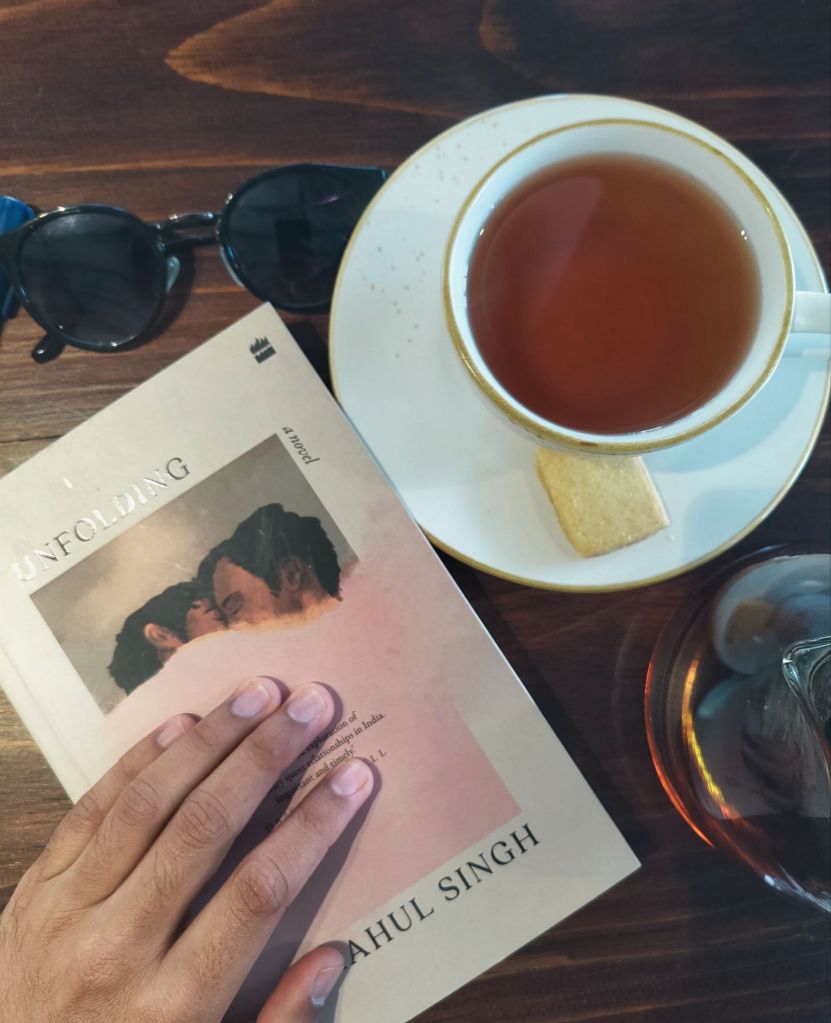
Unfolding, the debut novel of Rahul Singh, is a story about love. Not the comfortable kind. Not the kind that settles easily into names, identities, rituals, and recognisable shapes. It is a strange, restless, sometimes painful kind of love — but love nevertheless.
About Unfolding
At the centre of the novel are two men: Ralph and Ojas. They are in a homosexual relationship, and not a conventional one. They are open — or at least, they are trying to be. This decision, which to Ojas appears liberating, becomes the source of much of the novel’s emotional tension. An open relationship is not simply about freedom; it is about constant negotiation — of boundaries, desires, fears, and power. What makes this dynamic especially fragile is that both partners are not equally convinced by the arrangement. Where Ojas sees openness as possibility, Ralph experiences it as threat. Love, in this novel, is never stable. It is always shifting, stretching, tearing, trying to become something it does not yet know how to be.
Parallel to this story runs another life: quieter, simpler, shaped by different kinds of constraints. This story is about Zubina who works as a house help in Ralph’s home. She is married to Aadil and has two daughters. Her world is far removed from the emotional vocabulary of open relationships, yet it is just as full of longing, disappointment, and silent endurance. Through Zubina, the novel steps outside the relatively privileged world of Ralph and Ojas and enters a life shaped by economic pressure, domestic fatigue, and social limitation. Her marriage is not dramatic in the way Ralph and Ojas’s relationship is, but it carries its own slow ache. The ache of being unseen, of giving more than one receives, of being trapped in roles that leave little room for becoming.
The question of identity
What holds the two stories together is not plot alone, but identity.
At its deepest level, Unfolding is a novel about how identities complicate love. Gender identity, sexual identity, religious identity, caste identity, even class identity. They all intersect and interfere with the most intimate parts of life. The novel asks, quite persistently: what happens when love is already difficult, and then identity adds more weight to it? What happens when two people are not only trying to love each other, but also trying to survive the meanings society has attached to who they are?
Ralph and Ojas do not argue only as lovers. They argue as men shaped by different social locations, different emotional histories, different ways of understanding freedom. Zubina does not suffer only as a wife. She suffers as a woman whose labour is invisible, whose desires have no language, whose worth is measured in service rather than selfhood. And both these acts were, in large parts, were shaped by their unique histories. In this sense, Unfolding goes beyond simply being a romantic novel. It becomes a social novel, one that understands that private life is never purely private.
Thoughts on the novel
The structure of the novel reflects its emotional urgency. It is fast-paced, almost breathless at times. The first half unfolds during the summer of 2019, the second in the autumn. Events follow each other quickly. Scenes change rapidly. Conversations erupt and dissolve. For much of the book, it reads like a page-turner. No, it is not suspense-driven, but because emotional tension keeps pulling you forward. You want to know what will break next, who will say the thing that cannot be unsaid, what kind of wound will finally force a change.
Jealousy and insecurity run like a dark thread through the novel. In an open relationship, jealousy gets exaggerated. Especially when one partner is less convinced than the other, openness can feel less like freedom and more like abandonment in slow motion. The novel captures this with sensitivity. It shows how jealousy is not always loud. Sometimes it is just a tightening of the chest, a silence after a phone call, a question that is never asked.
Yet this same speed that makes the book gripping also becomes its weakness in places. Some moments pass too quickly. Take this passage, for instance:
Zubina returned with Soniya. Amrin was in the middle of taking a bowl brimming over with water and emptying it with a splash outside. Everyone changed into dry clothes. Soniya was asked to remain seated in the corner of the bed that was yet untouched by water. Zubina tried to help Amrin with work but left it midway. She was restive. She started discussing everything to do with the shopping that was due, the ceiling that needed urgent repair, and the food she wished to eat for the evening’s meal. She was breathless with chatter. She wanted to continue without losing her daughter’s attention. Finally, she paused, then cleared her throat and croaked her question.
Certain feelings — as you can notice from the above example — could have benefited from more space. The reader sometimes senses that the author is moving faster than the emotions themselves. A pause, a thoughtful lingering inside a character’s inner life, might have made some scenes more powerful. The novel often tells us that something hurts, but does not always let us sit long enough inside that hurt.
Interestingly, the second half of the book feels stronger than the first. The emotional stakes deepen. The conflicts no longer feel merely dramatic and become more transformative. By this point, the characters have accumulated wounds, and those wounds begin to speak. The writing slows slightly, the emotions grow heavier, and the novel moves towards an ending that feels well earned: emotionally resonant.
Unfolding is a debut, and it shows both the hunger and the uncertainty of a first novel. There is urgency in it. A desire to say many things at once: about love, sexuality, class, gender, power, and loneliness. At times, this abundance overwhelms the form. But there is also courage in it: the courage to write about relationships that do not fit easily into moral comfort, the courage to let characters be flawed rather than exemplary.
In the end, Unfolding lives up to its title. It is a book that opens instead of getting resolved. It opens wounds, questions, identities, and desires. It does not tell us what love should be. It shows us how complicated it already is.
 Kalampedia