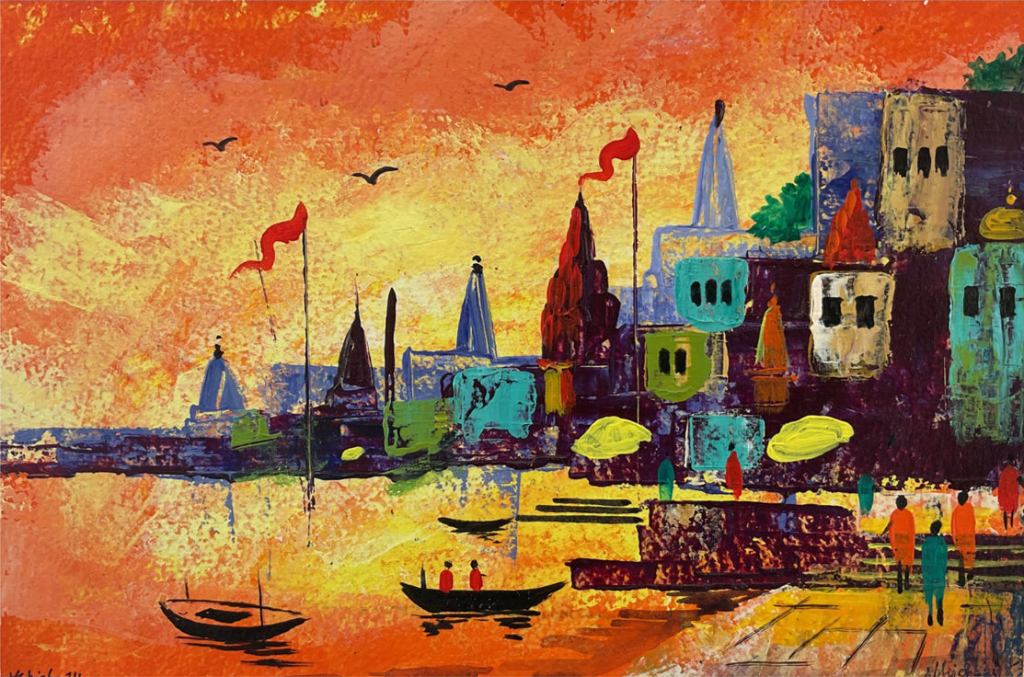
Jerry Pinto’s essay “Death Lives in Varanasi” is a meditation on the Western quest for spiritual meaning in India, the rituals of the Ganga, and the strange, intimate ways in which death becomes part of the everyday life of Banaras. Through the encounters of travellers, seekers, cynics, pilgrims, hustlers and grieving strangers, Pinto creates a portrait of Varanasi that is unsettling, vivid and tender — an India where death is not merely an end, but a landscape.
Here’s the full text of the essay.
Death Lives in Varanasi, Jerry Pinto (1997)
‘Burning is lurrrning,’ says Suresh Boatman as he pulls on the oars past Manikarnika Ghat in Varanasi where boatloads of tourists stop to watch as the bodies of the dead are consumed by fire. It is a catchphrase that has yielded results before and Stu Mills, a twenty-three-year-old Australian computer nerd, puts down his copy of The Tibetan Book of Living and Dying and grins.
‘Yeah,’ he says, face reddened by the fires, sweat beading his brow. ‘I hope it will be.’
Like many other westerners, Stu did not come to Varanasi because it merited four pages in his Lonely Planet guide to India. With a slight trace of embarrassment, he describes his journey as a spiritual quest.
‘Someone very close to me died. Of AIDS. And I realized that death was not something that would come at some indistinct point in the future. I realized it was going to happen to me. Nothing in our civilization prepares us for it, or even encourages us to prepare for it. Death is negative and we are taught, trained, forced almost, to focus on the positive. And yet I could die tomorrow; it was time to confront it.’ He looks around and then says, ‘And if anywhere, death lives in Banaras.’
Indians have always had a special place for the Ganga in their traditions and mythology. Along her banks are some of the most sacred sites of Hinduism: Gangotri, where the river starts as a stream and where the devotions of the gods keep a single diya burning for the six months of the year that snow closes the temple doors; Haridwar, where the temples of Har-ki-Pauri enshrine the sacred footprint of Vishnu; Rishikesh, where the river was crossed by the Ramjhoola made of Lakshman’s arrows; Varanasi, where those whose ashes are immersed are assured of heaven; Allahabad, where three rivers meet and the Kumbh mela takes over the world’s imagination for three weeks.
But what’s in it for Stu and those like him who come to Varanasi and Rishikesh in search of something more than the ability to say ‘Been there, done that’ with the oft-heard codicil, ‘It was reeelly reeelly intense’?
‘Earlier they would ask where they could get ganja,’ smiles Minto Panjwani of Hotel Midtown near Haridwar. ‘Now they ask where they can get lessons in yoga.’
I had come to Varanasi to look for a story that wasn’t happening. Time magazine had reported that thousands of young Western people were flooding India carrying the ashes of their dead to the Ganga. They were following in the footsteps of Jerry Garcia’s wife who had brought his ashes to the Ganga for immersion. The last bits and bobs of the star of Grateful Dead, a rock group with cult status, were floating down the river. That much had happened.
Nothing else had. The hotel owner in Rishikesh who had so willingly claimed to Time that they were all here with their urns, suddenly clammed up. And as for the foreign faithful, their knee-jerk response was, ‘No.’ It did not matter that I was not a tout, had nothing to sell, that I just wanted to talk. They saw a brown skin and said ‘No’.
The story was not happening because nothing was happening.
Then two days before I was about to leave, I met Raju Boatman. He had followed me across four ghats, urging me to try his boat, and finally, disheartened by another five ‘No’s, I gave in.
‘Why are you chasing the phirangis?’ he asked when we were ensconced in a boat of considerable vintage and suspect river-worthiness.
I explained.
He sighed and tucked his chin into his shirt.
‘Why are you called Raju Boatman?’ I asked in turn.
‘There are no surnames on the Ganga,’ he replied.
Only philosophers, I thought. A long silence. And then suddenly: ‘How much will you pay to meet one of these phirangis?’
We haggled for a while and settled on a price.
That was how I met Yvette.
Yvette had come to Varanasi to die. When the sixty-five-year-old Belgian had a section of her intestine cut out of her and a bag took over the functions of excretions, she decided it was time to admit that she was terminally ill.
‘Only, no one else seemed prepared to admit it. I don’t know whether it was my imagination, but everyone around me seemed to want me to say that I was getting better, feeling better. All their solicitous enquiries began to ring false. Eventually, it got to the point where I would say that I was feeling better even if I was feeling terrible, simply because there seemed to be such a premium placed on putting on a brave face, on a denial of death. I wanted to shout, “I’m dying, I’m not getting better.” When I couldn’t bear it any more—this persistent negation of what was inevitable—I left.’
And Satyajit Ray brought her to Varanasi. ‘A few years ago there was a retrospective of his work in Paris where I was living and I saw the Apu trilogy. One of the many images that stayed with me was those solid geometric steps leading down to the river, and the flight of pigeons. And I decided that like Sarbojaya I would die in Banaras.’
Each night she comes to the empty western bank, across from Manikarnika Ghat, and takes up a lonely vigil under the stars. Around her there is nothing; in front of her a city that turns its face to the rising sun, Diana Eck’s city of light.
Like so many things in her life, she muses, this is not what she expected.
‘I thought I would find the black-and-white beauty of Ray’s Banaras. Now I watch the bodies come down and come down and I watch some of them borne away in boats and some burn for hours and it is nothing like what I expected … but there is something more here for me than just beauty. This is the way I want to die: with people around me, and singing, and the fire burning all night and—see there, how that man is drying his clothes against the flames? And those boys wrestling in the mud? And those women washing their clothes and the men taking dips near the place where the dead bodies are also immersed before they are burned? I want that continuity, that pageant around me …’
In the end she hopes that her ashes will end up in the river. ‘I hear it’s a direct route to heaven,’ she smiles. ‘I’ve never had any firm religious beliefs but sometimes I find it consoling.’
She may find it even more consoling that according to Sudanshu Shastry, the principal of the School of Sanskrit Studies and Theology, Banaras Hindu University, ‘It does not matter whether she was a Hindu or not while she was living. If her ashes are immersed in the Ganga she will attain heaven.’
Raju Boatman is not so sure.
Pocketing his money, he rows me away from Yvette’s vigil.
‘This is not good,’ he sighs. ‘I have told her and told her but she will not listen to me.’
I try to explain that she has chosen not to undergo any further medical treatment.
He looks at me strangely. He understands that. What he doesn’t understand is why she crosses the river.
‘If she dies on that side of the river [the west bank] she will be reborn a donkey. I have told her and told her …’
On the right bank, he tries to make me pay for the ride as well. Shanti, the Bengali owner of Kumiko Guest House (‘specialist in Japanese food’) drives him away with a few choice abuses.
‘You see how it is? This is what makes Banaras so bad, so bad.’
He leads me into the eccentric building that balances on the edge of the ghats. And I begin to see where the refusal to speak begins. An entire wall of the reception area is covered with photographs of missing persons, none of them Indian, each with its tragedy rendered in terse phrases:
‘Noriko, 23, Japanese, last seen going towards Dasashwamedha Ghat with a local boy …’
‘Tarmezi, 19, Indonesian, last seen in the company of three men in a boat …’
‘Shoji, 27, Malaysian, last seen taking a train to Haridwar …’
‘I tell them,’ says Shanti, ‘I tell them the Ganga can take you to heaven or to hell. But they do not listen. Why should they? The gods have promised them mukti …’
Perhaps it is this promise that has brought Yuki to Rishikesh with its thirteen-storey Godmall, where the top of the pops is ‘Vishnu ke charnon mein Gangaji ka vaas hai’ sung to the tune of ‘Gore gore mukhade pe kaala kaala chashma’ (from the popular Hindi film Suhaag). Yuki ignores the music, the fake tribals with their real snakes, and the innumerable offers of everything from rooms to let and shilajit to rudraksha beads, and crosses the Lakshman jhoola with a small bundle containing a few of her mother’s effects.
Her mother died suddenly of a coronary embolism at the age of fifty-seven. ‘Most of her stuff I gave to charity,’ says the forty-seven-year-old graphics designer who left Japan to work in Singapore. ‘But there were some things I couldn’t let other people have, but which I couldn’t bear to keep either. I had planned this trip to India really as a tourist. But now I suppose I’m here as a pilgrim.’
She steps into the river, quiet here and shallow in the summer, with an underbelly of richly coloured stones. Hitching up her loose trousers, she puts the bundle down into this conduit of corpses and other offerings just as peculiar. Almost immediately, barely a few metres away a little boy swims out into the stream and snags the bundle. Bobbing furiously in the water, he opens it and checks the contents. Then he’s off, shrill in triumph. He gains the shore and hotfoots it up the steps and vanishes.
Yuki sighs. ‘I don’t know what I expected. I thought perhaps the Ganga would miraculously wash my grief away.’
I pick up a purple stone, lined with the white of several Gangetic tides. Yuki looks too and finds a red stone dappled with grey. In a few minutes, we have a collection of riverine oddities and an audience. A wet little boy squirms his way through the crowd. He is wearing Yuki’s mother’s spectacles.
Yuki sighs again and climbs the steps away from the river and folds her hands in a namaste to the pandas trying to lure her into a temple. Later, sipping a soft drink, she tries to put reality into her vision of the river.
‘I suppose it’s about letting go, isn’t it?’
The wet little boy interrupts with an engaging smile and an offer. For five rupees a stone, he is willing to get us as many as we want.
Yuki abandons her drink and gets up to go. Her feet are clumsy with grief and anger.
The boy grabs the drink, throws away the straw and slurps what’s left. Then he offers to find us stones for four rupees, three rupees, two … one?
The Ganga is now an international phenomenon. Every great river is, in its own way. And it could equally be argued that every great river has its own offer of spirituality, its own metaphors for our lives. The only difference is that the Ganga has spirituality on direct wholesale offer. At Varanasi, you can do a four-day course in yoga to ‘rise up your Kundalini’ as the Scientific School of Yoga offers. Or you can learn Hindi in a one-day course at Haridwar with ‘special attention to scripture-reading’. All geared to the spiritual day-tripper like Gabriel, the catering college student from Sweden who wants to ‘get all there is from this intense experience and get back in time for term’. Or to those who want a quick escape from reality via ganja which to the consternation of the locals is freely available around Har-ki-Pauri. The newspapers are full of a campaign to eliminate ‘anti-socials’ who sell these drugs.
This could also be a resurfacing of the ’60s, the Mystic East Made Easy by the ubiquitous sadhus and the availability of mineral water and tissue paper. The Beatles may have disbanded, the Maharishi is no longer the force he was, the Beat guru Ginsberg may be dead, but quietly flows the Ganga. Is Karma Cola on sale again?
Stu rejects the idea vociferously: ‘I am not a hippie. I’m not looking for a way out, I’m not trying to evade responsibility. I’m trying to face it. I’m trying to look life full in the face.’
For him the quest is real. As it is for some of the young people from the West at the Centre for Tibetan Studies at Sarnath—where the Buddha attained enlightenment—who have spent years of intense concentrated work there. And at various places, there is evidence of a genuine interest in mythology and religion. At Kankhal, three kilometres outside Haridwar for instance, Cathy from London and Sreela from Birmingham discuss the possibility of recasting the Sati story as a fable for misdirected feminine anger which according to Sreela, ‘is too often turned against the self instead of the offender’.
As Ram Chandra Pathak, also of the School of Theology at BHU warns, ‘How can we judge with what intention they come to the Ganga? The quest is as much internal as it is external and that is something that we should leave to the gods to decide.’
And to the Ganga.
 Kalampedia