
When I opened Jan Morris’s book Among the Cities, I immediately turned to the chapter on a Himalayan hill station, thanks to my biases. I live in one, so I must never let go the opportunity to sell this point. Anyway, coming to this particular essay, titled Hill Station: Darjeeling, it is one of the finest in this collection. The essay allowed me to enter Morris’s larger imaginative project: the attempt to understand the world through its urban centres, each one approached as a personality, a mood, a small world of its own.
Among the Cities, published after decades of Morris’s travel, gathers together essays written over thirty years, each offering a portrait of a different place — Manhattan, Hong Kong, Venice, Oxford, Sydney, and more. But Morris does not treat cities as static backdrops; she treats them as living characters whose energies, histories, and eccentricities reveal something essential about humanity.
It is within this grand mosaic of global urban life that Darjeeling appears — almost as an anomaly. For compared to the monumental cities that fill the rest of the book, Darjeeling is not really a city at all. It is a hill station, a “deliberately diminutive” town, perched precariously on a narrow ridge, small in size yet immense in atmosphere. And Morris knows this. She begins her essay with a frank admission:
I have mixed feelings about the Indian hill stations, some of which (Ootacamund for instance) are altogether too neo-British for my taste. The marvellous setting of Darjeeling, though, the most spectacular of them all, easily puts history in its proper place.
(By the way, Ootacamund is another name of Ooty, in case you didn’t realise.)
As you can see, Morris is not a sentimental traveller; she is wary of colonial hangovers, suspicious of devoted prettiness. But she cannot resist Darjeeling. Its setting (especially its sheer audacity of location) subdues all her reservations. One senses that she has walked into this chapter already softened, already intrigued. That mood acts as an invitation to the reader: Darjeeling is allowed to reveal itself slowly, through scale, atmosphere, and the odd mixture of people who inhabit it.
The pleasures of a small town
Morris’s first impression is of smallness; not a weakness, but a kind of deliberate restraint. She calls Darjeeling “the most deliberately diminutive town I know,” as though the place had chosen its size and kept it. Even arriving there is an act of rediscovering proportion: the long crossing from Calcutta, the vast plains, the colossal rivers, the endless gorges, and then, almost comically, a “little blue-painted trundle of a train” that pulls you upward. Morris captures Darjeeling not by describing its sights but by describing its effect on the traveller. The town shrinks you in the best possible way. And when she sees it wrapped entirely in cloud, enclosed and almost imaginary, she realises how self-contained it is: a place that seems to have negotiated its own terms with the world.
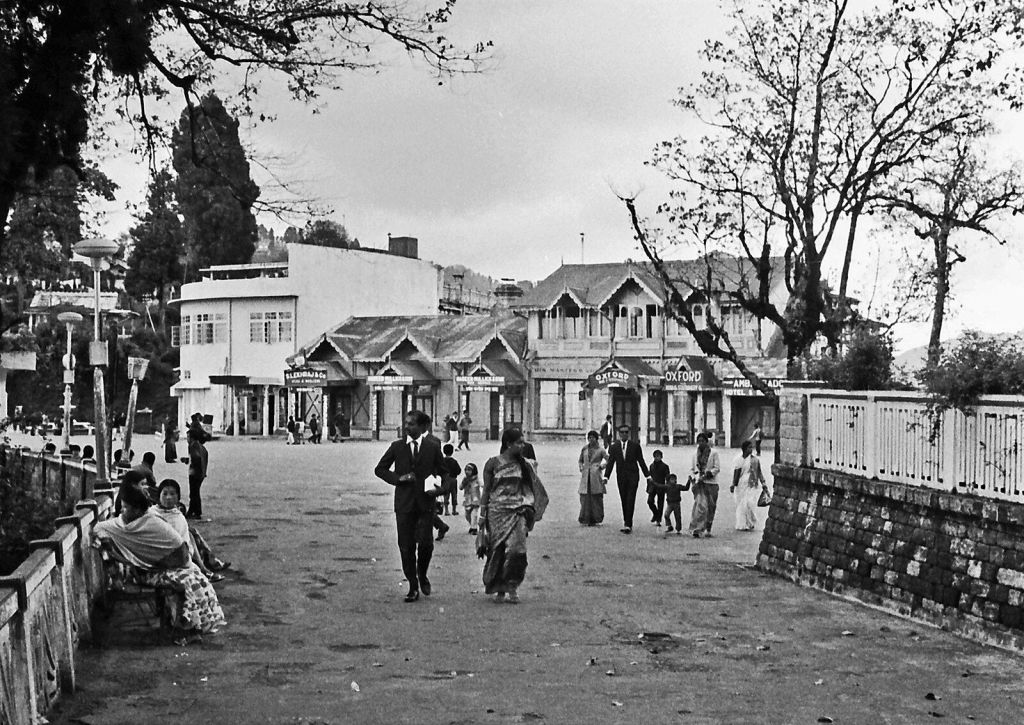
This sense of negotiated smallness is what makes Darjeeling sit so interestingly within Among the Cities. The book presents places that dominate, cities that assert themselves, overwhelm the senses, reshape their inhabitants. But Darjeeling doesn’t dominate anything. It accommodates. It is a meeting place by accident of geography and empire; its diversity is not the orchestrated diversity of global cities but a casual, everyday mingling. Morris walks through the bazaar and sees a tableau that could exist nowhere else:
Lepchas, Sherpas, Tibetans, Nepalis, Rajput officers, Bengali families, European tourists, children in party frocks, monks, priests, porters with rucksacks, girls in saris, gnomish men in fur caps.
And somewhere in the middle of it all, Jan Morris sitting on a bench, watching the world go by. She calls it “a microcosm of the world,” but it is not the world on display — it is the world compressed, reduced to human scale.
That is perhaps the key to understanding why Morris includes Darjeeling in a book about cities. A real city, for her, is not defined by population or infrastructure but by its concentration of life, its intensity of experience. Darjeeling, in its tiny ridged existence, contains an astonishing amount of human variety, and contains it lightly. People appear not as abstractions but as faces, voices, small gestures. The town makes the world intimate.
The spirit of Darjeeling
Then there is the other part of Darjeeling, the one travellers look for but rarely find described so honestly: its cheerfulness. Morris is not naive about poverty (she notices the material strain, the cramped houses, the burdens carried by porters), but she also observes something else. A kind of shared buoyancy. The children tumbling around the lanes, the mothers who remain unflustered, the bundles of hay carried by labourers speckled with flowers, the steady, good-tempered rhythm of work and movement. Nothing is idealised, yet nothing is dismissed. Darjeeling, she implies, has found a way of being poor without being defeated. It has not lost its humour or its softness.
The writing becomes more inward when Morris describes her morning walks up Observatory Hill. This part of the essay makes sense only when you remember that Among the Cities is not just about architecture or crowds; it is also about the spiritual tones of places. Even in Venice or Oxford, Morris is alert to private rituals. In Darjeeling, the climb becomes a kind of daily rite. The hill is sacred to Buddhists, drenched in prayer flags, bells, murmured chants, and the subdued seriousness of people who come here to meditate or read scriptures. Morris notices a solitary figure who writes each day in a black notebook while gazing towards Tibet — a detail that feels as close as the essay gets to autobiography, as though Morris has found a version of herself on that hillside.
These scenes prepare the way for the quiet emotional culmination of the piece. Morris, normally so controlled, is undone when she hears the Gurkha pipe band playing a Highland lament. The music catches her off guard, stirs some buried sense of origin, and the tears arrive before she can resist them. A man asks if she is unwell. “Not ill,” she says. “Only susceptible.” That line, simple as it is, summarises her relationship with the town. Darjeeling asks for no posture, no cleverness. It asks only that you allow yourself to feel. Morris, who has written about cities with wit, detachment, and precision, lets herself be vulnerable here.
In the end, this is what makes the essay one of the most memorable pieces in the book. It gives you a town, yes — a misty, miniature, irrepressibly alive settlement in the eastern Himalayas — but it also gives you a writer responding in real time to a place that disarms her. Darjeeling becomes the exception in a book about cities because it dissolves the very idea of scale. It does not need the grandeur of Venice or the drama of Manhattan to matter. It matters because it alters something in the traveller: one’s sense of proportion, one’s sense of human variety, one’s sense of the world’s gentleness.
Morris does not say this outright; she lets the town imply it. She simply presents Darjeeling as it is — clouded, concentrated, cheerful, spiritual, surprising — and trusts the reader to understand why such a small place can stand confidently among the great cities of the world.
Note: Listen to the complete essay by Jan Morris here.
 Kalampedia