
Whenever someone asks me this question — if you could travel in time, where would you like to go? — the first thing, and often the only thing, that comes to my mind is British India, preferably a hill town. There is something about it: the pollution-free hill towns of 1800s, the newly-built colonial architecture standing against the timeless backdrop of the Himalayas, the mingling of cultures. And that is exactly the setting of Manjul Bajaj’s latest novel Once Upon a Summer.
Manjul Bajaj is the author of books like In Search of Heer (novel) and Another Man’s Wife (short story collection), works that explore cultures and relationships with sensitivity and depth. In this book too, she takes us across time and space, allowing us to enter multiple worlds that are strikingly different, yet they find a way to overlap. Let me tell you about these worlds.
The first belongs to Alfred in 1959 New York. He is a man who has spent decades in publishing after leaving India as a young man. On the ship that carried him away from his old world, he met Rose (they got married on the journey itself) and together they built a life in America. Now, after Rose’s death, Alfred finds himself reflecting on the choices that shaped his life and wondering what comes next. His world feels much like America, where dreams are supposed to come true.
The second is Azeem’s world, which takes us to the early 1900s in Rannpur. Born into relative privilege as the son of a man who worked with the Nawab, Azeem’s life takes a tragic turn when he loses his entire family. Forced into poverty, he carries with him only fragments of his education, which eventually earn him work as a groom for horses, first in Saharanpur, and later in Nainital. His story is full of colours, textures, and contradictions of a princely India being reshaped by colonial power. You can notice the persistence of an old world even as the new one forces its way in.
The third belongs to Madeline, a young woman growing up in Middlesbrough, England. She is intelligent, ambitious, and has just earned a place at Oxford. This was a time when women’s presence in these institutions was still contested. Madeline’s mother Martha is a firm supporter of her ambitions, as the suffrage movement goes on in the background. Her father, meanwhile, serves in the colonial government in a small Indian town called Jaunpur. It is to India that Madeline and Martha travel for a holiday.
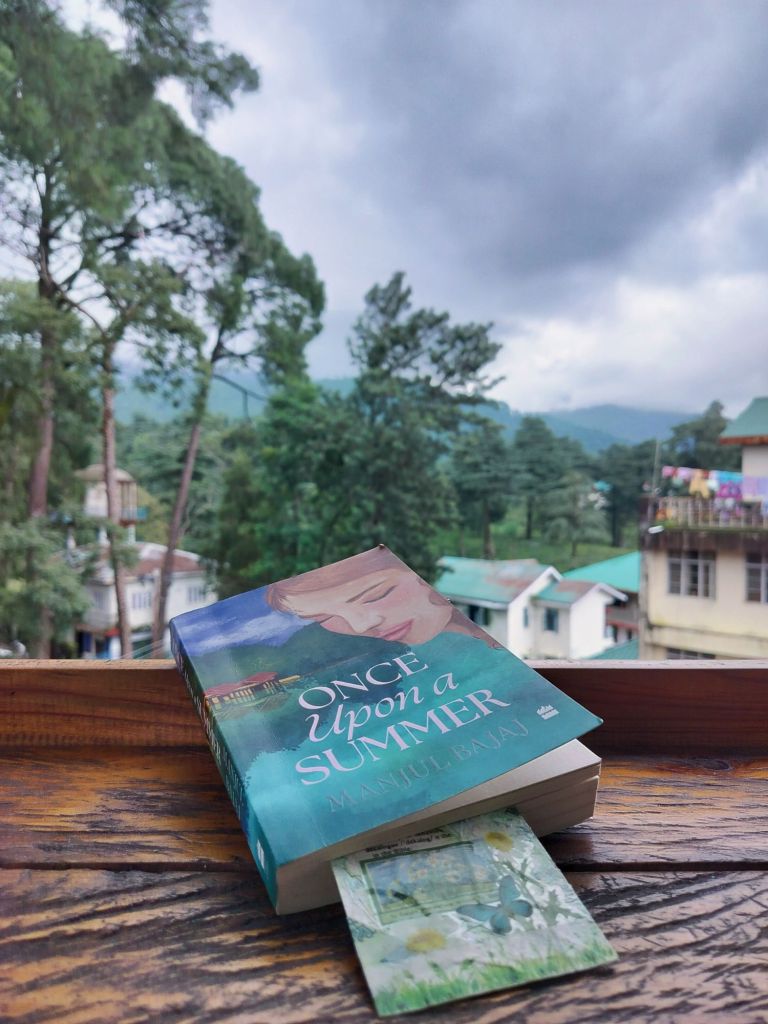
John Gardner once said that good fiction is like stepping into a dream. You don’t notice the language itself, only the world it creates. Reading Once Upon a Summer feels exactly like that. Alfred’s New York is painted in sharp, slightly modern strokes, with prose that captures the great American dream. Azeem’s world glows with vivid details: the rhythms of royal life, the joys of belonging to a rich culture, the struggles of an old world adjusting to new ways, the sensory texture of bazars and mosques. In contrast, Madeline’s England feels more predictable, and even restrained. There is order, etiquette, and the quiet pressures of class, race and gender. The brilliance of Bajaj’s writing lies in how the language shifts between these worlds, as she takes us through each one.
To be honest, I am not the only one to notice the difference in the textures of these worlds. This is how Madeline describes India when she first experiences it:
What a spectacular country this is! I’ve never seen so much colour before. I think god must have begun making the world from east to west and quite run out of colours by the time he reached England.
The most beautiful moments, in this book, occur when these worlds overlap. In Nainital, Azeem and Madeline’s paths cross. Against the backdrop of pine-covered slopes, colonial residences, and a lake that reflects ancient faith as well as modern reality, the two fall in love. For Madeline, it is love at first sight. For Azeem, cautious at first, love grows over time, him slowly letting down his guard. This love feels irrational, impossible, and yet so believable. And that is exactly what love does: it erases logic and replaces it with a fierce conviction that anything is possible. They begin to dream of escaping together, even though they know that the world will not allow it.
What about Alfred? How does his world come into contact with theirs? Rose, Alfred’s late wife, was once Madeline’s close friend. The friendship began on a ship to India, long before the story catches up with Alfred in New York. At the same time, Alfred keeps thinking about his promise to Azeem which he made long ago. But there is a twist — and I won’t give that away here.
What stays with me after finishing the novel is the sheer seamlessness of Bajaj’s prose. It just flows like a river. It changes depending on the landscape (sometimes swift, sometimes gentle), but it always carries you along. The research that must have gone into recreating these worlds is immense, yet it never feels heavy-handed. Once again, it is easily absorbed into the flow of the narrative. There were some moments where the dialogue felt a little stiffer than the rest of the narrative, but they were very few. I could literally count those instances on my fingers. That tells you something about the author’s craft.
At its heart, though, Once Upon a Summer is not just a historical novel or a cultural mosaic. It is a love story. A simple, timeless tale of two young people falling in love against all odds, willing to risk everything, even life itself, for the possibility of being together. That is the essence of the book. And that is what makes it unforgettable.
 Kalampedia