
If you haven’t read Volga’s books, you’re missing out on some of the finest works of Telugu literature. And no, you don’t need to know the language. Just like me, you can rely on translations.
Volga’s novels are, as the publisher puts it, feminist retellings of the Indian epics. She takes us back in time, introduces us to a fascinating female character, pauses and asks some thought-provoking questions. In The Liberation of Sita, she imagined Sita’s life not as a story of suffering but of learning. In Yashodhara, she told the story of the woman who stayed behind when the Buddha left home. Now, in the final book of the trilogy, titled On the Banks of Pampa, we meet Sabari from Ramayana.
If you’re familiar with the Ramayana story, you’d remember the Sabari episode, where the old woman tastes berries before offering them to Rama, because she wants to make sure they are sweet. That’s all. A small act of devotion that has lived in memory for centuries. But Volga doesn’t treat this as a passing event. She lingers there. She asks a number of questions. Who was Sabari? What kind of world surrounded her? How did she know about Rama? When Aryans were invading and spreading their culture, why did Sabari wait for Rama, an Aryan king? The book grows out of these questions.
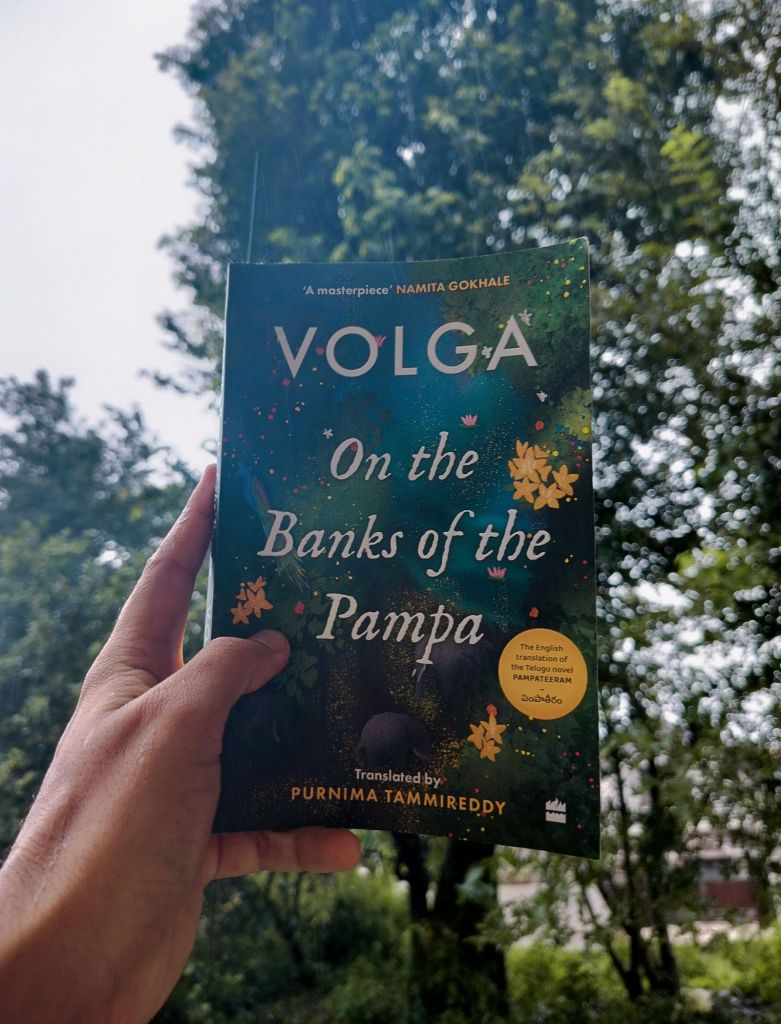
The book begins, not with Sabari or Rama, but with mesmerising descriptions of the forest on the banks of the pampa river. The darkness of the forest “so dense that not even dawn could dispel it entirely.” Sunlight coming down “in rivulets,” and the branches weaving a “trellis that stifled the free passage of light.”
It makes you realise very early in the opening chapter: the forest is not the background. It is the living world in which everything happens. The Pampa river flows quietly, carrying “tales from the forest” on its flowers. Light moves on the water. Nothing is still, nothing is dead scenery.
Coming to the story, Sabari belongs to the aranyavasis, the dwellers of the forest. They are not kings or warriors, not the people history usually remembers. They live with the trees and rivers, gathering, making, surviving. In Volga’s telling, they are also the ones most vulnerable to the coming of empire. When the state expands, when armies march, it is these people who lose their land, their lives, their way of being. On the other hand, the state has its own reasons to expand.
The invaders were from a city on the other side of the forest, where they had been living for many years. However, their population had grown exponentially. Their streets got crowded. There was not nearly enough water for irrigation, and that impacted the agricultural produce, resulting in a shortage of foodgrains. The only solutions they could conceive for all these problems were to occupy the forest, expand the city, convert parts of the forest into arable land and divert water from the rivers to the streams for irrigation.
Does that ring a bell?
In a way, On the Banks of the Pampa is not only about Sabari. It is about the politics of the forest. Rama’s journey south is not just a divine quest; it is also, as Volga shows, a political conquest. The expansion of territory, the taming of wilderness, the bringing of land and people into the control of the state. Reading this, I could not help but think of our own times, where development often comes at the cost of forests, rivers, and communities who have lived with them for centuries. The book does not directly make these comparisons for us, but they are impossible to avoid.
Sabari stands in the middle of this tension. She is not someone with authority. She is an old woman who has lived her whole life in the forest. In the Ramayana she is remembered for her devotion. In Volga’s book, she is elevated to a symbol of another way of being in the world. One not built on conquest or expansion, but on care. Care for the world around her. Care that looks simple on the surface (keeping best fruits for the guests) but carries within it an entire way of living.
There are several passages in the book that ask difficult questions. For instance, the below description of state (rajyam) made me question today’s political realities.
The rajyam ran everything. And for the rajyam, borders were of paramount importance. The rajyam exerted control over any living being within its defined boundaries, with the sole purpose of domination. The rajyam decided who got to breathe and for how long … Expanding territories was its favourite game, its primary indulgence. It could neither understand nor stand a land without borders, a land without control. It drew lines. It built walls. It restricted movement. To expand its dominion, it indulged in war — its favourite sport.
And then, there is Sabari, who sees the world, not through the lens of power, but compassion. As the author puts it, Sabari had fulfilled her duty on earth with care, love and freedom till her last breath. She raises thought-provoking questions, but once again, she does that with great care. To give you an example, Sabari tells Rama:
You all have forgotten the basics. You act as if all of nature is one side and you’re on the other. Rama, aren’t we, too, a part of this infinite universe?
This is a powerful quote. It strikes at the heart of all social, cultural and religious ideas where humans are supposed to rule the natural world. Does it have to be that way? Sabari, like other aranyavasis, does not believe that.
Volga, through this book, gives us language and perspective to understand the past better. In one sense, the book is about colonisation long before the word existed in our languages. It is also about living simply, without pretence, and exploring spirituality in its purest form. What I enjoyed most was how Volga holds all of this without ever raising her voice. She does not shout at the epic, otherwise such retellings can become controversial. She simply retells. And by retelling, she shifts the ground. Sabari becomes central. The forest becomes central. Empire becomes visible. Devotion becomes care, not submission. It’s beautiful.
The book ends with a dialogue between Volga and her translator, Purnima Tammireddy. I loved this part, something, I believe, publishers should do more often. It opens up the process of writing and translating, showing how an idea moves from its conception to completion. In a way, it perfectly completes the circle, reminding us that stories do not belong to a single voice, but are carried forward by many hands, many minds, across time and language.
 Kalampedia