
Yuval Noah Harari needs no introduction. The renowned historian has captivated us with his thought-provoking exploration of humanity’s past, present, and future. Recently, I picked his book 21 Lessons for the 21st Century and thought about sharing its key ideas with you.
21 Lessons for the 21st Century delves into the complexities of our contemporary world, offering an interesting analysis of the challenges we face and the potential paths forward. Building upon his previous books, Sapiens and Homo Deus, Harari shifts his focus from the grand sweep of history to the immediate concerns of our time.

Harari invites us to consider the pressing issues of our era, from the rise of technology and the erosion of traditional values to the threats of climate change and global conflict. Through a series of insightful essays, Harari provides a broad overview of the challenges and opportunities that shape our lives.
Yuval Noah Harari on technology
One of the central themes explored in the book is the profound impact of technology on human society. Harari warns of the potential dangers of unchecked technological advancement, such as the rise of artificial intelligence and the erosion of privacy.
A key aspect of this technological era is the evolving nature of employment. Here’s an example. Traditionally, we’ve perceived medical professions as hierarchical, with doctors commanding higher wages than nurses due to their perceived complexity of tasks. However, the advent of artificial intelligence (AI) is going to disrupt such notions. AI’s capacity to diagnose diseases, interpret lab results, and prescribe treatments based on patient data challenges the traditional role of doctors. While AI excels in these areas, the human touch of nursing—providing comfort, emotional support, and personalised care—remains irreplaceable. This potential shift in job hierarchies is just a sign of a broader trend. A careful examination of various industries reveals similar patterns, where the value of human skills and empathy is increasingly recognised alongside technological advancements.
Here’s a short excerpt from the book:
In the long run no job will remain absolutely safe from automation. Even artists should be put on notice. In the modern world art is usually associated with human emotions. We tend to think that artists are channelling internal psychological forces, and that the whole purpose of art is to connect us with our emotions or to inspire in us some new feeling. Consequently, when we come to evaluate art, we tend to judge it by its emotional impact on the audience. Yet, if art is defined by human emotions, what might happen once external algorithms are able to understand and manipulate human emotions better than Shakespeare, Frida Kahlo or Beyoncé?
Such technological transformations will undoubtedly reshape societal values and structures. For example, a significant portion of today’s children may never need to engage in traditional employment. Think about its implications on the future of humanity. A world where individuals are rendered irrelevant poses a far greater threat than oppression. While one can resist oppression, irrelevance is a more insidious adversary. Against whom would one rebel? Algorithms? Machines? The idea of such a struggle seems futile.
All of it eventually leads us to the question of data and the ownership of it. As Harari says, whoever owns the data will own the future. Therefore, regulating the ownership of data is perhaps the most important question that we are facing today. If we cannot answer this question soon, our sociopolitical system might collapse. People are already sensing the coming cataclysm. Perhaps this is why citizens all over the world are losing faith in the western-liberal world order. In the west, they are opting for right wing political parties, while outside the west, they are increasingly turning towards the Chinese story.
Yuval Noah Harari on politics

Continuing with the above mentioned ideas, Harari examines the political and social landscape of the 21st century. He discusses the rise of populism and nationalism, the decline of traditional institutions, and the increasing polarisation of societies. Harari argues that these trends are fueled by a sense of uncertainty and anxiety about the future.
Harari writes:
In previous centuries national identities were forged because humans faced problems and opportunities that were far beyond the scope of local tribes, and that only countrywide cooperation could hope to handle. In the twenty-first century, nations find themselves in the same situation as the old tribes: they are no longer the right framework to manage the most important challenges of the age. We need a new global identity because national institutions are incapable of handling a set of unprecedented global predicaments. We now have a global ecology, a global economy and a global science—but we are still stuck with only national politics. This mismatch prevents the political system from effectively countering our main problems. To have effective politics, we must either de-globalise the ecology, the economy and the march of science—or we must globalise our politics. Since it is impossible to de-globalise the ecology and the march of science, and since the cost of de-globalising the economy would probably be prohibitive, the only real solution is to globalise politics. This does not mean establishing a global government—a doubtful and unrealistic vision. Rather, to globalise politics means that political dynamics within countries and even cities should give far more weight to global problems and interests.
One of the interesting political discussions is about immigration, which has been a polarising issue in recent times, especially in Europe. The European Union was built on the promise to transcend the cultural differences between French, Germans, Spanish and Greeks. However, as Harari points out, it might collapse due to its inability to contain the cultural differences between Europeans and migrants from Africa and the Middle East.
It tells you something about the immigration debate and how it has evolved in recent times. It used to be the case that only the right wing was worried about immigration, but have a look at the prescription on immigration by Yuval Harari, who is pretty much on the left. He recommends three basic conditions for immigration:
- Condition 1: The host country allows the immigrants in.
- Condition 2: In return, the immigrants must embrace at least the core norma and values of the host country, even if that means giving up some of their traditional norms and values.
- Condition 3: If the immigrants assimilate to a sufficient degree, over time they become equal and full members of the host country. ‘They’ become ‘us’.
Does it sound LEFT-WING? Let me know what you think of it.
Are 21 lessons too many?
Throughout the book, Harari tries to make us think our assumptions about the meaning of life and the purpose of human existence. He questions the prevailing narratives about progress, happiness, and success, suggesting that we may need to adopt new ways of understanding ourselves and our place in the universe.
It was at this point that I began to feel that the author was stretching his ideas to justify the title of 21 lessons. I’ve never quite liked such titles anyway. 21 lessons for the 21st century? When you think of such titles, you can almost guess that the author must have forced himself to create such a list.
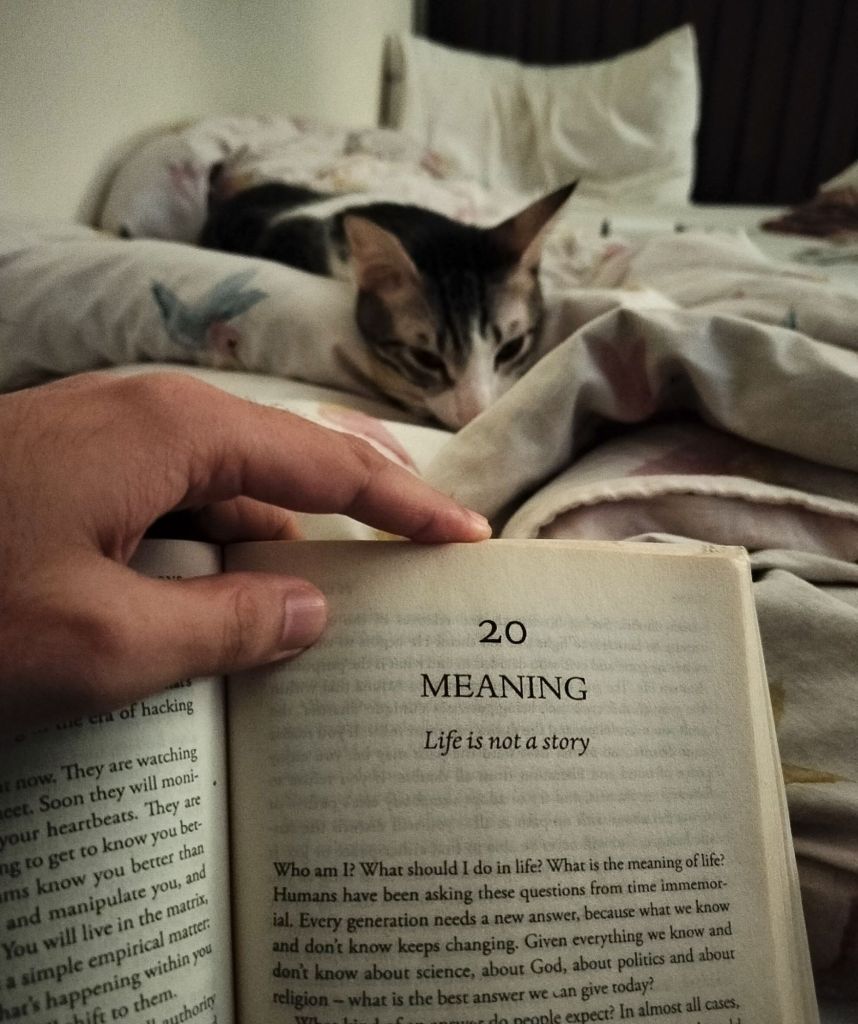
There are several chapters dedicated to questions you would find frequently in news media or on Youtube. Harari himself admits at the beginning that he wrote this book to answer the questions his readers posed. So that’s not surprising. What was surprising, though, was the lack of philosophical depth in these later chapters. The question of God, for instance, or ethics in the absence of a religion, requires much more intellectual discussion. Harari provides some simple answers while leaving many open-ended threads for the reader to ponder.
As a reader, I appreciate the author’s honesty when he says that he might be lacking perspective in some ways.
When discussing global issues, I am always in danger of privileging the viewpoint of the global elite over that of various disadvantaged groups. The global elite commands the conversation, so it is impossible to miss its views. Disadvantaged groups, in contrast, are routinely silenced, so it is easy to forget about them—not out of deliberate malice, but out of sheer ignorance.
While it’s an honest admission, the fact remains that it is still a blindspot in most of Harari’s works. And you cannot ignore that.
Towards the end of the book, things become a little more random. However, you still have to give credit to the author for coming up with thought-provoking arguments every now and then. Harari is indeed a gifted writer—you’ll have to grant him that.
Consider the passage below, for instance:
The greatest crimes in modern history resulted not just from hatred and greed, but even more so from ignorance and indifference. Charming English ladies financed the Atlantic slave trade by buying shares and bonds in the London stock exchange, without ever setting foot in either Africa or the Caribbean. They then sweetened their four o’clock tea with snow-white sugar cubes produced in hellish plantations—about which they knew nothing.
It’s difficult to describe this book in one sentence. But if I were to do that, I would say something like this: The book fluctuates between Harari’s brilliant understanding of human history and his cliched approach to answering the world’s problems using only the lens of Western liberal values.
 Kalampedia