
Have you ever heard of a princess who not only witnessed the rise of a great empire but also wrote about it? Well, if you haven’t, here’s one for you. Meet Gulbadan Begum, a Mughal princess who lived in the 16th century.
Daughter of the empire’s founder, Babur, Gulbadan wasn’t just a royal bystander. Her firsthand accounts offer a fascinating glimpse into the Mughal court, the battles fought, and the daily life within the harem walls. Moreover, she wasn’t all about palace life. This adventurous soul also undertook a pilgrimage to Mecca, a journey that broadened her horizons even further.
Luckily for us, Gulbadan’s experiences weren’t lost to history. She penned her own memoir, the “Humayun-Nama,” which focused on the life of her brother, Emperor Humayun. To delve deeper into Gulbadan’s world, you might want to pick up a copy of “Gulbadan: Portrait of a Princess at the Mughal Court” by Rumer Godden. This book brings the princess and her era to life through a beautiful blend of historical details and eloquent storytelling.
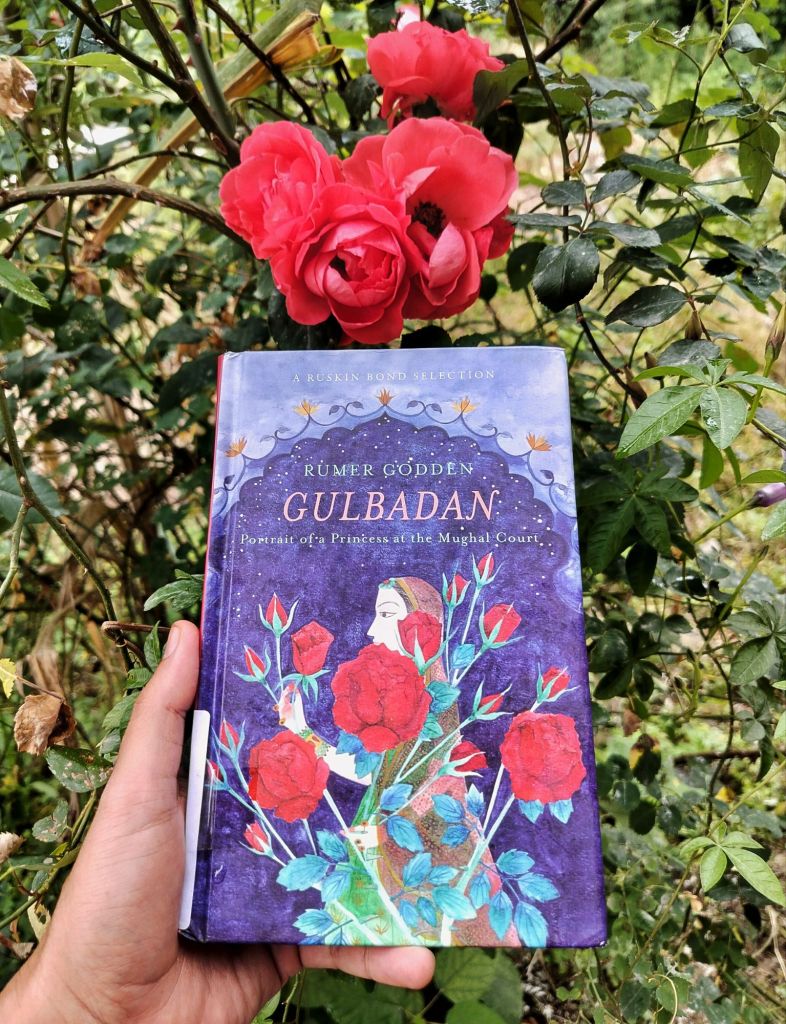
This is how Godden introduces Gulbadan to us in the opening paragraph of the book:
She called herself ‘this Insignificant Person’ but she was not at all insignificant nor even just a person, though perhaps she was wise to call herself so because her name was Princess Rosebody, which sounds like someone in a fairy tale, but she was real, and of real and most dramatic times, being Gulbadan Begum, the youngest daughter of Babur, first Mughal emperor of India.
Through this biography, not only do we get to know Gulbadan, but we also get a glimpse into the lives of the three important figures in Mughal history: Babur, Humayun and Akbar.
Life of Gulbadan in Mughal Empire
Living in the early Mughal days meant a lot of travelling and facing political and military conflicts day after day. That’s the kind of world Gulbadan witnessed right from her early days. At two years old, perhaps three, she had seen Babur ride away with his horsemen, banners and pennants. He was always riding away.
“From the eleventh year of my age till now,” she wrote when she was thirty-four, “I have never spent the fast or the festival of Ramazan in the same place.”
Even after Babur had established his Court in Kabul, his womenfolk seldom knew, until weeks afterwards, where he had been, how he had been, how a battle had gone; nor did they know when he was coming back.

Once Babur conquered the northern parts of India, the newly established empire meant that the womenfolk would also travel with him. The journey sounds almost like a pilgrimage. Gulbadan described the experience of reaching the heart of India:
When My Lady reached Kul-jalali (now Aligarh) his Majesty had sent two litters with three horsemen. She went on post-haste to Agra. His Majesty had intended to go as far as Kul-jalali to meet her but at evening prayer time someone came and said to him, “I have just passed Her Highness on the road, four miles out.” My royal father did not wait for a horse to be saddled but set out on foot and met her.
Life for Gulbadan settled into a rhythm of residing primarily in Agra, the new capital Fatehpur Sikri for a brief period, and Lahore, with occasional travel alongside the Mughal court. A defining moment in her life was the seven-year pilgrimage she undertook to Mecca, a testament to her deep faith (1575-1577). This experience even found a place in her writings.
Akbar, recognising her literary talent, encouraged her to write the Humayun-Nama, a memoir chronicling her brother’s life and reign. This unique perspective from a woman within the royal household provided invaluable insights into Mughal history, particularly the experiences of women in the court. Interestingly, despite some discord with Akbar’s more liberal religious views, they maintained a respectful relationship. This was evident in Akbar’s act of carrying her bier during her funeral in 1603, a gesture signifying the high esteem in which he held her.
Gulbadan lived a good life. From a young child, watching her father disappear into battles to a respected elder stateswoman and author, she left behind a rich legacy, not just through her family lineage but also through her insightful writings.
Note: Click here to listen to our podcast on Gulbadan and Mughal history.
 Kalampedia