
Every March, when rhododendrons stain their slopes crimson with their blooms, a sturdy little steam engine goes huffing and puffing through the 103 tunnels between Kalka and Shimla, in the north of India. This is probably the most picturesque and romantic way of approaching the hill station.
Rudyard Kipling’s Shimla (in the 1870s and 80s) was slightly different. Travellers spent the night at Kalka and then covered the sixty-odd miles hill miles by tonga, a rugged and exhausting journey. It was especially hard on invalids who had travelled long distances to recuperate in the cool air of the mountains.
In his story ‘The Other Man’ (Plain Tales from the Hills), Kipling describes the unhappy results of the tonga ride on one such visitor.
Sitting back on the back seat, very square and firm, with one hand on the awning stanchion and the wet pouring off his hat and moustache, was the Other Man — dead. The sixty- mile uphill jolt had been too much for his valve, I suppose. The tonga driver said, “This Sahib died two stages out of Solan. Therefore, I tied him with a rope, lest he should fall out by the way and so we came to Simla. Will the Sahib give me bakhshish?” “It,” pointing to the Other Man, “should have given one rupee.”
Today’s visitor to Shimla need have no qualms about the journey by road, which is swift and painless, but the coolies at the Shimla bus stand will be found to be as adamant as Kipling’s tonga driver in claiming their bakhshish.
Shimla is worth visiting at any time of the year, even during the monsoon. The monsoon season is one of the most beautiful times of the year in the Himalayas, with the mist trailing up the valleys, and the hill slopes, a lush green, thick with ferns and wild flowers. The call of the kastura, or whistling thrush, can be heard in every glen, while the barbet cries insistently from the treetops.
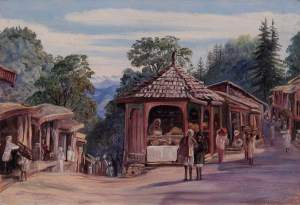
Not far from Christ Church is the corner where a great fictional character, Lurgan Sahib, had his shop — Lurgan being the curio dealer who took the young man Kim in hand and trained him as a spy. He was based on a real-life character, who had his shop here. Kipling wrote Kim a few years after he had left India. His nostalgia for India, and in particular for the hills, come through in his description of Kim’s arrival in Shimla in the company of the Afghan horse dealer, Mahbub Ali:
“A fair land — a most beautiful land is this of Hind — and the land of the Five Rivers is fairer than all,” Kim half chanted. “Into it I will go again… Once gone, who shall find me? Look, Hajji, is yonder the city of Simla? Allah! What a city!
They lead their horses below the main road into the lower Shimla Bazaar — ‘the crowded rabbit-warren that climbs up from the valley to the Town Hall at an angle of forty-five!’ And together they set off ‘through the mysterious dusk, full of the noises of a city below the hillside and the breath of a cool wind in deodar-crowned Jakko, shouldering the stars.’
Shouldering the stars! This is how one thinks of Shimla — standing on the Ridge and looking up through the clear air into the vault of the heavens where the stars seem so much nearer… And they are reflected below, in the myriad lights of the shops and houses.
For those who want a bit of history, Shimla came into being at the end of the Anglo-Gurkha War (1814-16), when most of the surrounding district — captured by the Gurkhas during their invasion — was restored to various states; but the land on which Shimla stands was retained by the British — ‘for services rendered!’ Lieutenant Rose built the first house, a thatched wooden cottage, in 1819. His successor, Lieutenant Kennedy, built a permanent house in 1822, which survived until it was destroyed in a fire a few years ago. In 1827, Lord Amherst spent several months at Kennedy house and from then on Shimla grew in favour with the British. Its early history can be read about in more details in Sir Edward J. Buck’s Simla, Past and Present, copies of which sometimes turn up in second-hand bookshops.
From 1865, until World War II, Shimla was the summer capital of the Government of India. Later, it served as the capital of East Punjab pending the construction of Chandigarh, and today, of course, it is the capital of Himachal Pradesh.
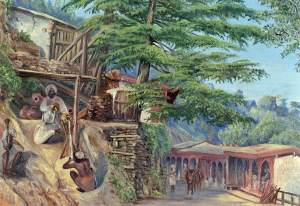
‘Romance brought up the nine-fifteen’, wrote Kipling and there is still romance to be found on trains and at lonely stations. Small wayside stations are always fascinating. Manned sometimes by just one or two men, and often situated in the middle of a damp subtropical forest, or clinging to the mountainside on the way to Shimla, these stations are outposts of romance, lonely symbols of the spirit that led a certain kind of pioneer to lay tracks into the remote corners of the earth.
Today’s Shimla might be different, very different, but, if you look at it through Kipling’s eyes (or at least, through his characters’), you would find that — Romance still drives the nine-fifteen! And you would still find the glimpses of Rudyard Kipling’s Shimla.
Reference Books:


 Kalampedia