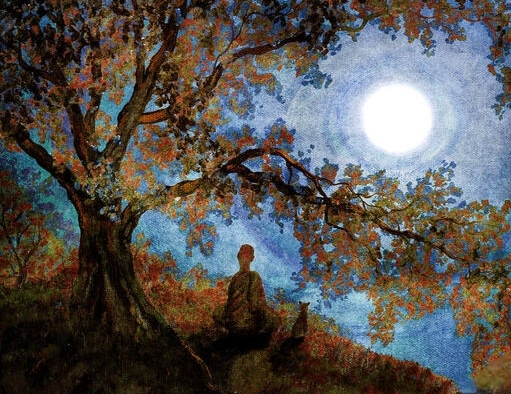
Close your eyes for a moment. Imagine the soft sound of the wind rustling through leaves, or the rhythmic crash of waves against the shore. Now, let that feeling expand, encompassing the vastness of the universe–the sparkling array of stars, the silent dance of planets. Does a sense of awe fill you inside, a yearning to understand the grand mystery of it all?
That, dear reader, is a glimpse of mysticism.

In the West, mysticism might conjure up images of monks cloistered in monasteries, chanting in candlelit rooms. That’s because it is difficult to see mysticism outside religion or the idea of God in the western imagination. Sometimes it even evokes whispers of secret societies and hidden knowledge. But mysticism, at its core, is a deeply personal experience. It’s about peeling back the layers of the everyday and seeking a connection with something profound, something beyond the tangible world.
Many cultures around the world have mystical traditions. In India, mysticism has blossomed for millennia. It’s woven into the fabric of its religions, from the ancient Vedic hymns to the contemplative practices of yoga and meditation. Indian mystics believe in a universal consciousness, a oneness that connects all things. Their pursuit of this connection isn’t about intellectual understanding; it’s about a direct, transformative experience–a tasting of eternity in the present moment.
And that’s what I am exploring with this book titled Indian Mysticism: Rig Veda to Present Day by MG Gupta.
The basic unity of the universe
Think of it this way.
There are two stories of our existence. One says that consciousness came first and out of it came all the matter. The other says that matter came first and out of this matter emerged our consciousness. Both stories are fascinating and neither is any less miraculous than the other. The second is what the modern science suggests, whereas the first is what the mystics have been saying for millennia.

But it is not just that. Mystics, instead of focusing on the theories and ideas, focus on direct experience. They maintain that any knowledge can be best acquired through direct experience. And it is through direct experience they come to their conclusions such as the oneness of the universe.
Let’s discuss some key ideas in Indian mysticism.
Maya
Brahman, the ultimate consciousness, is a great magician who transforms himself into the world, which is referred to as Maya in the Hindu philosophy. The mystics suggest that as long as we confuse the myriad forms of the divine play with reality, we are under the spell of Maya. It does not mean that the world is an illusion (although one might get that impression based on this point of view), the illusion merely lies in our point of view if we think that the physical world around us is the ultimate reality. That is, if we confuse the map with the territory.
Karma
In Indian mysticism, all forms of matter are relative, fluid and ever changing. The world of Maya changes continuously because the divine play us a rhythmic, dynamic act. The dynamic force of this play is Karma.
Karma means action which is the active principle of the play, the total universe in action, where everything is dynamically connected with everything else. Being free from Karma means to realise the unity and harmony of all nature, including humans, and to act accordingly.
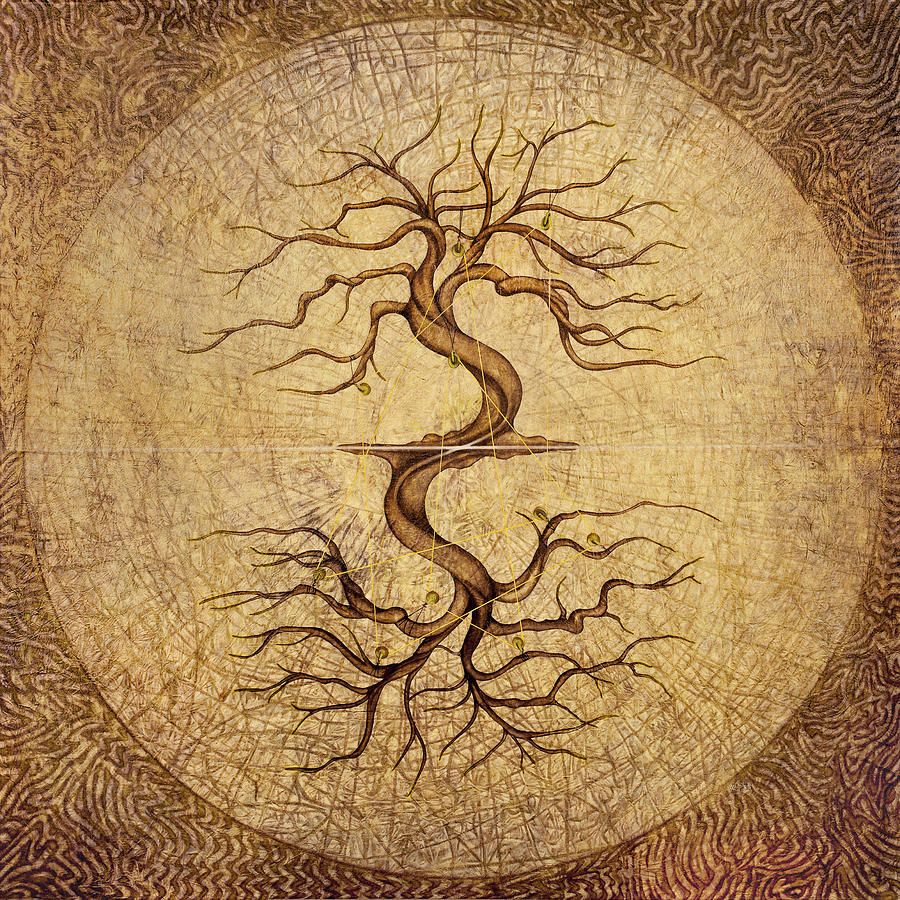
To be free from the spell of Maya, to break the bonds of Karma means to realise that all the phenomena we perceive with our senses are part of the same reality. It means to experience, clearly and personally, that everything, including our own self, is Brahman. This experience is called Moksha, or ‘liberation’ in Hindu philosophy. The Buddha took up the traditional concept of Karma and gave it a new meaning by extending the idea of dynamic interconnections to the sphere of human situations. Karma thus began to signify the never-ending chain of cause and effect in human life which the Buddha had broken in attaining the state of enlightenment.
The Buddha took up the traditional concept of Karma and gave it a new meaning by extending the idea of dynamic interconnections to the sphere of human situations. Karma thus began to signify the never-ending chain of cause and effect in human life which the Buddha had broken in attaining the state of enlightenment.
Beyond Vedic mysticism
From the stage of Vedic mysticism, we see the evolution of Upanishadic and Yogic mysticism, which then further gives rise to mysticism in Buddhism and Jainism.
Jainism, for instance, does not believe in one transcendent or absolute existence. The idea, here, is to break free from the bondage of material world. The soul needs to be entangled from the body, the process known as Nirvana.
On the other hand, the Buddhist mysticism is much more psychological. The Buddha was not interested in satisfying human curiosity about the origin of the world, the nature of the divine, or such other issues. He was primarily concerned with the human situation — the suffering and frustrations of human beings. His mysticism therefore is not one of metaphysics but psychotherapy.
Then, there is Tantric mysticism which explores the ritualistic aspect. The terms Tantra, who Sanskrit root means ‘to weave,’ refers to the interwovenness and interdependence of all things and events. The Tantric mysticism sees the polarity of masculine and feminine, not just outside, as it manifests in gender forms, but also inside a man or woman. It affirms that a union of one’s male and female modes can only be experienced on a higher plane of consciousness where the realm of thought and language is transcended and all opposites appear as a dynamic unity.
No discussion on Indian mysticism is complete without the mention of the medieval Bhakti saints who brought together the elements of Sufism and traditional Hindu knowledge to their mystical practices. All this, and more, you’d find in the book.
 Kalampedia