
When he was 19, his adventure took a perilous turn during a hunting expedition, as a ruthless fever struck him down. Urgently needing to return to Calcutta, an unconventional saviour appeared — a notorious and untamed horse, infamous for its near-lethal encounters with the previous rider. The next moment we find him riding the horse and somehow reaching the train station. He survived the immediate danger, but the ominous specter of a prolonged and debilitating fever loomed over him for the next several years.
That’s how we are introduced to Jagadish Chandra Bose, the eminent Indian scientist, in Sudipto Das’s latest book Jagadish Chandra Bose: The Reluctant Physicist. If the above scene sounds like a glimpse into an interesting movie, prepare yourself for a marathon of such enthralling experiences.

The name Jagadish Chandra Bose would be familiar to many of you, especially if you happen to be Bengali. Born in 1858 in British India, Bose made groundbreaking contributions to the fields of physics and biology. The polymath was remarkable in his ability to seamlessly blend his love for science and nature. The book captures this journey, taking us through the complexities of scientific experiments in a world full of socio-political tensions.
Bose in his school days
Since his home was some 60 miles away from Calcutta, Bose was sent to a hostel. However, unlike many of his contemporaries, he didn’t confine his studies to the laboratory alone but ventured outdoors to explore the mysteries of the living world. He spent his pocket money on buying pets — rabbits, pigeons and even a long-tailed lamb. The world was like a canvas which he would colour with his own imagination.

Sudipto Das mentions one such instance where Bose came up with a simple mechanism that fed the stream with a continuous flow of water through a winding aqueduct of half-open discarded pipes. The water would flow from a broken bucket placed at a height, acting as a reservoir and collect at the end of the stream in a small pool. He would spend a good part of his time watching the water meandering through the pipes, flowing under the bridge and finally filling up the small pool at the other end. It was the beginning of his lifelong quest to see continuity in everything.
The challenges ahead
Bose faced multiple challenges during his time at the University of Cambridge, including the denial of access to well-equipped laboratories due to his Indian origin. Additionally, financial constraints and discriminatory attitudes prevalent in the colonial era posed obstacles to his academic pursuits.
To give you an example, in those times, a native’s salary was two-thirds of the white man’s. Bose decided to protest against it and did not back down until the issue was resolved.
Despite these struggles, Bose persisted, conducting groundbreaking experiments in his own makeshift laboratory and eventually establishing himself as a pioneering scientist in the fields of physics and botany.
The Man of Science
Bose’s dedication to research and scientific experiments marks the true beginning of his story. What captivated me the most was the author’s adept blend of history and mythology to narrate this journey.
Take a look at how he talks about radio waves:
As a child, Bose had heard stories about Indra’s weapon Vajra and how the fierce God of Gods could strike a cloud, a glacier or a dam with it to kill the demons who kept the waters confined.
The ancient Etruscans were also supposed to have attracted lightning by shooting metal arrows, their Vajras, into the clouds. In 1752, Benjamin Franklin flew a kite with a conducting hemp string during a thunderstorm and collected the electricity of the lightning in a Leyden jar. A dangerous stunt that could have killed him!
Indra’s Vajra, the metal arrows of the Etruscans, Franklin’s kite and Tesla’s hands were all essentially the receivers of radio waves created by lightning or an electric spark.
Jagadish Chandra Bose would soon be inducted into the ancient Order of the Vajra.
Understanding prana, the life force
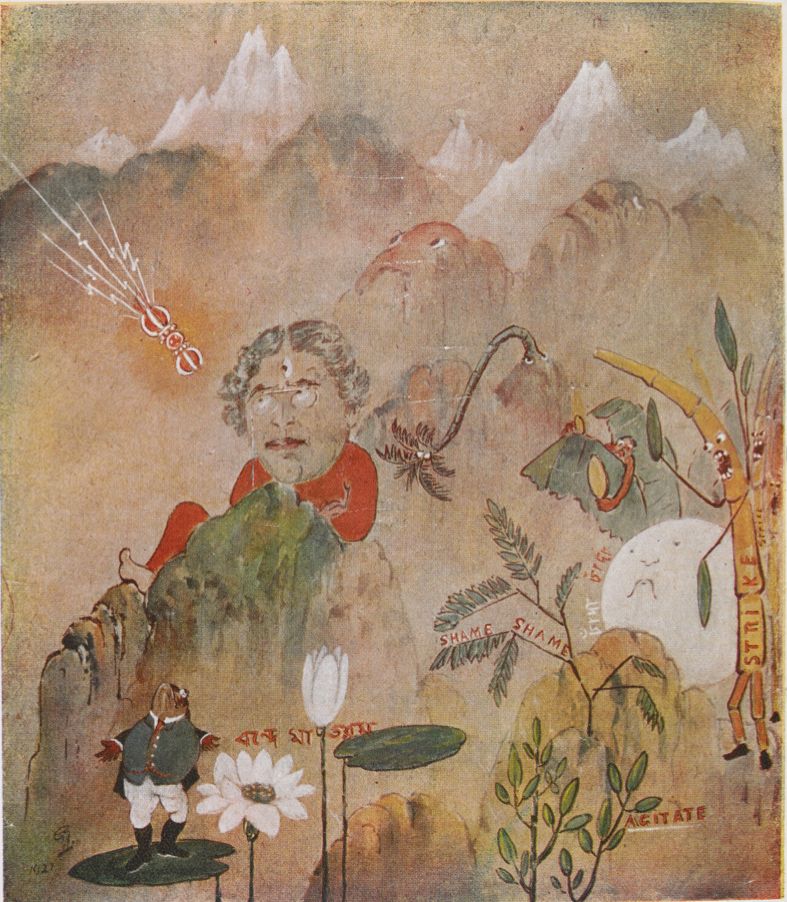
Bose lived in the times of Vivekananda and Tagore. So it was unsurprising that he drew inspiration from the prevailing spiritual ideas of India. Notably, Bose and Tagore developed a strong friendship, further intertwining their lives amidst the rich intellectual and spiritual tradition of their time.
“Both poet and scientific worker have set out for the same goal,” Bose said once, “to find Unity in thd bewildering diversity. The difference is that the poet thinks little of the path, whereas the scientific man must not neglect it…”
Bose was fascinated by the idea of understanding plant life. Are plants conscious beings, just like us? It was a curious question — and Bose pursued it relentlessly. He developed specialised instruments, such as the crescograph, which revealed the hidden life of plants, showing their reactions to various stimuli like light, heat, and music. His work essentially unveiled the secrets of plant behaviour, helping us see the dynamic and responsive nature of the seemingly still botanical world.It’s more than just a biography.
More than just a biography
Sudipto Das’s book is definitely more than a biography. It stands out for various reasons. The narrative grips you like a captivating page-turner, seamlessly unveiling the intriguing details of scientific experiments. For science enthusiasts, like myself, it’s a treasure trove.
In the end Das suggests that Bose might have been the chosen Oracle, echoing the wisdom of ancient Indian civilisation through his work. Similarly, the unspoken facets of Bose’s life seem to find resonance in Das’s eloquent storytelling, adding a layer of drama and depth to the narrative.
Click here to listen to our podcast on Jagadish Chandra Bose.
 Kalampedia