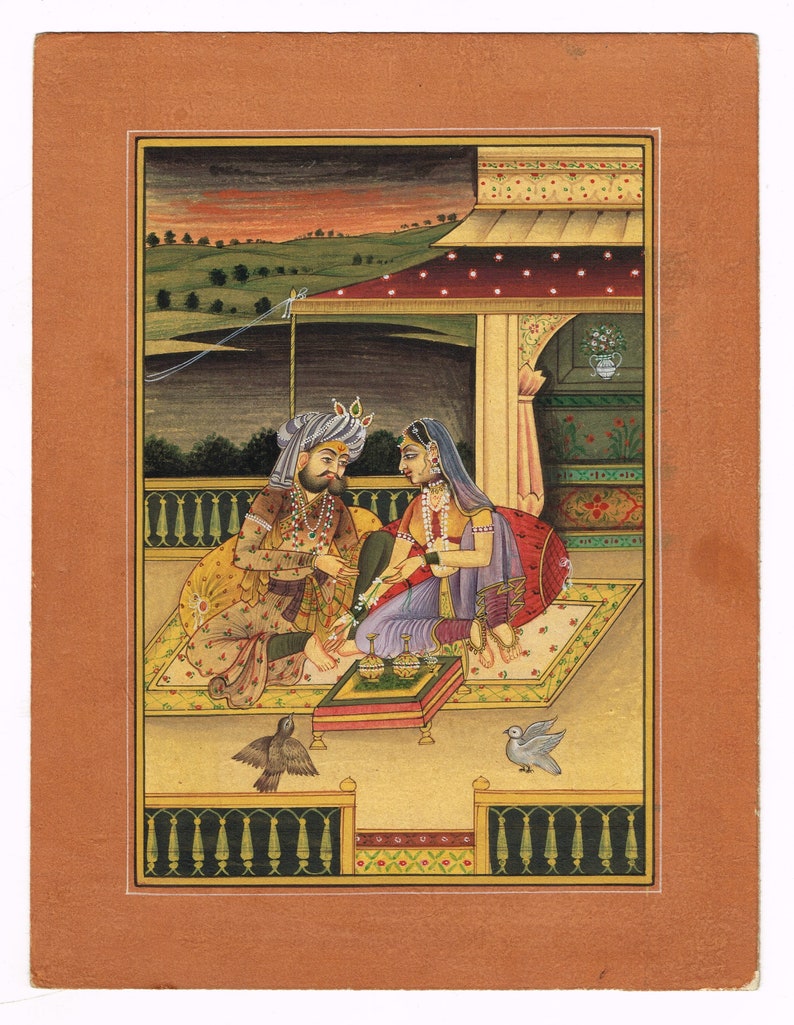
Note: Continuing our Padmavat series (the story of Queen Padmavati and King Ratan Sena), we now turn to the sequence of events that followed after their marriage. If you haven’t read the story so far, you can start here.
Coming back to where we left…
After the marriage, Ratan Sena settled in Simhala and soon became its king. Life was going well, until a messenger bird from the Chittaur royalty landed on his windowsill.
The message painted a bleak picture: since Ratan Sena’s departure, the queen had been heartbroken and the kingdom had fallen into disarray. An enemy was now poised to conquer Chittaur.
Alarmed, the king consulted his ministers. After long hours of discussion, the unanimous decision was made that he should make a hasty return to Chittaur, with Padmavati by his side. Together, the royal couple embarked on a long journey across the vast sea to mainland India, and then through the dense forests and dangerous terrains to Chittaur. Upon their arrival, the golden gates of the kingdom opened wide, and they were greeted with jubilation and fanfare. The entire kingdom, from the elders to the children, was in a festive mood. Nagmati, Ratan Sena’s first wife, overwhelmed with emotion, couldn’t hold back and shed tears of happiness.
As the days turned to months, tension began to simmer in the palace corridors. Both Padmavati and Nagmati, queens of unparalleled beauty, grew increasingly aware of the silent competition between them. Each was proud of her own allure and grace, and the feeling of jealousy became obvious. But amidst this tension, the palace echoed with the joyous cries of newborns. Both queens were blessed with sons: Nag Sena, who had the fierce eyes of a warrior, and Kanwal Sena, with a serene and gentle disposition.
Once again, life was returning to normal, and once again, an unexpected turn of events happened.
Raghava Chetan, not just an advisor but also a confidant to the king, found himself entangled in palace politics. He was accused of deceit and, in a heart-wrenching decision, expelled from the kingdom. While the courtiers supported the king’s decision, Padmavati couldn’t help but feel sympathy for Chetan. She believed that there might be more to the story than met the eye. Yet, in the royal court, the king’s word was the law, and his decision remained unchallenged.
Thrown out of Chittaur, the exiled Raghava Chetan, with his wounded pride, ventured north, finding solace in the thriving sultanate of Delhi. The Sultan invited him and listened to his story. Touched by his tragic tale and seeking to gain an ally, the Sultan offered a hand of friendship. The conversations continued for a long time. Sensing an opportunity for revenge, Raghava Chetan, under the ornate chandeliers of the Sultan’s court, spun tales of Padmavati’s ethereal beauty and the boundless treasures Ratna Sena had brought back from distant Simhala.
The trick worked… Raghava Chetan had lured the Sultan!
Determined to see for himself, the Sultan dispatched a message to Chittaur’s king, demanding Padmavati’s presence. If denied, there would be dire consequences, he said.
Reference books:
 Kalampedia