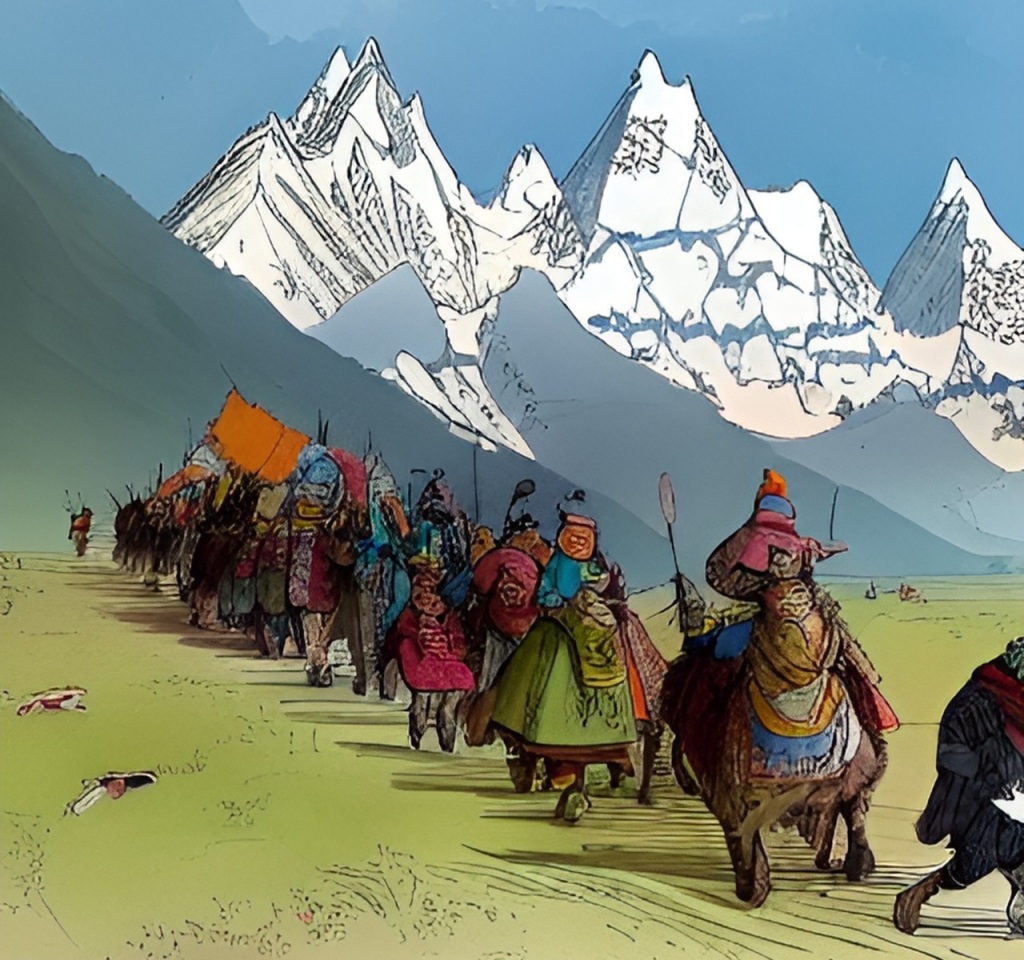
The concept of mountains as places of perfection in an imperfect world is a powerful trope in India, especially when it comes to the mighty Himalayas. Author and mountaineer Ed Douglas writes about the perspective through which Indians (of past and present) have viewed these mountains in his book Himalaya: A Human History.
In the age of constant strife and endless digital noise, middle-class Indians increasingly view mountains as places to escape the petty compromises of day-to-day life and live more simply. They don’t like to speculate too much about the past. The Puranas, though, Douglas says, have a great deal to say about the sacred geography of this spiritual wellspring.
According to the Puranas, in these valleys are spirits, gandharvas, both good and ill, half animal or bird, enchanting the gods with their singing, as well as nature spirits, yaksha, mercurial, sometimes lecherous protectors of the trees and the wealth of the earth, and their cousins, the rakshasa, eating raw human flesh, born from the breath of Brahma. These mountains are the region of Swarga, or paradise, the home of the righteous.
Here there is no sorrow, nor weariness, nor anxiety, nor hunger, nor apprehension; the inhabitants are exempt from all infirmity and pain, and live in uninterrupted enjoyment for ten or twelve thousand years.
At the centre of this cosmic landscape, we are told, is the mountain Meru, in the shape of a lotus seed, like an inverted, rounded cone, on its summit the city of Brahma, among its petals the abode of the gods, and projecting from its base, like the filaments of a lotus, many mountains. Meru is often taken to be Mount Kailas, high on the Tibetan plateau, poised between the Himalaya to the south and the Kun Lun mountain range to the north. The myth of Shangri-La – a hidden, paradisal realm located in the Himalaya – was the concoction of an English novelist, but it has its origins in texts like these.
Among the Puranas is another work called the Manasakhanda, one that is often cited when describing the Kailas region, partly because it has more useful information about the pilgrimage sites in this part of the Himalaya than any other text, but also because it’s so charming. Its chief focus is the segment stretching south from Mount Kailas and the sacred waters of Lake Manasarovar nearby.
One story tells how Dattatreya, an ascetic who has renounced the world and now lives among the mountains, goes to Kashi, the city of light, more familiar as Varanasi. Here he talks with Dhanvantari, prince of Kashi. The pair are also both gods: the ascetic being an incarnation of Vishnu while the prince is god of ayurveda or health. The two discuss tirtha, or sites of pilgrimage, and the ascetic tells the prince at length about the wonders he has seen in Himachal.
“He who thinks of Himachal, though he may not behold them, is greater than he who performs all worship in Kashi,” he says. “In a hundred ages of the gods, I could not tell thee of the glories of Himachal … As the dew is dried up by the first rays of the sun, so are the sins of man by the sight of holy Himachal.”
 Kalampedia