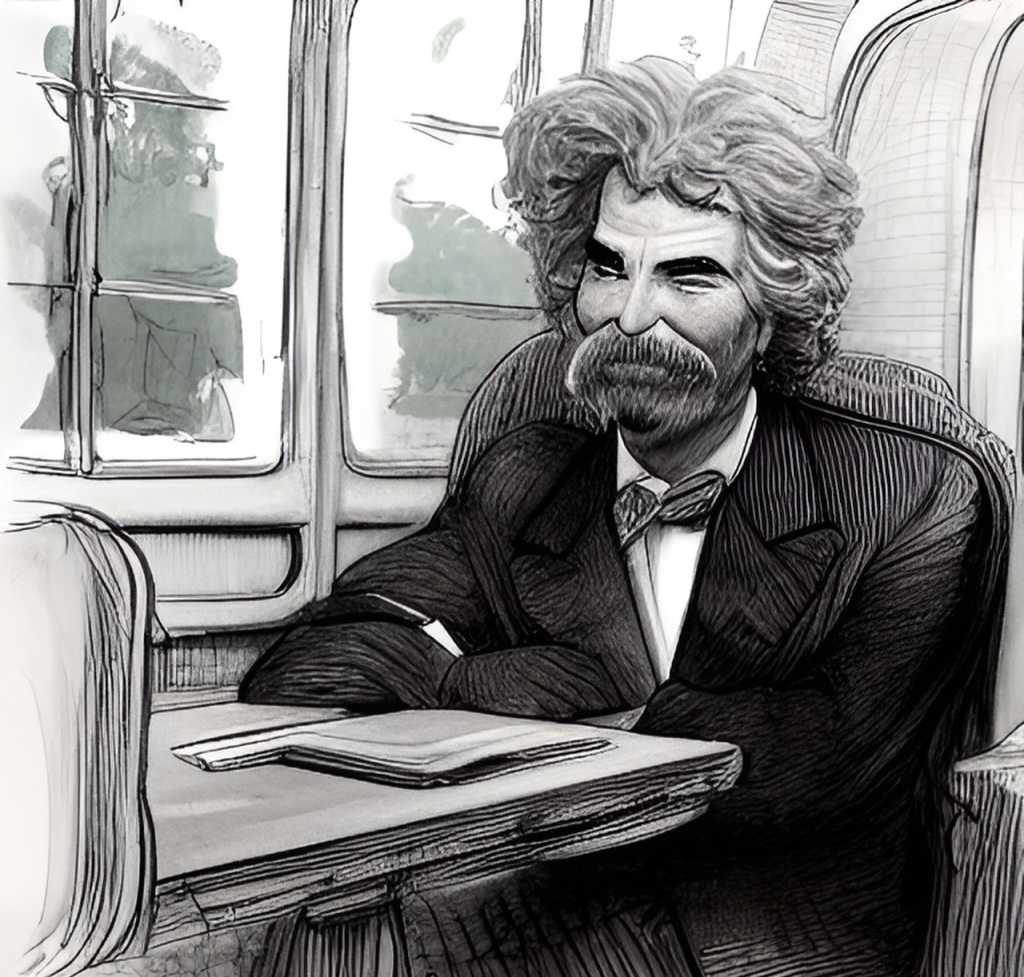
The year was 1894. Mark Twain, the great American writer, had gone bankrupt due to some poor investment choices. Therefore, in order to extricate himself from the debt, he undertook a journey through the British Empire, which, back then, meant pretty much the entire world. The route provided a wonderful opportunity for Twain to deliver his lectures and also write a book, which was published in 1897 as Following the Equator: A Journey Round the World.
When he was in India (which was a major British colony back then), Twain took a train to Darjeeling and wrote about this experience in the book. Let’s see how he described the journey.
Some time during the forenoon, approaching the mountains, we changed from the regular train to one composed of little canvas-sheltered cars that skimmed along within a foot of the ground and seemed to be going fifty miles an hour when they were really making about twenty. Each car had seating capacity for half-a-dozen persons; and when the curtains were up one was substantially out of doors, and could see everywhere, and get all the breeze, and be luxuriously comfortable. It was not a pleasure excursion in name only, but in fact.

As the train to Darjeeling began to climb the mountains, Twain could see the forests getting denser, and hence richer. He provides a vivid description of the sight that he captures through the windows.
The road is infinitely and charmingly crooked. It goes winding in and out under lofty cliffs that are smothered in vines and foliage, and around the edges of bottomless chasma; and all the way one glides by files of picturesque natives, some carrying burdens up, others going down from their work in the tea-gardens; and once there was a gaudy wedding procession, all bright tinsel and colour, and a bride, comely and girlish, who peeped out from the curtains of her palanquin, exposing her face with that pure delight which the young and happy take in sin for son's own sake.
As you can see, the picture that Twain paints, using only words and nothing else, is irresistibly charming. And it keeps getting better as the train approaches the hill town of Darjeeling.
By and by we were well up in the region of the clouds, and from that breezy height we looked down and afar over a wonderful picture -- the Plains of India, stretching to the horizon, soft and fair, level as a floor, shimmering with heat, mottled with cloud-shadows, and cloven with shining rivers. Immediately below us, and receding down, down, down, towards the valley, was a shaven confusion of hilltops, with ribbony roads and paths squirming and snaking cream-yellow all over them and about them, every curve and twist sharply distinct.

At an elevation of 6,000 feet we entered a thick cloud, and it shut out the world and kept it shut out. We climbed 1,000 feet higher, then began to descend, and presently down to Darjeeling...
How about that? Doesn’t it make you feel like taking a few days off and catch that train to Darjeeling and spend some time in the Himalayas?
 Kalampedia