
Fa-Hien, also spelled as Faxian, was a Chinese Buddhist monk, who, like many other monks of the time, liked to travel. Between CE 399 and 412, he travelled from China to India (today’s India, Pakistan and Afghanistan) and Sri Lanka and back. In his travel accounts, he describes his journey through Buddhist sites and kingdoms in the Hindu Kush region as well as the Western Himalayas.
Let’s follow his journey along the Himalayas and what he saw there.
After travelling through the vast, barren land of Tibet, Fa-Hien reached Kashgar. While it is now a part of China, it used to be a part of Kashmir once upon a time. Fa-Hien describes the city as mountainous and cold. “With the exception of wheat,” he says, “no grains grow or ripen here.”
Following the western terrain of the Himalayas in North India, the monk then crossed the Bolor-Tagh range (Xinjiang, China). It took him over a month to travel through that region. Of course he was not alone. The monks were travelling in large groups, following different routes and staying in monasteries along the way.

The Bolor-Tagh range remained covered in snow throughout the year. The nature was at its fierce best, and the human presence, hardly any. Since modern science was still a thing to be born, these travellers had the company of their own superstitions. They believed that venomous dragons inhabited these mountains, and, if provoked, they would spit forth poisonous winds, rains, snow, sand and even stones. So, the necessary caution was taken.
Then came the river Indus. Having crossed the river, Fa-Hien and his fellow travellers arrived at the country of Udyana (Swat valley in Pakistan). They notice that people in these parts used the same language which was common in the central parts of India. In that sense, it was just an extension of India. Also, Buddhism was flourishing in most parts of the subcontinent — the monks were clearly at home.
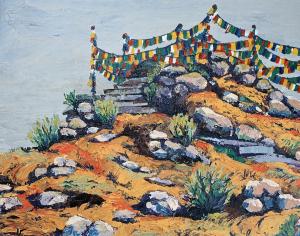
Tradition says that when Buddha came to North India, he visited this part of Swat valley and left behind his footprint. There was also a stone on which Buddha believed to have dried his clothes. Hence it was a place of reverence for the travelling Buddhists. While some decided to prolong their stay there, some continued their journey to the other parts of India.
Once again, they crossed the Indus river, this time entering the plains of Punjab. Punjabis, as welcoming as they are, greeted them and showered them with generous hospitality. But the monks continued to march on, following their doctrine of compassionate detachment.
 Kalampedia