
Saadat Hasan Manto, one of the greatest short story writers of the Urdu language, was also a film journalist for Bollywood (then referred to as Hindi Film Industry). As an insider he was privy to the most private moments of the men and women who have dazzled generations of audiences. Thankfully, just like a good writer would do, he captured those moments and preserved them for us to read today.
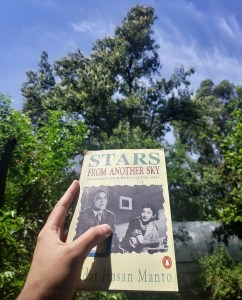
In his book Stars From Another Sky, Manto wrote a series of sketches on some of the famous film personalities from the time. Let’s read some interesting anecdotes from the book.
Nur Jehan and her true lover
Nur Jehan, according to Manto, was one in a million. To the movie-goers of those days, she was provocative, a ticking bombshell for whom they pined. She was a fine actress, but it was her singing that impressed most people. As Manto describes, “her voice was pure like crystal.” Even the suggestion of a note was discernible when she sang, being perfectly in command whether the notes she employed were in the lowest range, the middle one or the highest.
No wonder there was no dearth of her lovers. One such lover was a barber by profession.
The barber would sing her songs all day long and never tire of talking about her. Someone said to him one day, “Do you really love Nur Jehan?”
“Without doubt,” the barber replied sincerely.
“If you really love her,” the man said, “can you do what the legendary Punjabi lover Mahiwal did for his beloved Sohni? He cut a piece of flesh from his thighs to prove his love.”
The barber gave him his sharp cut-throat razor and said, “You can take a piece of flesh from any part of my body.”
The man was no less crazy. He slashed away a large chunk of flesh from the barber’s arm and ran away. The barber, meanwhile, fainted after providing a strong evidence of his love. When he regained consciousness in Maya Hospital, Lahore, the first words that came to his lips were, “Nur Jehan”.
The horrors of partition
1940s was a turbulent time in India. The British Raj was about to end and the religious fervour was moving towards its peak. The worst moment arrived during the partition of India and Pakistan in 1947, which led to widespread riots between Hindus (alongside Sikhs) and Muslims. While Bombay wasn’t nearly as affected as Punjab or Bengal, but the signs were evident.
The newly liberated India and Pakistan had found new obsession. As Manto says, when people were colonial subjects they could dream of freedom. But once that was over, they didn’t know who they should fight against next. So they turned against each other. Every question now had three different answers: the Indian answer, the Pakistani answer and the British answer. Some blamed the British Empire, while others suggested that it was time to analyse the Mughals, some went even further, back in history.
Soon Manto stopped going out and started drinking heavily. But even that didn’t help, and one day he said to himself, “The hell with it all. I am leaving.” And so he left for Pakistan.
The colourful lives of colourful folks
It’s not a news to anybody that film celebrities enjoy colourful lives. However, it fascinates us far more when we hear about the stars of the yesteryears and what misadventures they were up to.
For instance, we learn that the conquests of Rafiq Ghaznavi, unlike those of Mahmood Ghaznavi, were only restricted to courtesans. We also learn that Kuldip Kaur was too hot to handle, not just for men but for the state too, as she had been charged with spying for Pakistan.
Be it Ashok Kumar or Nargis or Sitara, the 1940s’ stars, too, were living the kind of lives that would give gossipers, tabloids and paparazzi a run for their money.
 Kalampedia