
Syed Ahmad Khan was perhaps the most eminent Muslim reformist and philosopher of the 19th century. He was born in Delhi in 1817. The family was not orthodox in any sense — they patronised musicians and mystics.
There was a tradition of scholarship too: among Syed Ahmad Khan’s forebears were some keen mathematicians. He continued along the same path, and in fact, left much more valuable legacy: The Aligarh Muslim University, which is now well into its second century.
India is like a bride which has got two beautiful and lustrous eyes — Hindus and Muslims.
Sir Syed Ahmad Khan
Despite all that he did for the education of Muslims in the British India, there are still question marks over his politics, especially on the question of Hindus and Muslims. The fact that he inspired a generation of Indian Muslims to create a separate identity, many believe that he laid the foundation of Pakistan. This, of course, can be perceived positively or negatively, depending on which side of the border you live in — Pakistan or India. In either case, it’s important to understand his views on religious identity, particularly when we talk about the Hindus and Muslims of India. Because the question that he faced in the 19th century, still holds relevance in India, Pakistan and Bangladesh, and the question is: can Hindus and Muslims live together in peace?
To answer that, let’s start with his 1883 speech in Patna, emphasising the need for cordial relations between Hindus and Muslims, holds a lot of relevance. Here are some excerpts from the speech:
India is the home for both of us [Hindus and Muslims]. We both breathe the air of India and take the water of the holy Ganges and the Jamuna. We both consume the products of the Indian soil. We are living and dying together. By living so long in India, the blood of both have changed. The colour of both have become similar. The Muslims have acquired hundreds of customs from the Hindus and the Hindus have also learned hundreds of things from the Mussulmans. We mixed with each other so much that we produced a new language -- Urdu, which was neither our language nor theirs. Thus if we ignore that aspect of ours which we owe to God, both of us, on the basis of being common inhabitants of India, actually constitute one nation; and the progress of this country and that both of us is possible through mutual cooperation, sympathy and love. We shall only destroy ourselves by mutual disunity and animosity and ill-will to each other. It is pitiable to see those who do not understand this point and create feeling of disunity among these two nations and fail to see that they themselves be the victims of such a situation, and inflict injury to themselves. My friends, I have repeatedly said and say it again that India is like a bride which has got two beautiful and lustrous eyes -- Hindus and Mussulmans. If they quarrel against each other that beautiful bride will become ugly and if one destroys the other, she will lose one eye.
It’s crystal clear that Syed Ahmad Khan was talking about Hindu-Muslim unity. Why is the confusion, then? The confusion comes from the fact that while he was hoping that Hindus and Muslims of India should unite, in his heart, he did not believe that it could ever be possible. Which was what defined his politics.
Syed Ahmad Khan’s loyalty to the British
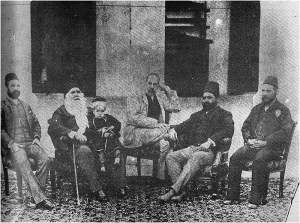
On many occasions, Syed Ahmad had pointed out how the British system of governance was better than the native rule — better not only in terms of their technological advancements, but also politically for certain groups, especially Muslims. The latter comes from his fear that if the British left and democracy prevailed, Hindus and Muslims would try to conquer each other to gain power. And there would be bloodbath. Moreover, in such a scenario, if not the British, some other colonial power would invade India and rule over it. Behind such speculative scenes, there is, once again, the same fear: Hindus and Muslims are different, and in the absence of the British they might not live peacefully. He went a step further and said, “it is necessary that for the peace of India and for the progress of everything in India the English Government should remain for many years — in fact for ever!”
Like everyone else, his views changed with time. His 1883 speech was very different from the one he delivered in 1888, to a Muslim audience in Meerut. In latter he explained his growing suspicions of the Congress party. That’s because the Congress party was demanding the control of administration from the British, and once again, if that happened, his fears would have come true.
So, coming back to our original question: can Hindus and Muslims live together in Peace? — the answer that Syed Ahmad Khan found was a clear No. He had hoped that they could… but he knew that it would not happen, and certainly not of the two groups were left on their own.
 Kalampedia