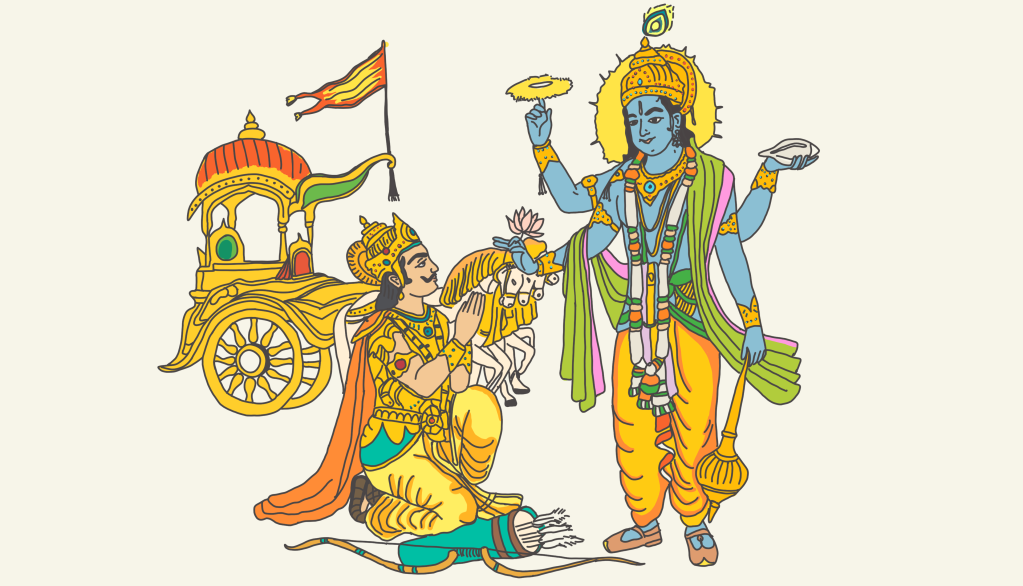
You often hear the term Gita when someone talks about Hinduism. Some people believe that it is the central text of the religion. That’s not true. In fact, there is not just one Gita, but many.
Even in Mahabharata, the great Hindu epic, we come across many Gitas. There is Vyad Gita, or Butcher’s Gita, where a butcher tells a Gita to a sage. Then there is Pingala Gita where a prostitute is offering wisdom.
What does Gita mean?
Gita, in simple terms, means a conversation where learning is being imparted. It is written in metre called Anustubh metre, which sounds musical while being read. The word is quite similar to Geet (in Hindi), which means a song. So, that is what we mean by Gita.
Listen to the below short podcast on the history of the Gita:
However, generally speaking, we use the word Gita for The Bhagavad Gita, which refers to the conversation that took place between Krishna and Arjuna on the battlefield of Mahabharata.
How the Bhagavad Gita found popularity
Interestingly, The Bhagavad Gita gained importance when the British East India Company first translated it into English around 200 years back. It had never been translated before. While it was written in Sanskrit around 2000 years ago, Sanskrit scholars — Adi Shankaracharya, Ramanujan, Madhavacharya, Vallabhacharya — wrote commentaries on the Gita, called Bhashyas, only around a millenium ago. These too were in Sanskrit, so only Brahmins could understand it.
During the fourteenth and fifteenth centuries, Bhakti saints composed poems by simplifying the Gita and took it to the common people through colloquial language and folk songs. But the exact translations were not widely available. This changed when Charles Wilkins translated the Gita into English and many prominent Indians (some of whom were fighting against the British Empire) read it for the first time.
This newfound popularity meant that the Gita was now being interpreted in many different ways, as the reader found convenient. So, on the one hand, Mahatma Gandhi found counsel for non-violence in it, and on the other, Lokmanya Tilak found justification for righteous war.
What’s in The Bhagavad Gita?
The Bhagavad Gita has 700 verses in eighteen chapters. The Mahabharata also has eighteen chapters, the war too was fought in eighteen days and eighteen armies were involved in it. Devdutt Pattanaik proposes an interesting explanation for number 18 in his book Devlok. According to him, Krishna calls our body Navadwarpur, the place with nine doors. These nine doors are the two eyes, the nose, two ears, the mouth, genitals and the anus. Any relationship between two people makes it eighteen doors, and hence this number.
The Bhagavad Gita takes forward the teachings of the Hindu philosophy and presents it to the common man. Metaphorically speaking, Vedas are like the grass and the Upanishads are like the cows grazing on it. Krishna is the milkman, drawing milk from the cow, the milk being the Gita, which he gives to Arjuna. In this way the Gita can be called the essence of the Vedas. But it is offered in such a way that it remains palatable to the common man.
The key message of the Bhagavad Gita can be captured in the following lines that Krishna says to Arjuna. Read slowly and reflect on them as you read.
If you are seeking validation from outside, if you are hoping that others will praise what a great warrior you are, then you are finished. But if you are working from within, for your inner peace and satisfaction, then do whatever you want. Why do you want to fight? Because people will say you fought your family? Whatever is meant to happen will happen. There is no certainty that you will win, nor that you will lose. Why are you so tense? Don't expect to be perfect. Nobody is, including me. Don't run after accolades. Just do your karma.
You can listen to the below podcast series for the detailed discussion on the Bhagavad Gita.
That’s the message you get after reading the Gita. The ultimate responsibility lies with you. You have come into this world alone, you will live and die alone. Don’t blame others, don’t make excuses on behalf of others. Just do what you think is the right thing to do.
 Kalampedia