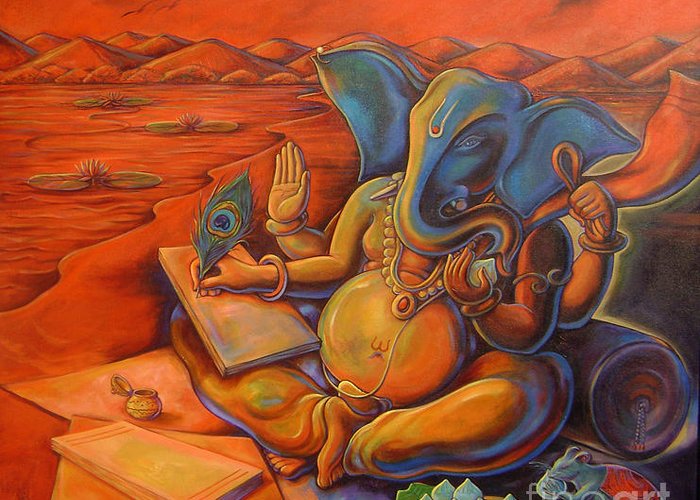
In this series, I am going to narrate the story of Mahabharata. The epic poem consists of over a hundred thousand couplets in Sanskrit, therefore, it is likely that a number of details will be missing from this account. Nevertheless, here is an attempt to give you a flavour of this thousands of years old Indian mythological genius.
Let’s begin, then.
Mahabharata begins with the story of King Shantanu who was the ruler of the Kuru kingdom, with his capital at Hastinapura.
Some versions begin with the following line, said by the king Shantanu to the goddess Ganga: You must certainly become my wife, whoever you may be. The goddess Ganga is standing before him in human form, intoxicating his senses with her superhuman beauty. But, he does not know who she is or where she has come from.
The goddess makes it even more complicated by saying, “O king, I shall become your wife. But on certain conditions — that neither you nor anyone else should ever ask me who I am, or where I come from. You must also not stand in the way of whatever I do, good or bad… If you act otherwise, I shall leave you then and there. Do you agree?”
That’s quite a demand, if you think about it. However, men of every generation have succumbed to the beauty of a woman, and the king was no different. He vowed his assent and thus began their life as a married couple.
Together the two bore seven children; each newborn baby she took to the river Ganga and cast into it. But she never revealed her secret. She kills all seven of them, at which point, Shantanu finds out the truth. However, he stays quiet, as he had promised her. That changes when the eighth child is born and the king could bear no longer. She is about to throw it into the river, but just then, the king comes and stops her.

The vow is broken.
The goddess Ganga decides to leave her husband, as she had warned, but she spares the life of the child. Then she goes on to tell the reason behind why she was doing all this. Vasishtha, one of the most revered Vedic sages, had cursed the eight Vasus (deities) to be born in the world of men and Ganga was to be their mother. She then tells Santanu that she will raise their eighth child and then return it to him. And she fulfils this promise. Devavrata, she calls her son, who would later be known as Bhishma (remember the name, he is an important character).
Years go by and Devavrata is now the prince of Hastinapur. The king, still shocked by the loss of his wife, spends a lot of time alone, wandering on the banks of the river. One of these days, he sees a beautiful maiden and gets attracted. Now he wants to marry her. But, as so often happens in this story, there is another twist. When the king goes to her father for the consent, the father makes a cruel demand.
“The child born of those maiden should be the king after you,” he says.
The king does not know what to say or do. He goes back to the palace and spends the next few days in sickness. He could not abandon his son Devavrata and he could not let go the thought of the maiden, Satyavati. When the son finds out the truth, he goes to talk to Satyavati’s father and makes a promise that he will renounce the throne and the maiden’s son shall become the king.
“Still,” says the old man, “your sons might claim it after you.”
“In that case,” says the prince, “I shall never marry and shall dedicate myself to a life of unbroken chastity.”
As he utters these words of renunciation, the gods shower flowers on his head and cries of Bhishma-Bhishma resound in the air. Bhishma means the one who undertakes a terrible vow and fulfills it.
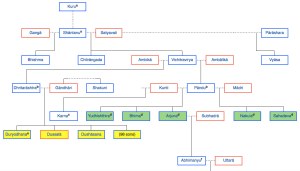
Satyavati gets married to the king Shantanu and gives birth to two sons: Chitrangada and Vichitravirya. Vichitravirya has two sons, Dhritarashtra and Pandu, born respectively of his two queens, Ambika and Ambalika. The sons of Dhritarashtra, a hundred in number, were known as the Kauravas. Pandu, on the other hand, had five sons who became famous as the Pandavas. As you might be aware, the story of Mahabharata is about the war between the Kauravas and the Pandavas.
What happens next? We will find out in the next part of The Story of Mahabharata.
 Kalampedia
.jpg)