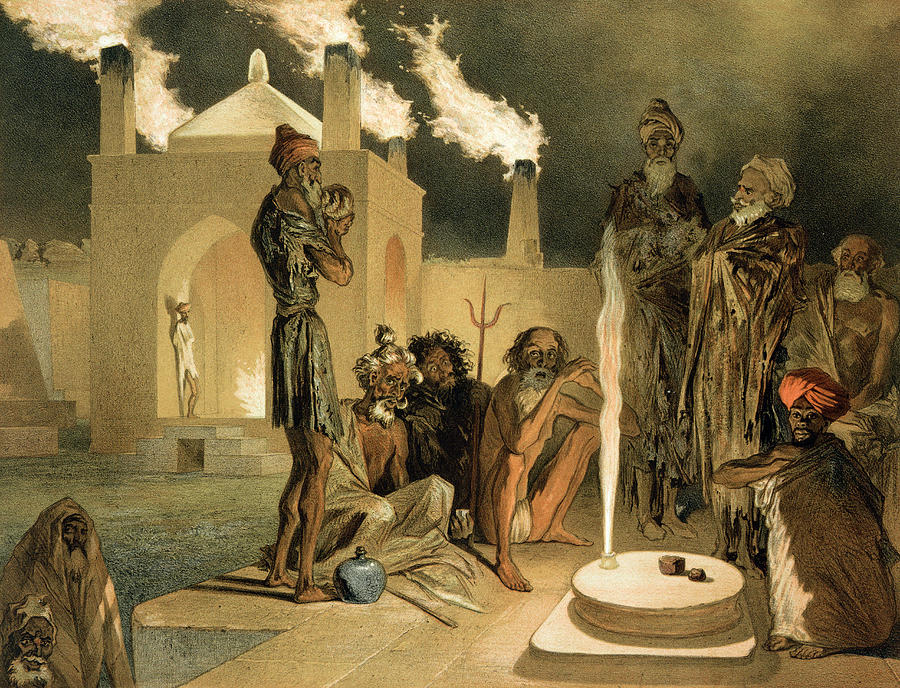
Zoroastrianism is one of the most ancient monotheistic religions in the world; its foundation dates back to approximately 3,500 years ago. Yet, many of us don’t know much about it. That’s why this short introduction to Zoroastrianism will help you understand the religion better.
Zoroaster, also known as Zarathustra, is regarded as the spiritual founder of Zoroastrianism. 3,500 years ago, Zoroastrianism was among the world’s most powerful religions. For at least 1,000 years, it had a strong religious following and was the most popular religion for the people of the Persian Empire (present day Iran and surrounding areas).

After the Islamic conquests in the region, a few of those who fled the Persian Empire to escape persecution took the religion to India where today, the Indians refer to them as Parsis. There, they have been struggling to keep the religion alive against odds such as a lack of followers. In the present day Iran, only a select few dare to practise the religion because of the limited freedom of worship in the country.
An introduction to Zoroastrian beliefs and practices
Zoroastrianism must begin with the beliefs and practices of the religion. Let’s take a brief look at these two aspects.
First, Zoroastrians believe in one supreme god by the name Ahura Mazda, which means ‘the wise god’. Ahura Mazda is an omniscient and omnipotent god who symbolises strength, justice, patience, courage, purity, order and truth. He created the world and all the creations in it. He is the sustainer and protector. The concept of Prophethood also exists in Zoroastrians, Zoroaster being the first. It is believed that after the 3,000 years of the cycle of creation, another prophet will come to guide the humanity.
So, on the one hand, Zoroastrianism resembles Abrahamic monotheisms (one god revealing himself to the prophets), on the other hand, Zoroastrians also practise polytheism in a limited sense where they believe that there are other immortal beings who represent the good qualities of the supreme god and who assist him in his fight against the evil.
There is also a belief in the duality of good and evil in Zoroastrianism. An evil spirit called Angra Mainyu, who always opposes Ahura Mazda, is the source of all evils. These two forces, good and evil, are in constant competition to dominate the world.
One of the unique aspects of the Zoroastrian belief system is that they consider the dead impure and evil. Therefore, when a person dies, there is no cremation or burial; instead, the body undergoes a ritual exposure. A four-eyed dog (dog with two spots above eyes) is brought before the corpse, five times a day to gaze at the corpse. After the first visit, they light a fire in the room where the body lays and keep the fire burning for three days. They then move the body to the tower of silence, something they can only do during the day. In this tower, they expose the naked body to vultures that devour the flesh off the bones. They then sun-dry the bones before sweeping them into the central well.
The above ritual may seem disturbing to many but it will make sense if you understand their beliefs in sacrificial rituals. According to Zoroastrians, sacrificial rituals are a way of pleasing and communicating with god and other divinities. They also consider sacrificial rituals a must for the sake of religious observance; failure to do this is a sin. The rituals are a way of redeeming themselves and the world. However, only qualified priests can perform sacrificial rituals in a fire temple because maintaining purity during the ritual is mandatory. The sacrifices occur amidst chants from the Avesta, the holy scripture of Zoroastrians.
 Kalampedia
_p012_BAKU,_FIRE_TEMPLE_(cropped).jpg#mw-jump-to-license)