
There are many contenders for the spot, but some of us would argue that Florence can easily be called the world’s most beautiful city. The splendid Renaissance town holds the flame for sheer, unadulterated Italian beauty. A walk down any cobblestone street will reveal astonishing piazzas and cathedrals — and the skyline dominating the cathedral of Santa Maria del Fiore is something you cannot miss. The history of this magnificent place is even more intriguing. Let’s talk about that today.
When I thought of Florence, it was like a miracle city embalmed and like a corolla, because it was called the city of lilies and its cathedral, St. Mary of the Flowers.
Marcel Proust
Perhaps no city has embodied so many and such different forms of political regime in its history as Florence: bishop sovereignty, marquisate of the Holy Roman Empire, rule by consuls, government by the podestà (the legislative and military leader of the city in the 13-14th centuries), rule by magnates, rule of the guilds, outside dictatorships, the Ciompi democracy, bourgeois oligarchy, family signoria, a theocratic republic, absolute monarchy, a humanistic and paternalistic state. In its historical evolution of little more than a thousand years, Florence reflects all the most varied kinds of social organisation.
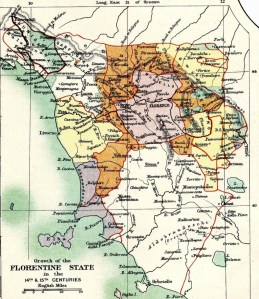
It was Florence itself that created its ideal genealogy. Once it had reached power and greatness, the city could not stop looking into its past for evidence of present legitimacy. Chroniclers, historians and poets joined in transforming the few certain data that survived barbarian invasions coining a “golden legend” that was often mistaken for history and certainly had all the appearance of history and preserved it’s fascination.
Where a castrum had actually existed i.e. a military camp, a colony founded by Caesar’s soldiers, one of the many training grounds spread over the peninsula by the consulate’s armies, stories were made up of a municipium splendidissimum, one of the “child and work of Rome”, one dreamed about “the favourite of the gods”, one talked wildly of the first City rebuilt after the Flood. There are those who said Aeneas was its founder, whereas others fixed its centre at Fiesole, those who believed they had discovered remains of it at San Salvi and those who followed its development and glory through imaginary wars and victory.
Forgetting legend, even if it confirms salient features that are the very essence of Florence, we see what archaeologists and historians think about the foundation of the city according to the most recent excavations in the city centre.
Let’s start with pre-history. The land where Florence rose was geologically very new. In the far-off Pliocene Age, Tuscany practically did not exist: the Thyrrhenian Sea got as far as lapping the Apennines. The very short Arno entered the sea at Arezzo; little emerging islands were the Pisan mountains. Only in the Quaternary Age did the earth emerge here; this was two million years ago and the landscape was all lake and marshes. the Val di Chiana was a huge swamp; the Arno flowed into the Tiber. Later this capricious river changed course in its basin and waste into what was to become the plain of Florence and Pistoia. The heat was equatorial: big animals roamed these areas (the remains of an elephant were found where today the Lungarno della Zecca is).
Homo sapiens perhaps appeared one hundred thousand years ago in the Florentine area. Discovered remains go back thirty thousand years.
Other excavations point to the residents having exchanges with distant places like Sardinia and Greece at least as far back as 4000 BC. Perhaps where the Uffizi stands today, a river port sprang up. The Ligurians lived here and Indo-European peoples who came down from the Apennines. Their double presence is proved by numerous remains (ashes were collected in charnel-houses, one of which was found at the end of the 19th century under the historical centre). Recently traces have been found of actual workshops for stone objects (about 2000 BC) under the spur of Piazza Signoria.

Next comes the age-old question of Etruscan Florence. Was Florence founded by the Etruscans or by the Romans? Historians divided on the question, have discussed it at length: today the opinion definitely prevails of a Roman Florence. But for centuries the opinion had been held of an Etruscan Florence based on the authority of the great historian, Davidson. He had found remains if ancient walls (over a kilometre long) under where San Salvi is today. He maintained they went back to about 2000 BC, when Fiesole founded a city close by, i.e. Florence, in order to facilitate its own traffic towards the sea. Again according to Davidsohn, Florence lasted scarcely a century but it achieved power and flourished. Archaeologists have found no traces but only because they were looking in the wrong place: further upstream than today. Then the city was destroyed by Silla in 82 BC to punish it for its alliance with the people’s faction in Rome.
Even if evocative, Davidsohn’s theory has few adherents. Above all, a city does not become rich and powerful in scarcely a hundred years. As far as the ancient walls really existing are concerned, Davidsohn blundered: they were not Etruscan but probably barbarian, erected by the Byzantine Belisario in the 6th century, when he built them to protect his own camp during a siege at Fiesole.
Today it is the theory of a Roman Florence that seems to be indisputable, even if date and method of foundation remain uncertain. There are those who want it founded by the Consul Flaminius, in 187 BC, others by Silla after punishing and destroying Fiesole (but if so, then why does no ancient historian speak about it?). The safest theory is that it was Caesar who founded Florence, perhaps in the year 59 BC which tradition insists on, as seen in the April flower festivals, the “Floralia” from which in fact the name of the city comes. The Roman dictator would have founded the new city to pacify these territories, stained with blood by the events of Silla and Catiline and perhaps to give land to his veterans. Florence would have signalled renewed peace between Fiesole and Rome.

The uncertain history of the birth of Florence has yet another version: the city might be even more recent, founded perhaps in 40 AD by Lepidus or Octavian who, as is historically certain, founded at least eighteen towns for the advantage of their over one hundred thousand veterans. The Piazza Signoria excavations would support this theory.
Therefore Florence is Roman. And the centre, the fulcrum of interest lay in one fact: here was the place the Cassia could best ford the Arno and unite Rome with Cisalpine Gaul. Florence has this origin and this purpose.
Everything else, even the current shape of the city, goes back to its Roman origins: centuriation is still to be seen in the routes the streets take and the area covered. Florence was modelled on the Roman castrum, a quadrilateral protected by long walls, little less than two kilometres each side: the north to south route was the Cassia itself that passed over the future Ponte Vecchio (the oldest bridge in the city); the east to west route might today follow the Via del Corso and Via Strozzi. At the meeting of the two routes was the Campidoglio, today the Piazza della Repubblica.
Roman Florence flourished in the first two centuries. At that time there were perhaps ten thousand inhabitants. A real bridge substituted the ferry: a river port grew and flourished and there was an aqueduct that brought water down from Monte Morello. At the end of the second century Diocletian, reorganising the land of the empire, made Florence responsible for the whole of the Tuscia.

It is now that Christian influence comes to bear in the world’s most beautiful city. The first evangelists reached here from the east. If Deacon Lorenzo were Roman, Miniato, the Florentine protomartyr and Felicita, of Palestinian origin, were eastern. Even Zanobi, the first great Florentine bishop, has a name that comes from the eastern Zenobio. Also St Reparata was Syrian, the patron saint of the city whom the first Christian Church in the historical centre was dedicated to, on which Florence cathedral later arose.
Florence soon, right from the Constantinian period, had its own bishop and started out in its religious history, at first divided because of the persistence of the pagan cult of Mars (in the centre and on the Campidoglio whereas outside the walls, where the basilica of San Miniato rose, there was proof of early Christianity), then totally linked to the new religion that was to have such important even of a civil nature in Florentine history.
This was just a quick overview of what we consider the world’s most beautiful city. To explore it further, you’ll have to read the book.
 Kalampedia

