
As Khushwant Singh once wrote, “To know India and her peoples, one has to know the monsoon.” Indeed, one has to know the monsoon. More importantly, one has to feel it. Therefore, while we were busy chasing the monsoon last week, let’s take a pause and experience the multitudes of monsoon feelings.
As we have a clear bias at Kalampedia — it’s heavily tilted in favour of books — I am going to, once again, turn to a book to make the monsoon experience more enjoyable. The book is called Monsoon Feelings: A History of emotions in the Rain and it serves our purpose well. It’s a collection of essays, which make use of art, culture, history, architecture, and even films and songs, to tell the story of rains and how it has been told in the context of Indian traditions.
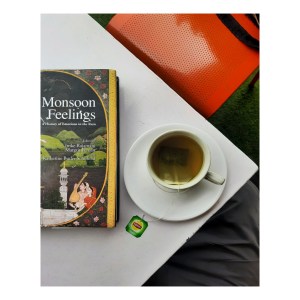
Imke Rajamani introduces the idea of monsoons in the opening chapter and what they’ve meant for the subcontinent people. “The monsoon,” she says, “is not just a seasonal weather condition, but also a lived social and cultural phenomenon. The immediate experience of wind and rain is this not the only way of learning how one could and should relate to the monsoon emotionally.”
The idea here is that it’s not only the natural phenomenon that affects our emotions, it’s also the culture, art, traditions or any kind of conversations around that phenomenon. In fact, if you look closely, you’d find that it’s usually the latter that has the upper hand. However, it’s not a static process, it’s dynamic. It’s evolving right in front of our eyes as people migrate, cultures come closer and new meanings are created. The book sets out to capture just that.

Essay after essay, we explore different moods and different elements that symbolise or evoke a particular emotion. For instance, in Sunil Sharma’s essay we get to see how the Indo-Persian poets used the idea of rains to represent two contrasting themes — love and war — while in Richard David Williams’s essay we find out how theology can create a feeling of transcendence among people. In Claudia Preckel’s essay, we experience something entirely different. It analyses effects of monsoon on our health, particularly as seen from the lens of the Unani medical tradition. It is Perso-Arabic traditional medicine, practised mostly among the Muslims in South Asia and modern day Central Asia.
One of the most fun essays (here my bias towards Bollywood songs could be speaking) is by Rachel Dwyer. The author explains how many of today’s popular Hindi songs are rooted in different traditions. One example is the striking continuation of imagery between Kalidasa’s Ritusamhara and a Shahrukh Khan song from the 90s.
Kalidasa writes:
The rain advances like a king
In awful majesty;
Hear, dearest, how his thunders ring
Like a royal drum, and see
His lightning-banners wave; a cloud
For elephant he rides,
And finds his welcome from the crowd
Of lovers and brides.
Whereas Shahrukh Khan, in the movie Dil To Pagal Hai, sings:
A walk like a horse,
The magnificence of an elephant,
O king of the Rainy Month,
Where have you come from?

Monsoon Feelings is not just a book, it’s a fascinating journey into the history and culture of the subcontinent, aided by some of the most beautiful art, poetry, literature and music created on the subject of rains. What struck me the most was the authors’ biographies section. When I went through each author’s profile and learnt more about their research, publications etc, I discovered that each one of them has produced a great body of work. And I am going to read more about it soon.
 Kalampedia