
“The first sounds I ever heard were those of falling rain.“
Thus begins Alexander Frater’s famous book Chasing the Monsoon. As the subtitle goes, it’s a modern pilgrimage through India, from the southern shores of Kerala to the majestic mountains in Meghalaya. Frater’s journey — that of chasing the monsoon — took place back in 1987. The idea was to follow the monsoon, staying sometimes behind it, sometimes in front of it, and everywhere watching the impact of this extraordinary phenomenon.
For those of you who don’t know, monsoons are seasonal winds from the southwest or south of Asia that bring heavy rainfall to the region in the summer. The word itself is believed to have originated from the Arabic word for season ‘mawsim’.
The monsoon means a lot to the people of India, both culturally and historically. In the Rigveda, it is described as a period of meditation and fasting, while Kalidasa has romanticised it in his classic Meghaduta and his epic Kumarasambhava. In our times, you’d find countless occasions of “Bollywood-style” singing and dancing in the monsoon rains.
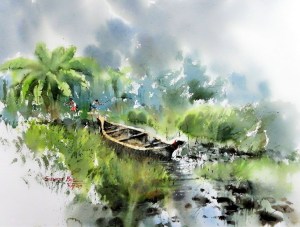
Just like the ancient humans from Africa, who entered India through the shores of Kerala, the monsoon too prefers this place to announce its arrival. It does that every year, around the first week of June. This is the time when most parts of India are suffering from unbearable heat, praying for the rains to arrive. As the first raindrop appears, there is a collective sigh of relief, as if a long-lost lover has sent you a letter. The desolation turns into hope.
The sky on every side is shrouded by rain-clouds
Which wear the beauty of deep blue lotus petals,
And here look like heaps of made-up eye-salve, and there
Possess the charm of breasts of woman with child.
Kalidasa
Once the monsoon advances into India it moves at great speed, causing large depressions, air pockets, raising storms, overrunning the last of the mango crop. And it moves at tremendous speeds. As the author notices, one morning it is at Kovalam beach, touching Trivandrum, by midnight it has moved many miles northwards over the green coastal plains of Kerala. The next day it is in Cochin, blowing through the Chinese fishing nets, first the wind bending the palm trees to its will, then the rains. Over the next few days it gathers the clouds along the way and then, one early morning, they burst over Mumbai. The journey continues all the way up to the Himalayas.
However, the book is not just about the monsoons. Frater recollects his own memories as he comes across familiar — or unfamiliar — people and places. At the same time, he paints a picture of India which is full of stories, mind-boggling stories. Once he meets a man who says, “My grandfather once planted a Langra tree but, before he could eat the fruit, he had to marry it to another tree. A tamarind. Custom decreed it.” To which another replies, “I know about that custom. The jasmine is considered a suitable bride for a mango.”
Layer by layer, Frater explores India — sometimes by having conversations with locals, sometimes through his own reflections. It’s a great lesson in how to travel in India (or anywhere), whether you are chasing the monsoon or your own spiritual calling.
 Kalampedia