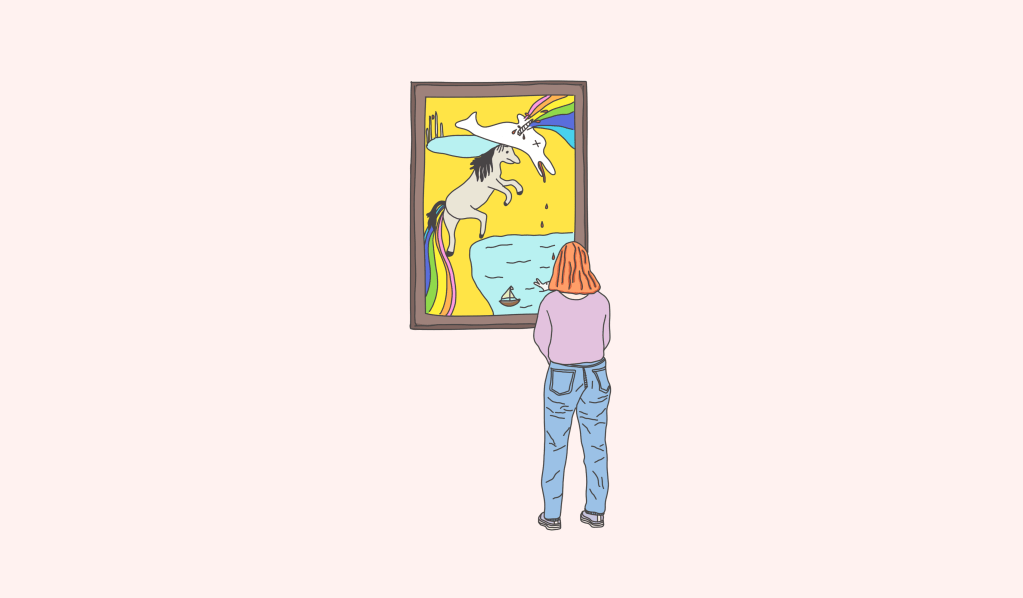
There is no such thing as ‘good art’ or ‘bad art’, you might say. That it’s all subjective. Fair enough. However, for the purpose of this discussion, let’s confine ourselves to the idea of depth in art. That is to say, on one end you have an art that barely brushes the surface of your skin, while on the other, there is something that pierces through your bones and stirs the deepest emotions within you.
The following scenarios will help illustrate the point.
Scenario 1:

You are stuck in a traffic jam and there is no end in sight. To make it sound more Whitmanesque let’s just say, “the endless trains of the faithless… keep coming… in a city filled with the foolish.” Suddenly you notice that there is a song playing on the radio. Ask yourself: what kind of music would you prefer in such a situation? Something deep and intense that brings tears to your eyes or sway every part of body with its intricate melody? Or, something casual that allows you to check your phone, chat with the person sitting next to you, etc?
Similarly, as you look outside, you see an advertisement hoarding. What kind of picture and words are you likely to find there? An abstract painting with a couple of literary verses, or something flashy with catchy slogans?
Scenario 2:

You go to an art gallery, a movie theatre, a museum or let’s say you pick a book to read in your bed. What is your expectation in this case? Would you prefer something pretentious that hardly takes a few moments of your attention while you check your phone? Or would you go for an immersive experience that connects with your emotions at a deeper level?
Bad art is here, there and everywhere
It should be obvious that inevitably we are going to find ourselves in both kinds of scenarios, which means, we are going to come across both kinds of art. (Let’s just not make too much fuss about what art is and what not, at this point, shall we?)
The trouble is, with our busy schedules (and ever-growing distractions making their way into those schedules) we are more likely to find ourselves in Scenario 1. Maybe all the time. Let’s see, how.
Since we don’t have any spare time to listen to a piece of music, perhaps we are going to enjoy it while having food, or talking to a family member, or on our way to office. There is a certain expectation here: that the music does not stand out but gets dissolved in the air of background noise. This is also what restaurants keep in mind while choosing a playlist. The prevailing music is of an astounding banality — it is there in order not to be really there. You also notice certain visuals on a TV screen, at certain restaurants. They are also just there, without adding any value, apart from acting as a background to the business of consuming things.
We are invaded by bad art all the time. And the standard explanation we are given is, it is for the average people. This concept of average people, especially prevalent among marketers, is a fraud. The person who mentions ‘average’ invariably applies it to others. He always assumes that he himself is other than average — above, preferably, but never below.
Unfortunately, this notion of the ‘average’ person has caused a deliberate cheapening and lowering of standards in all art. Anyone who has anything to do with the public conjures up a vision of an average person according to their own limitations and on this basis sets out to give people whatever is convenient. So, every time a bad artist is unable to come up with a work of genius, he often presents this lazy explanation: it will appeal to a common person.
But, is it just the artist’s fault? No, that would be unfair, as our own lifestyles too play a role in it. While we do realise that the art has the potential to shape and improve our lives, rarely do we acknowledge that it works the other way around as well.
Bad Art and its Good Price
One of the most dangerous things about bad art is that much of it is free — at least, it appears to be so. However, there is a price that we pay for it.
We are the price. Bad art desensitises us, dehumanises us, and it does so while adding superficial pleasures to our senses. It kills the very thing that makes us human. It manipulates us based on the market research and tries to impose itself on us. It has no intention to connect with us, understand us, heal us. No! It is desperate to engage in a transaction and say, “GET LOST!”
That’s quite a price, don’t you think?
Reference books:


 Kalampedia
