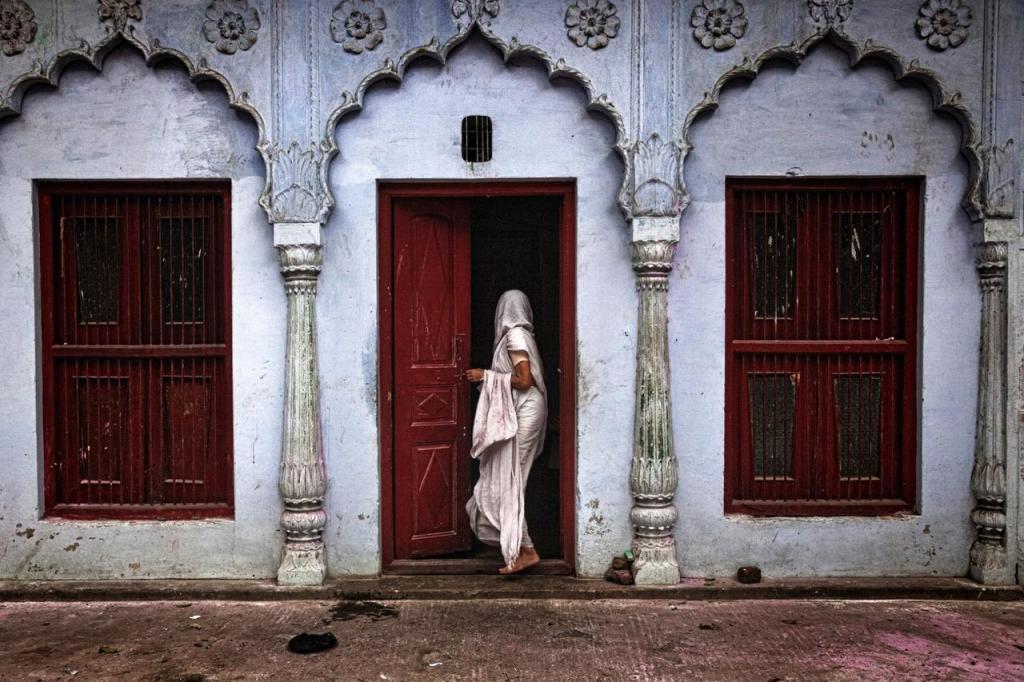
If you live in India, you probably know about it; if not, then you probably don’t. There is a city of widows in the state of Uttar Pradesh in India: Vrindavan. The place has a huge significance for Hindus; the Hindu god Krishna is said to have spent his childhood here. And it’s because of these religious underpinnings Vrindavan got its name ‘the city of widows’. William Dalrymple, notable historian and author, narrated this story in his 1998 travel book The Age of Kali which turned out to be a revelation for most of his readers outside India.
Faith in Krishna
Devout Hindus believe that Krishna is still present in this temple town. “Listen carefully in Vrindavan,” people often tell you, “for if you are attentive you can still catch the distant strains of Krishna’s flute.” Some would even suggest that in the morning the god can sometimes be glimpsed bathing at the ghats, while in the evening he is often seen walking with his lover Radha along the bank of the Yamuna river.
Every year, hundreds of thousands of Hindu devotees come to Vrindavan, making their way barefoot to the Yamuna along the parikrama which links all the town’s most holy temples and shrines. Most then head on to another neighbouring pilgrimage site: the mountain of Govardhan, which, according to legend, Krishna used as an umbrella, lifting it with his little finger. It is now not much more than a hillock, but this does not worry the pilgrims; they know the legend that the more sin proliferates in the world, the more the mountain is diminished.

Life in Vrindavan, the city of widows
Some who come to Vrindavan, however, never leave the town again. Many Hindus believe that there is nowhere more holy in all of India, and therefore that there is nowhere better to spend your final days, nowhere better to prepare for death. The pilgrims come from many different castes and communities, from amongst the rich and the poor, from north and south, but one group in particular predominates: the widows.
You notice them the minute you arrive in Vrindavan, bent-backed and white saried, with their shaven heads and outstretched begging-bowls. On their foreheads they wear the tuning-fork-shaped ash-smear that marks them out as disciples of Krishna. Some of these widows have slipped out of their homes and left their families, feeling themselves becoming an encumbrance; others have fled vindictive sons and daughters-in-law. Many have simply been thrown out of their houses.
The whole practice receives certain legitimacy in the ancient Hindu tradition that old people who have seen the birth of their grandchildren should disappear off into the forest and spend their last days in prayer, pilgrimage and fasting. In modern India the custom has largely died out, but in some parts, notable rural Bengal, a form of it has survived. Widows from all these places come to find refuge in this city which soon becomes their home.
Every day they arrive in Vrindavan. They come to seek the protection of Krishna, to chant mantras, and to meditate on their own morality. They live in great poverty. In return for hours of chanting, the principal ashram will give a widow a cupful of rice and a few rupees. Otherwise the old women, a surprising number of them from relatively wealthy, high-caste, landowning families, subsist on what they can beg. They have no privacy, no luxuries, no holidays. They simply pray until they keel over and die, while singing…
Mare Keshto rakhe ke? Rakhe Keshto mare ke?
(Whom Krishna destroys, who can save? Whom Krishna saves, who can destroy?)
Reference books:


 Kalampedia