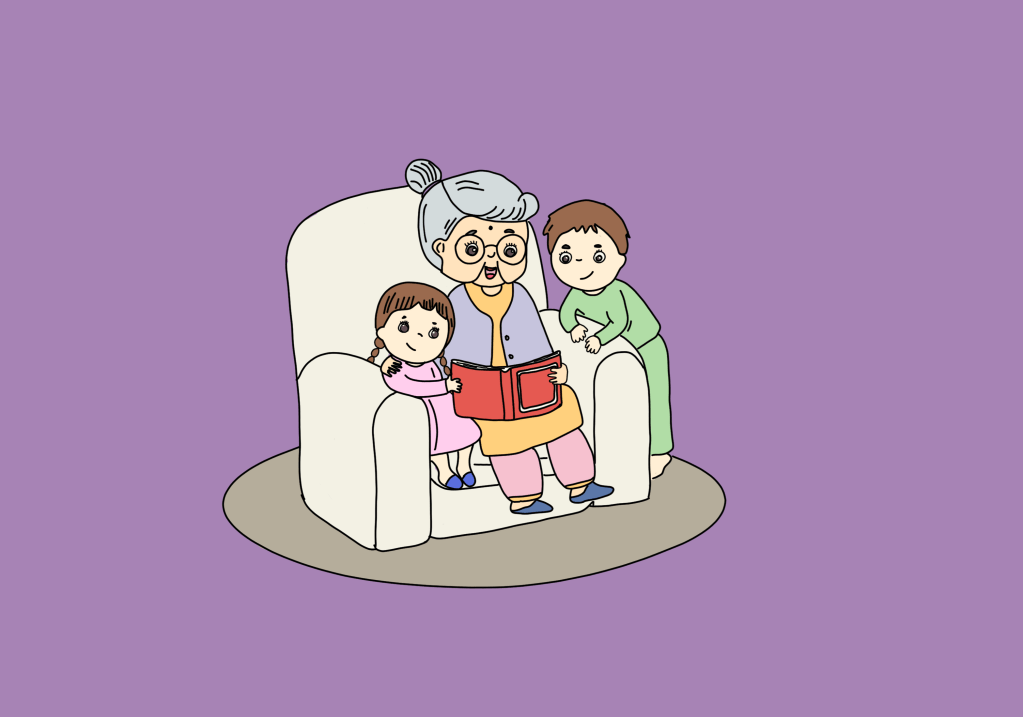
Every house needs a grandmother in it.
Louisa May Alcott
Perhaps when you were a child, when your parents and siblings were away for some reason, you spent a couple of days on your own just with your grandmother. Perhaps you noticed her unique way of cutting fruits, or telling stories, or doing ordinary things with great care. Perhaps you also helped her in the kitchen which had such a distinct smell that you can sense it even today. Speaking of grandmother and her kitchen, Ray Bradbury beautifully described its magic in his novel Dandelion Wine.
Grandma, he had often wanted to say, Is this where the world began? For surely it had begun in no other than a place like this. The kitchen, without doubt, was the center of creation, all things revolved about it; it was the pediment that sustained the temple.
Eyes shut to let his nose wander, he snuffed deeply. He moved in the hell-fire steams and sudden baking-powder flurries of snow in this miraculous climate where Grandma, with the look of the Indies in her eyes and the flesh of two warm hens in her bodice, Grandma of the thousand arms, shook, basted, whipped, beat, minced, diced, peeled, wrapped, salted, stirred.
Naturally, the details of personal experience vary enormously, but there is a charming ideal of what a grandmother is that we can imagine or piece together from fragments of memories. Maybe you did have (and remember) the above-mentioned experiences, maybe you did not, but it is quite likely that you have your own memory of her that you cannot leave behind and you don’t want to either.
A grandmother can function as what the British psychoanalyst Donald Winnicott called a transitional object. A transitional object (like a favourite blanket) stands for home, but it can also accompany the child in its early forays into the wider world. It provides an extended psychological lifeline back to maternal love and security. In its presence the child feels emotionally safe and therefore can risk experimenting with things that are at first a little frightening or alien. The grandmother is kind and gentle, and in her reassuring presence the child can start to encounter ideas that are potentially distressing: the fact that the world is very big, with a huge, complex past and filled with strangers.

There is a sweet alliance of the elderly grandmother (who is gradually becoming weaker) and the young grandchild (who is slowly becoming stronger). But at the moment, from opposite ends of the spectrum, they both understand frailty quite well. There is an open-ended tenderness in the grandmother’s attitude. Her awareness of her own short tenure on life makes her feel the preciousness of mere existence. She will probably die before the course of your adult life is established, but she is very interested in knowing how it will turn out to be.
In her company you will see the greatest wisdom that mankind has ever acquired in action. The knowledge that success is in the long run overrated, that simply being comfortable sitting next to another person watching a programme on television, or carefully watering a houseplant in the company of a small person, can be deeply important. Sadly, as you will grow into your teen years (sometimes even beyond that), you will find it boring, even irritating, but I can promise you that as you grow in years (and in wisdom), you are going to understand her value.
There is something about grandmothers that makes them unique. The parent is desperate that the child will grow up well; the lover wants to be understood; the friend wants a companion in adventure — but the grandmother doesn’t want anything from you, except your happiness. And maybe your occasional presence, especially as you grow up and move out.
Reference books:


 Kalampedia