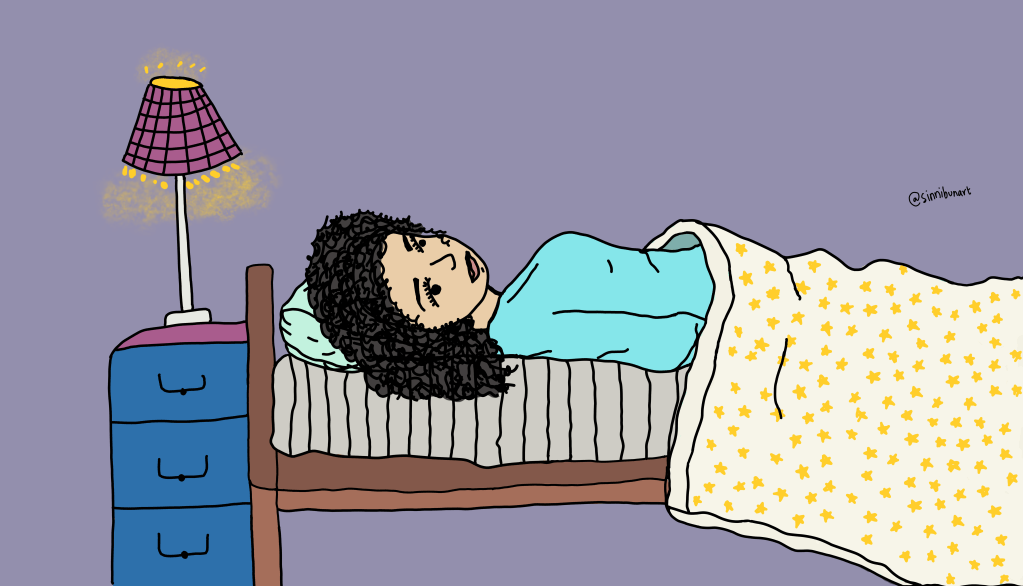
Philosophy and Insomnia are close relatives. Your inability to sleep causes you to think a little more and these thoughts in turn cause you to sleep a little less. This goes on until the truth (literally) dawns upon you that you have fallen victim to this rich man’s malady.
Philosophers are often awake at night, trying to make sense of the outside world inside the chambers of their heads. Hegel wrote in his Elements of the Philosophy of Right, “The owl of Minerva spreads its wings only with the falling of dusk.” The owl hoots at insomniacs. Of course, Hegel knew this, because he was one too. Insomniac, I mean.
But you don’t have to be a philosopher to stay awake at night. Insomnia can find you, if it wants to. Why? Nobody has been able to answer that. Steven Edward White, in his essay On Lying Awake at Night, wrote:
[Insomnia] comes from no predisposing uneasiness of indigestion, no rashness in the matter of too much tea or tobacco, no excitation of unusual incident or stimulating conversation. In fact, you turn in with the expectation of rather a good night's rest... and... snap! you are awake!

It just happens. And things get worse when you realise that it is going to be another one of those sleepless nights. This gets added to the list of thoughts, which already contains many more — from social-media notifications to the fear of mortality and what not?
A question occurs at this point. If philosophers can philosophise anything and everything, where is the philosophy of insomnia? Well,there is. In fact, there are two routes that you can take to get to the heart of the philosophy of insomnia.
Eastern philosophy
The eastern tradition understands that thinking is a natural process over which we have no control. Therefore, through meditation and reflection, it encourages us to separate ourselves from our thoughts and focus on living our lives more deeply. The practice of mindfulness helps. You don’t have to do anything but become merely an observer to your thoughts. Notice how they arise, seize control of mind and disappear on their own. One thought goes and another arises — like a train approaching and leaving the station. Often, there are gaps too. In those gaps, through meditation, for the first time you will have glimpses of no-mind, you will have the taste of no-mind. Call it taste of Zen, or Tao, or Yoga. Once there, your mind will naturally be in a state of calm.
Western philosophy
Western Philosophy also relies on meditations but they are of a different kind. Here, the underlying assumption is that a decisive share of the trouble in our minds comes from thoughts and feelings that haven’t been untangled, examined or confronted with sufficient attention. In this approach, our confused feelings and ideas are not supposed to be pushed aside but are considered valuable in terms of what they are trying to tell us. We are encouraged to not be lazy while dealing with our thoughts. Instead, we try to find a dedicated time for it and think actively — write down thoughts, assess them, maybe discuss them, and evaluate the psychological aspects of our feelings and behaviour carefully. Once we start devoting some part of our day to self-care, the quality of our lives improves dramatically.
However, what if neither works?
In that case, you can find some comfort in Leonard Cohen’s famous line: the last refuge of the insomniac is a sense of superiority to the sleeping world. That should work!
Reference books:


 Kalampedia