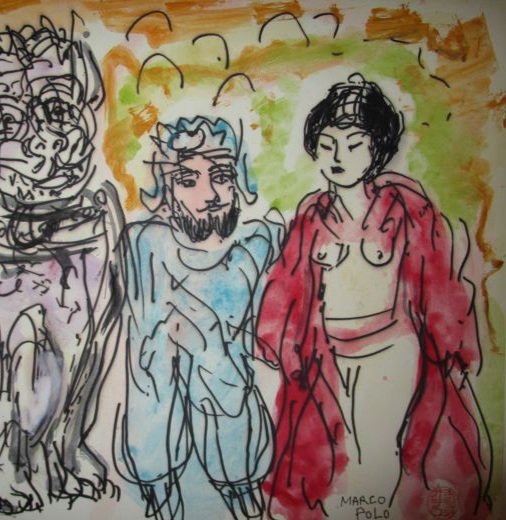
If you expected this article to be on Marco Polo, the fashion brand, and its latest travel collection for women, apologies are in order. A day may come when we fail our readers and start promoting brands on Kalampedia, but in the words of Aragorn from The Lord of the Rings, “It is not this day.”
We are talking about Marco Polo, the Venetian merchant, explorer, and writer who travelled through Asia along the Silk Road between 1271 and 1295. His accounts, written down by a 13th-century writer called Rustichello da Pisa, have been published as a book titled The Travels of Marco Polo. In this book, we come across a number of cultural shocks that Marco Polo experienced during his travels in the east. One of them is regarding the kind of life women lived in different cultures.
Tibetan women puzzled him
Let’s start by saying that Marco Polo liked women. He called Kashmiri women ‘very beautiful’ and those on the Afghan border, ‘beautiful beyond measure’. In Tibet, however, he noticed a strange practice which he could not make sense of. Here, the old women would ply strangers with girls, because sexual experience was valued by future husbands. He says:
People travelling that way, when they reach a village or hamlet or other inhabited place, shall find perhaps 20 or 30 girls at their disposal. And if the travellers lodge with those people they shall have as many young women as they could wish coming to court them. The traveller is expected to give the girl who has been with him a ring or some other trifle, something in fact that she can show as a lover's token... for every girl is expected to obtain at least 20 such tokens before she can get married. And those who have the most tokens, and so can show they have been most run after, are in the high-esteem, and most sought in marriage.

It was very much the same in Sichuan, where men offered their wives, daughters or sisters.
The stranger abides in the catiff's house, be it three days or be it four, enjoying himself with the fellow's wife or daughter or sister, or whatsoever woman of the family best likes him; and as long as he abides there he leaves his hat or some other token hanging at the door, to let the master of the house know that he is still there.
Marco Polo talked about Hangzhou too, which he suggested was notorious for its prostitutes.
Courtesans thronged the streets in such a number that I dare not say what it is. They are found not only in the vicinity of the market places, but all over the city. They exhibit themselves splendidly attired and abundantly perfumed, in finely garnished houses, with trains of waiting women.

These women are extremely accomplished in all the arts of allurement, and readily adapt their conversations to all sorts of persons, insomuch that strangers who have once tasted their attractions seem to get bewitched, and are so taken with their blandishments and their fascinating ways that they can never get these out of their heads.
Upper-class Chinese women piqued his curiosity
As established, Marco was a lover of women, in whatever form. He had a deep interest, perhaps a personal one, in upper-class Chinese women. He warmed to them precisely because they were not like the Mongol and Tibetan girls or those plying their trade on the streets of Hangzhou.
He wished to break into this enclosed world of China, and somehow did, apparently learning a good deal about the private lives of Chinese girls. What he learnt there was no less shocking either.
Chinese girls were expected to be virgins at marriage, which was not true of Mongol girls. First, the future husband and father would agree on terms. Then there was a test of virginity, which involved a procedure that was both odd and unique. It was conducted by ‘certain matrons specially deputed for this duty who will first examine the girl’s virginity with a pigeon’s egg’. An egg having been procured, it was used to see whether entry was possible. If the egg broke, then the confirmation was made.
But… this is just a small part of Marco Polo’s travels. As he himself admitted, “I did not write half of what I saw, for I knew I would not be believed.” So, you can only imagine all that he actually saw and experienced.
Reference books


 Kalampedia
