
It’s not rare to see a prophecy mentioned in a book coming true. Getting hold of a book which predicts future events with pinpoint accuracy feels exciting too. (Except when these events include wars and violent conflicts, in which case, we regret and wonder why we didn’t read it earlier.) This is precisely the case with George Friedman’s The Next 100 Years. In this book, Friedman attempts to predict the major geopolitical events and trends of the 21st century. It was first published in 2009 and since then its predictions have become more and more relevant with each passing year.
Let’s talk about Friedman’s view on the Russian conflict that we are witnessing today. In the chapter on Russia, he argues that the Russian Question remains unresolved and so it will lead to conflicts.
What do we mean by the Russian Question here?
In geopolitics major conflicts repeat themselves. France and Germany, for example, fought multiple wars, as did Poland and Russia, or India and Pakistan. When a single war does not resolve an underlying geopolitical issue, the successive conflicts are quite inevitable. Coming to Russia, the country has clashed with the rest of Europe on multiple occasions. The Napoleonic Wars, the two World Wars and the Cold War — all dealt at least in part with the status of Russia and its relationship with the rest of the Europe.
The question then becomes: if Russia is a united nation-state, where will its frontiers lie and what will be the relationship between Russia and its neighbours?
This is the Russian Question. Unfortunately, none of the above mentioned wars have been able to settle this. Which means, there will be more, including the one we are seeing right now in Ukraine. To understand it better, let’s try to see the two sides of this conflict: Europe and Russia.
What Europe fears?
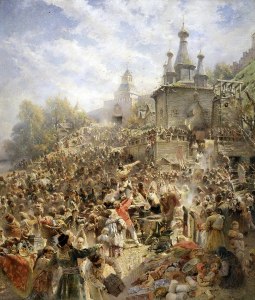
The very existence of a united Russia (in one form or the other) poses a threat to Europe. Russia is a vast region with a significant population. It is much poorer than the rest of Europe, but it has two assets: land and natural resources. As such it is a constant temptation to the European powers which see an opportunity to increase their size and wealth to the east. Interestingly, Russia sees the same opportunity in the west, and hence the fear.
The other problem that Europe faces is the one recently created by Russia. Because of its limited infrastructure and technology, Russia relies heavily on the oil and gas exports to build its economy. This has created Europe’s energy dependency on Russia. Therefore, on the one hand, Europe would like to expand its influence in the east (through NATO and EU), it cannot afford to have a major crisis in Russia. This puts additional pressure on the European powers while dealing with Russian misadventures.
What Russia fears?

To answer this question we have to understand where Russia’s vulnerabilities lie. According to Friedman, Russia’s main weakness is its borders, particularly in the north-west. He elaborates this point further.
Even when Ukraine is controlled by Russia, as it has been for centuries, and Belarus and Moldova are a part of the Russian empire as well, there are still no natural borders in the north... On the northern European plane, no matter where Russia's borders are drawn, it is open to attack.
How would Russia respond to these fears?

Russia would turn to its strengths, Friedman suggests. The only physical advantage Russia can have in this situation is geographical depth. The farther west into Europe its borders extend, the farther conquerors have to travel to reach Moscow. Therefore, Russia is always pressing westward on the northern European plane, as Europe is always pressing eastward.
A geographically-insecure Russia would look to strengthen its military. Then it would need bufferzones to protect itself from the rest of the world. And then, bufferzones for the bufferzones. Russia’s grand strategy would involve the creation of deep-buffers along the northern-European plane while it divides and manipulates its neighbours. This would create a new regional balance of power in Europe. What Russia cannot tolerate are tight borders without bufferzones and its neighbours united against it. This is why Russia’s future (even present) actions might appear to be aggressive but are actually defensive.
Friedman lays out a three-phase approach in which Russia will unfold its actions by 2020.
In the first phase Russia will be concerned with recovering influence and effective control in the former Soviet Union, creating this system of buffers that the Soviet Union provided it. In the second phase Russia will seek to create the second tier of buffers, beyond the boundaries of the former Soviet Union. It will try to do this without creating a solid wall of opposition, the kind that choked it during the Cold War. In the third phase Russia will try to prevent anti-Russia coalitions from forming.
In the light of the above analysis it becomes clear why Russia is so sensitive about its borders as well as about the prospects of its neighbours joining NATO. The threat was always looming, it’s just that we missed the book.
Reference books:


 Kalampedia