
In the previous post we covered till around 1200 BC in the history of the Middle East. We learnt that Phoenicians escaped from Egypt and invaded the land of Canaan from the east. They seized Jericho and gradually subdued its settled population in the hills. But they had to contend with a new wave of invaders from across the Mediterranean. Who were they? Let’s find out in the second part of the history of the Middle East series.
The Philistines

The Philistines invaded and settled on the coastal plain, giving their name to the region: Palastine (falastin in Arabic). The struggle ebbed and flowed until David, King of israel, united the Hebrew tribes, captured the Jebusite town of Jerusalem and made it his capital. There his son Solomon built the first Jewish temple.
The Jewish Story
The Kingdom of Israel lasted some two centuries before it split into two — the Kingdoms of Israel and Judah. In about 720 BC the newest great power from northern Iraq — the Assyrians — overran the two little Jewish states and caused them to disappear. From then on there was never an independent Jewish state until the twentieth century. It must be noted, however, that the Jews had a degree of autonomy in the Maccabean kingdom (166–163 BC) and its successor, the House of Herod. When the Jews rebelled against the Roman Empire in AD 70, the Emperor Titus destroyed Jerusalem. Their final revolt was put down by Hadrian in AD 135 and the Jews were scattered; only a few thousand remained in Galilee. Was this the end for the Jewish story? With the benefit of the hindsight, we know now, it was not.
The Jews stood apart from the other peoples who invaded and settled in Syria and Palestine in two important respects. One was that in general they did not intermarry and assimilate with the other peoples of religion. The other was their religious genius, which produced the first of the three great monotheistic faiths. The Ten Commandments and the Judaic legal code which derives from them were by far the highest system of morality to be developed in that region before the coming of Christ.
A Land of Invasions
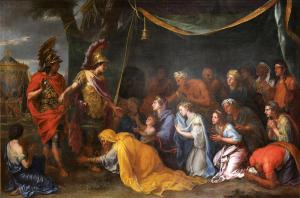
From about the end of the ninth century BC, the character of the invasions of Syria and Palestine began to change. It was now less a matter of migrating peoples seeking a better place in which to settle than of great powers aiming to conquer and impose their rule over the existing inhabitants.
The Assyrians, who had their capital at Ninevah near Mosul in modern Iraq, first appeared in Syria in about 1100 BC. It was their King Shalamaneser III (859–824 BC) who founded the Assyrian Empire, which lasted for more than two centuries and finally conquered Egypt.
The Assyrians were in turn defeated and overthrown by the Chaldean dynasty of Babylon. In 597 BC their King Nebuchadnezzar took Jerusalem. But the Chaldean Empire was short lived. Further east, in present-day Iran, a new and dynamic state was formed by the uniting of Medes and Persians. Their King Cyrus II — ‘the Great’ — reigned from 559 to 530 BC and founded his empire. This covered the whole of western Asia in the modern Middle East and more, from the Indus river to the Aegean Sea and the borders of Egypt.
In 525 BC the successors of Cyrus conquered Egypt. This meant that for the Egyptians two thousand years of foreign rule had begun.
The Persians were then masters of the whole civilised world of the time, apart from China. In the western province of Syria and Palestine, Aramaic was the official language. Administration was efficient, roads were built and taxes were collected regularly. The region enjoyed two hundred years of peace and prosperity.
The local indigenous population was a meltingpot of races. Non-Semites (from north and west) and Semites (from west) found a home here. The Arabs are first mentioned in Assyrian inscriptions of about 850 BC as a nomadic people of the north Arabian desert. They paid their tribute to their Assyrian overlords in the form of camels.
It was many centuries before the whole Middle Eastern and North african region became Arabised. In 336 BC Philip, King of Macedon, united the warring Greek city-states and it was his son Alexander who launched the astonishing series of conquests overthrew the Persian Empire. This was the beginning of a thousand years of Graeco-Roman civilisation on the eastern and southern shores of the Mediterranean. More on that and the next part of our history of the Middle East series.
Reference books:


 Kalampedia