
Literature — it plucks your heartstrings, tickles you in the strangest of the places, and in the end, leaves you craving for more. A reader will understand what it means, to lie-down on soft, curly grass, underneath winter’s sun and… read a book. We all have had the moments of ecstasy when a book (or a passage) pleasured all our senses and put us in a state of ‘awe’.
If you’ve had such experience, then read on; if not, then all the more reasons to read on. In this post, we are sharing some of the most beautiful literary passages written in the last one hundred years.
The Hobbit

First one is from The Hobbit. This is also the first passage of the book. It shows how simply and beautifully you can describe a world that does not exist in reality. This particular passage, and the ones that follow in the book, are written in such a way as if one were sitting next to a fireplace and telling a folktale to a child.
In a hole in the ground there lived a hobbit. Not a nasty, dirty, wet hole, filled with the ends of worms and an oozy smell, nor yet a dry, bare, sandy hole with nothing in it to sit down on or to eat: it was a hobbit-hole, and that means comfort.
It had a perfectly round door like a porthole, painted green, with a shiny yellow brass knob in the exact middle. The door opened on to a tube-shaped hall like a tunnel: a very comfortable tunnel without smoke, with panelled walls, and floors tiled and carpeted, provided with polished chairs, and lots and lots of pegs for hats and coats—the hobbit was fond of visitors. The tunnel wound on and on, going fairly but not quite straight into the side of the hill—The Hill, as all the people for many miles round called it—and many little round doors opened out of it, first on one side and then on another. No going upstairs for the hobbit: bedrooms, bathrooms, cellars, pantries (lots of these), wardrobes (he had whole rooms devoted to clothes), kitchens, dining-rooms, all were on the same floor, and indeed on the same passage. The best rooms were all on the left-hand side (going in), for these were the only ones to have windows, deep-set round windows looking over his garden, and meadows beyond, sloping down to the river.
Animal Farm
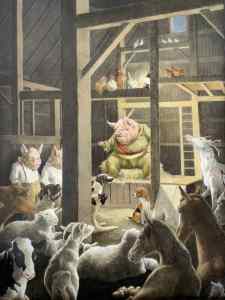
Animal Farm is a brilliantly written novella. This political satire makes you laugh in every alternate sentence while reflecting on the events that led to the Russian revolution. The passage below explains the turn around in the whole situation.
There was a deadly silence. Amazed, terrified, huddling together, the animals watched the long line of pigs march slowly round the yard. It was as though the world had turned upside-down. Then there came a moment when the first shock had worn off and when, in spite of everything–in spite of their terror of the dogs, and of the habit, developed through long years, of never complaining, never criticising, no matter what happened–they might have uttered some word of protest. But just at that moment, as though at a signal, all the sheep burst out into a tremendous bleating of–
"Four legs good, two legs better! Four legs good, two legs better! Four legs good, two legs better!"
It went on for five minutes without stopping. And by the time the sheep had quieted down, the chance to utter any protest had passed, for the pigs had marched back into the farmhouse.
Benjamin felt a nose nuzzling at his shoulder. He looked round. It was Clover. Her old eyes looked dimmer than ever. Without saying anything, she tugged gently at his mane and led him round to the end of the big barn, where the Seven Commandments were written. For a minute or two they stood gazing at the tatted wall with its white lettering.
"My sight is failing," she said finally. "Even when I was young I could not have read what was written there. But it appears to me that that wall looks different. Are the Seven Commandments the same as they used to be, Benjamin?"
For once Benjamin consented to break his rule, and he read out to her what was written on the wall. There was nothing there now except a single Commandment.
It ran: ALL ANIMALS ARE EQUAL BUT SOME ANIMALS ARE MORE EQUAL THAN OTHERS
One Hundred Years of Solitude

If one were to choose a book on magical realism, it would be hard to ignore One Hundred Years of Solitude. A remarkable thing about Gabriel Garcia Marquez’s writing is that he puts so much weight in every word and every sentence that you cannot help but surrender yourself to his spell.
On rainy afternoons, embroidering with a group of friends on the begonia porch, she would lose the thread of the conversation and a tear of nostalgia would salt her palate when she saw the strips of damp earth and the piles of mud that the earthworms had pushed up in the garden. Those secret tastes, defeated in the past by oranges and rhubarb, broke out into an irrepressible urge when she began to weep. She went back to eating earth. The first time she did it almost out of curiosity, sure that the bad taste would be the best cure for the temptation. And, in fact, she could not bear the earth in her mouth. But she persevered, overcome by the growing anxiety, and little by little she was getting back her ancestral appetite, the taste of primary minerals, the unbridled satisfaction of what was the original food. She would put handfuls of earth in her pockets, and ate them in small bits without being seen, with a confused feeling of pleasure and rage, as she instructed her girl friends in the most difficult needlepoint and spoke about other men, who did not deserve the sacrifice of having one eat the whitewash on the walls because of them. The handfuls of earth made the only man who deserved that show of degradation less remote and more certain, as if the ground that he walked on with his fine patent leather boots in another part of the world were transmitting to her the weight and the temperature of his blood in a mineral savor that left a harsh aftertaste in her mouth and a sediment of peace in her heart.
Midnight’s Children
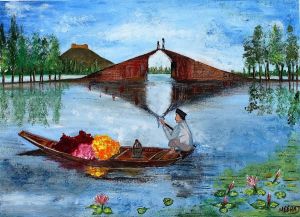
Midnight’s Children won the prestigious Man Booker prize. It won the best of the Booker too, twice actually. Surely, the book (or its author Salman Rushdie) needs no introduction. This passage has been taken from the first chapter of the book where the protagonist Saleem Sinai talks about his family’s roots in Kashmir.
One Kashmiri morning in the early spring of 1915, my grandfather Aadam Aziz hit his nose against a frost-hardened tussock of earth while attempting to pray. Three drops of blood plopped out of his left nostril, hardened instantly in the brittle air and lay before his eyes on the prayer-mat, transformed into rubies. Lurching back until he knelt with his head once more upright, he found that the tears which had sprung to his eyes had solidified, too; and at that moment, as he brushed diamonds contemptuously from his lashes, he resolved never again to kiss earth for any god or man. This decision, however, made a hole in him, a vacancy in a vital inner chamber, leaving him vulnerable to women and history. Unaware of this at first, despite his recently completed medical training, he stood up, rolled the prayer-mat into a thick cheroot, and holding it under his right arm surveyed the valley through clear, diamond-free eyes.
...
To reveal the secret of my grandfather's altered vision: he had spent five springs, away from home. (The tussock of earth, crucial though its presence was as it crouched under a chance wrinkle of the prayer-mat, was at bottom no more than a catalyst.) Now, returning, he saw through travelled eyes. Instead of the beauty of the tiny valley circled by giant teeth, he noticed the narrowness, the proximity of the horizon; and felt sad, to be at home and feel so utterly enclosed. He also felt—inexplicably—as though the old place resented his educated, stethoscoped return. Beneath the winter ice, it had been coldly neutral, but now there was no doubt; the years in Germany had returned him to a hostile environment. Many years later, when the hole inside him had been clogged up with hate, and he came to sacrifice himself at the shrine of the black stone god in the temple on the hill, he would try and recall his childhood springs in Paradise, the way it was before travel and tussocks and army tanks messed everything up.
Beatrice and Virgil

It would be unfair if we do not include any passage from the twenty first century. So, here we are, and the book is called Beatrice and Virgil, written by Yann Martel. In this book, when Beatrice asks Virgil about the pears (as Beatrice has no idea what they look like or feel like), Virgil goes ahead and explains everything about the pears. The conversation continues for a while, creating beautiful imagery.
(Virgil and Beatrice are sitting at the foot of the tree. They are looking out blankly. Silence.)

BEATRICE: What does a pear taste like?
VIRGIL: Wait. You must smell it first. A ripe pear breathes a fragrance that is watery and subtle, its power lying in the lightness of its impression upon the olfactory sense. Can you imagine the smell of nutmeg or cinnamon?
BEATRICE: I can.
VIRGIL: The smell of a ripe pear has the same effect on the mind as these aromatic spices. The mind is arrested, spellbound, and a thousand and one memories and associations are thrown up as the mind burrows deep to understand the allure of this beguiling smell — which it never comes to understand, by the way.
BEATRICE: But how does it taste? I can’t wait any longer.
VIRGIL: A ripe pear overflows with sweet juiciness.
BEATRICE: Oh, that sounds good.
VIRGIL: Slice a pear and you will find that its flesh is incandescent white. It glows with inner light. Those who carry a knife and a pear are never afraid of the dark.
BEATRICE: I must have one.
VIRGIL: The texture of a pear, its consistency, is yet another difficult matter to put into words. Some pears are a little crunchy.
BEATRICE: Like an apple?
VIRGIL: No, not at all like an apple! An apple resists being eaten. An apple is not eaten, it is conquered. The crunchiness of a pear is far more appealing. It is giving and fragile. To eat a pear is akin to . . . kissing.
BEATRICE: Oh, my. It sounds so good.
VIRGIL: The flesh of a pear can be slightly gritty. And yet it melts in the mouth.
BEATRICE: Is such a thing possible?
VIRGIL: With every pear. And that is only the look, the feel, the smell, the texture. I have not even told you of the taste.
BEATRICE: My God!
VIRGIL: The taste of a good pear is such that when you eat one, when your teeth sink into the bliss of one, it becomes a wholly engrossing activity. You want to do nothing else but eat your pear. You would rather sit than stand. You would rather be alone than in company. You would rather have silence than music. All your senses but taste fall inactive. You see nothing, you hear nothing, you feel nothing — or only as it helps you to appreciate the divine taste of your pear.
BEATRICE: But what does it actually taste like?
VIRGIL: A pear tastes like, it tastes like . . . (He struggles. He gives up with a shrug.) I don’t know. I can’t put it into words. A pear tastes like itself.
BEATRICE: (sadly) I wish you had a pear.
VIRGIL: And if I had one, I would give it to you.
(Silence.)
Hope you enjoyed reading these beautiful literary passages. Let us know about your favourite ones.
 Kalampedia