
Recently, there has been a lot of talk about Hijab and whether or not it is an integral part of Islam. To answer this question, we need to go back to the holy scripture of Muslims – The Quran. To understand the need and validity of Hijab, we should start with the specific Quranic verse [24:31] which specifically tells women what they should wear.
“And tell the believing women to reduce [some] of their vision and guard their private parts and not expose their adornment except that which [necessarily] appears thereof and to wrap [a portion of] their headcovers over their chests and not expose their adornment except to their husbands, their fathers, their husbands’ fathers, their sons, their husbands’ sons, their brothers, their brothers’ sons, their sisters’ sons, their women, that which their right hands possess, or those male attendants having no physical desire, or children who are not yet aware of the private aspects of women. And let them not stamp their feet to make known what they conceal of their adornment. And turn to Allah in repentance, all of you, O believers, that you might succeed.”
THE QURAN [24:31]
The Interpretation of the Verse [24:31]

The Quran uses the word ‘Khamar’ in Arabic to refer to a headscarf — that which covers your head. The word Khamar comes from a root word which means ‘to cover something’. It is similar to the Arabic word Kha’mir which is the word for alcohol, as alcohol impairs one’s intellect — one cannot think straight while under the influence of alcohol, as it creates a barrier between the mind and the power of speech and reasoning.
God says, ‘Tell the believing women to wear their Khomar (plural for Khamar) over their bosom. It is meant to throw their shawl over and cover their chest area. So, in addition to covering one’s chest, the head should be covered too. Therefore, the basic essentials of the Khamar dictate that the hair be covered and that a cloth cover the chest. Whereas generally speaking, the women of the days of the Prophet would wear headscarves, some of them would expose their chest area. So, in that context, they were commanded to cover the chest as well.
In addition to covering the head, neck and chest area, God instructs the believing women to throw unto themselves a Jilbab. It is a loose outer garment which conceals their body shape. This is in reference to a situation when a Muslim woman leaves her home or is in the presence of non-Mahram.
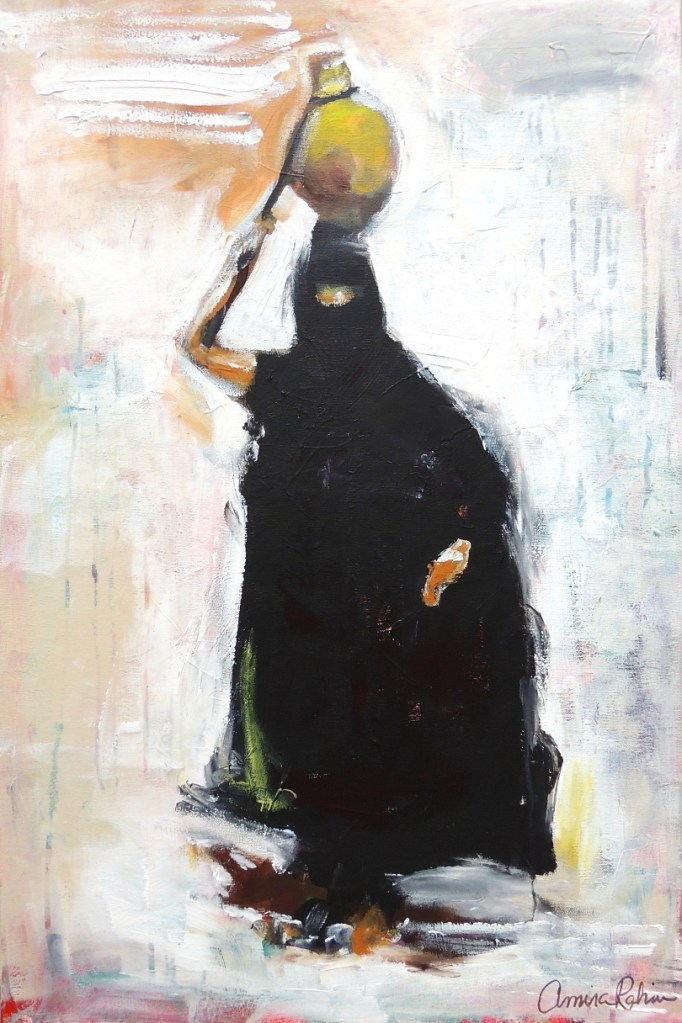
“O Prophet, tell your wives and your daughters and the women of the believers to bring down over themselves [part] of their garments. That is more suitable that they will be known and not be abused. And ever is Allah Forgiving and Merciful.”
THE QURAN [33:59]
Because these verses in The Quran are very explicit and direct, no disagreements or disputes have been posed to this edict. The primary reason as to why a Muslim woman wears the Hijab can be attributed to her faith. She is supposed to worship God and live her life according to the instructions given by him. Wearing a Hijab is an act of righteousness and obedience. And she does so to seek and gain the pleasure of the almighty.
It is the core teaching of Islam that whatever God instructs, one should follow. One may or may not understand the logic right away, but one must follow it nevertheless. A Muslim woman trusts God and believes that God knows whatever is best for her. And only when she submits to God and obeys His commands, does she start to feel the tranquility of life.
Reference books:


 Kalampedia