
Al-Hassan ibn-Muhammad al-Wazzan al-Fasi, better known as Leo Africanus, was probably born in the 1460s in Granada, the last Muslim toehold in Spain. He was then raised in Fez (modern Morocco), where his family migrated in the face of mounting Spanish military pressure. Educated in Islamic law, he entered the service of the Sultan of Fez, who sent him on a number of commercial and diplomatic missions, including two trips across sub-Saharan West Africa. Captured by Christian pirates and brought to Rome in 1518, he was presented as a slave to Pope Leo X, who persuaded him to accept Christianity and a new name, Giovanni Leon (John Leo), a name that would closely be associated with African history for centuries to come.

While in Rome in 1526 John Leo completed in Italian his History and Description of Africa, probably based on an earlier Arabic version. It recounts his observations during his travels in Africa north of the equator and became a principal source of European knowledge of the region. Because of this work, he became known as Leo Africanus, Latin for Leo the African. Little is known about the rest of his life except that sometime after 1530 he returned to Africa and died as a Muslim in Tunis around 1554.
In the following excerpts, Leo describes several states he visited in the western part of the Sudan, the extensive grass-covered plain that stretches across Africa south of the Sahara:
The Kingdom of Mali
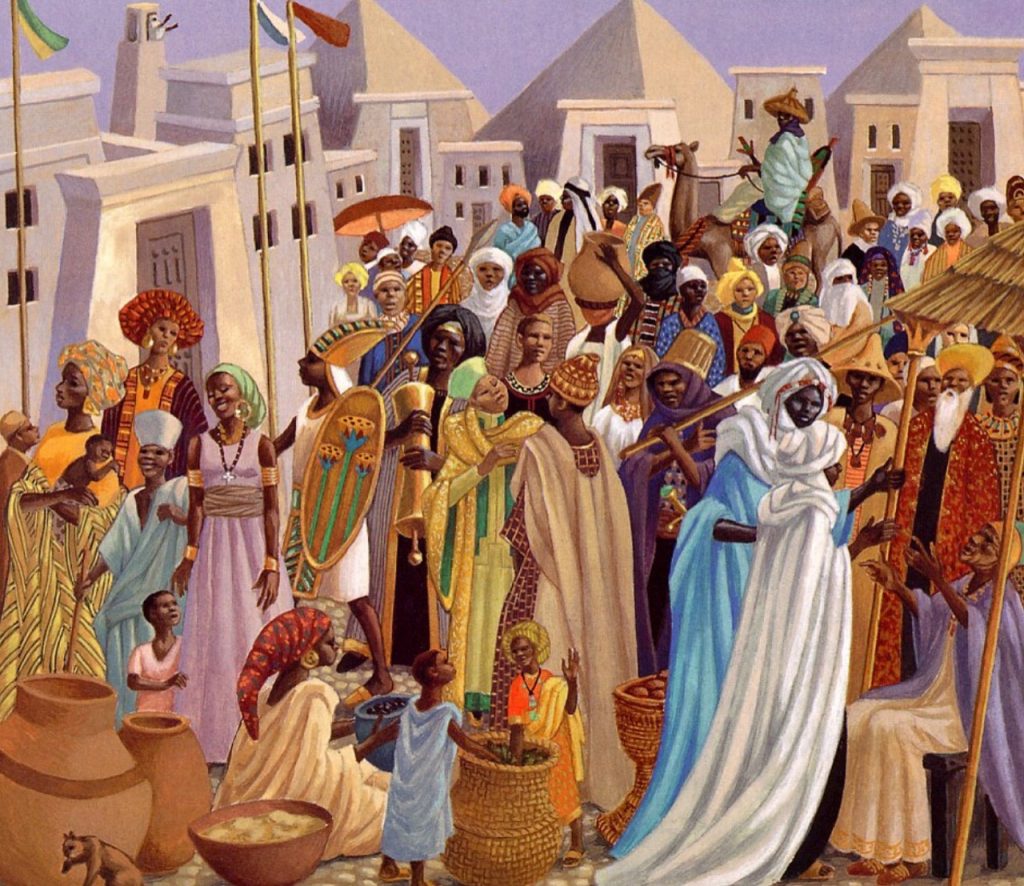
In this kingdom there is a large and ample village containing more than six thousand families, and named Mali, which is also the name of the whole kingdom. Here the king has his residence. The region itself yields great abundance of wheat, meat and cotton. Here are many craftsmen and merchants in all places: and yet the king honourably entertains all strangers. The inhabitants are rich and have plenty of merchandise. Here is a great number of temples, clergymen and teachers, who read their lectures in the mosques because they have no colleges at all. The people of the region excel all other Negroes in wit, civility and industry, and were the first that embraced the law of Muhammad.
The City of Timbuktu

All its houses are… cottages, built of mud and covered with thatch. However, there is a most stately mosque to be seen, whose walls are made of stone and lime, and a princely palace also constructed by the highly skilled craftsmen of Granada. Here there are many shops of artisans and merchants, especially of those who weave linen and cotton, and here Barbary merchants bring European cloth. The inhabitants, and especially resident aliens, are exceedingly rich, since the present king married both of his daughters to rich merchants. This region yields great quantities of grain, cattle, milk and butter, but salt is very scarce here, for it is brought here by land from Tegaza, which is five hundred miles away. When I was there, I saw one camel-load of salt sold for eighty ducats.
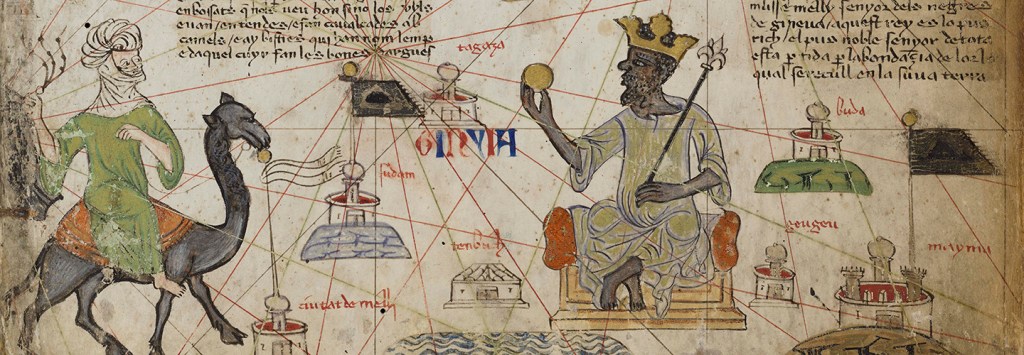
The rich king of Timbuktu has many plates and scepters of gold, some of which weigh 1,300 pounds, and he keeps a magnificent and well-furnished court. When he travels anywhere, he rides upon a camel, which is led by some of his noblemen. He does so likewise when going to war, and all his soldiers ride upon horses. Whoever wishes to speak to this king must first of all fall down before his feet and then taking up earth must sprinkle it on his own head and shoulders. The king always has under arms 3,000 horsemen and a great number of foot soldiers who shoot poisoned arrows. They often skirmish with those who refuse to pay tribute and whomever they capture they sell to the merchants of Timbuktu. Here very few horses are bred… Their best horses are brought out of North Africa.
Here are great numbers of religious teachers, judges, scholars and other learned persons, who are bountifully maintained at the king’s expense. Here too are brought various manuscripts or written books from Barbary, which are sold for more money than any other merchandise.
The coin of Timbuktu is gold, without any stamp or inscription, but in matters of small value they use certain shells from the Kingdom of Persia. Four hundred of these are worth a ducat, and six pieces of Timbuktu’s golden coin weigh two-thirds of an ounce.
The inhabitants are gentle and cheerful and spend a great part of the night in singing and dancing throughout the city streets. They keep large numbers of male and female slaves, and their town is greatly vulnerable to fire…
The Town and Kingdom of Gao
Here are very rich merchants and to here journey continually large numbers of Negroes who purchase here cloth from Barbary and Europe. The town abounds in grain and meat but lacks wine, trees and fruits. However, there are plenty of melons, lemons and rice. Here there are many wells, which also contain very sweet and wholesome water. Here also is a certain place where slaves are sold, especially upon those days when merchants assemble. A young slave of fifteen years of age is sold for six ducats, and children are also sold.
The king of this region has a certain private palace in which he keeps a large number of concubines and slaves, who are watched by eunuchs. To guard his person he maintains a sufficient troop of horsemen and foot soldiers. Between the first gate of the palace and the inner part, there is a walled enclosure wherein the king personally decides all of his subjects’ controversies. Although the king is most diligent in this regard and conducts all business in these matters, he has in his company counsellors and such other officers as his secretaries, treasurers, stewards and auditors.
It is a wonder to see the quality of merchandise that is daily brought here and how costly and sumptuous everything is. Horses purchased in Europe for ten ducats are sold here for forty and sometimes fifty ducats apiece. There is no European cloth so coarse as to sell for less than four ducats an ell. If it is anywhere near fine quality, they will give fifteen ducats for an ell, and an ell of the scarlet of Venice or of Turkish cloth is here worth thirty ducats. A sword is here valued at three or four crowns, and likewise are spears, bridles and similar commodities, and spices are all sold at a high rate. However, of all other items, salt is the most expensive.
The rest of this kingdom contains nothing but villages and hamlets inhabited by herdsmen and shepherds, who in winter cover their bodies with the skins of animals, but in summer they go naked, save for their private parts. They are ignorant and rude people, and you will scarcely find one learned person in the square of a hundred miles. They are continually burdened by heavy taxes; to the point that they scarcely have anything left on which to live.
The Kingdom of Bornu
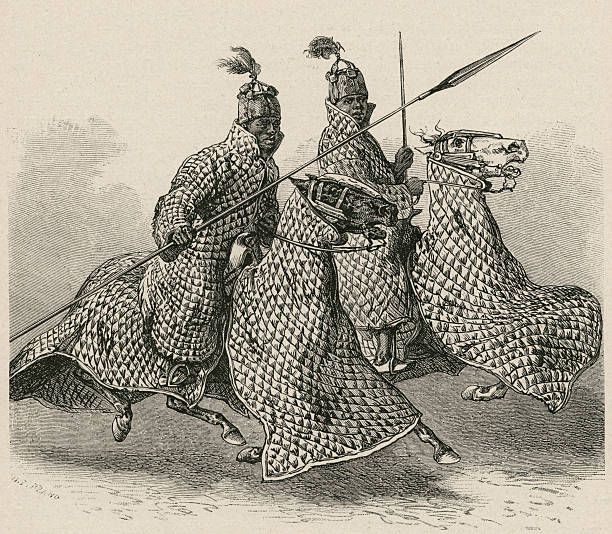
They have the most powerful prince… He has in readiness as many as three thousand horsemen and a huge number of foot soldiers; for all his subjects are so obedient to him, that whenever he commands them, they will arm themselves and follow him wherever he leads them. They pay him no tribute except tithes on their grain; neither does the king have any revenues to support his state except the spoils he gets from his enemies by frequent invasions and assaults.
He is in a state of perpetual hostility with a certain people who live beyond the desert of Seu, who in times past marching with a huge army of foot soldiers over the said desert, devastated a great part of the Kingdom of Bornu. Whereupon the king sent for the merchants of Barbary and ordered them to bring him a great store of horses; for in this country they exchange horses for slaves, and sometimes give fifteen or twenty slaves for a horse. And by this means there were a great many horses bought although the merchants were forced to stay for their slaves until the king returned home as a conqueror with a great number of captives, and satisfied his creditors for his horses.
Frequently it happens that the merchants must stay three months before the king returned from the wars. Sometimes he does not bring home enough slaves to satisfy the merchants and sometimes they are forced to wait a whole year. And yet the king seems marvelously rich, because his spurs, bridles, platters, dishes, pots and other vessels are made of gold. The king is extremely covetous and would rather pay his debts in slaves rather than gold.
Reference books:


 Kalampedia