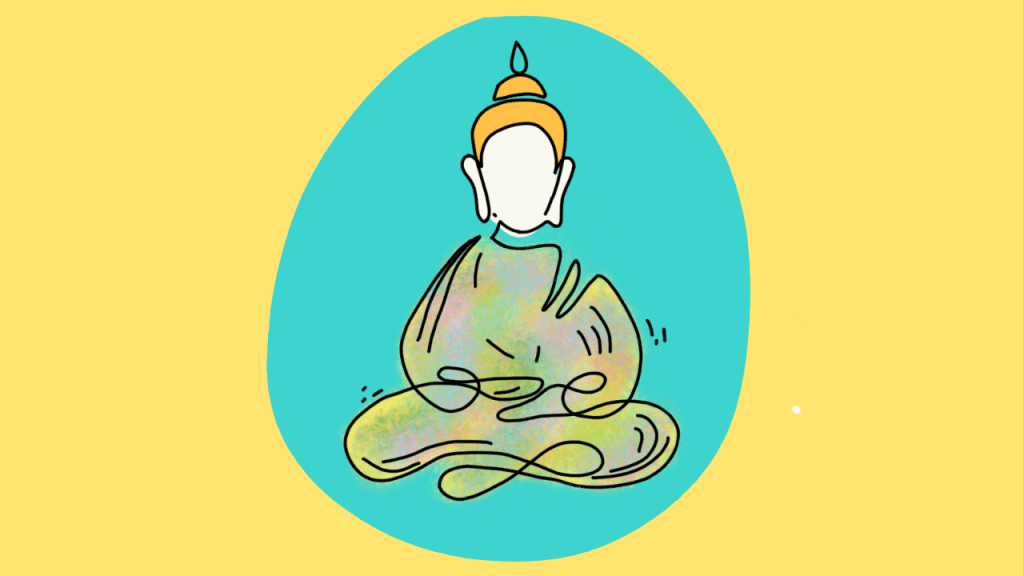
The monk Gautama awoke in the morning to the sound of birds singing. He was covered with dirt and dust, and his robe was so tattered and threadbare it no longer covered his body. He remembered seeing a corpse in the cemetery the day before, and he guessed that today or tomorrow people would lift it down to the river to perform the cremation ceremony, and the brick-coloured cloth that covered it would no longer be needed. He approached the corpse and, reflecting quietly on birth and death, respectfully removed the cloth from the body. Gautama would use the brick-coloured cloth as a new robe.
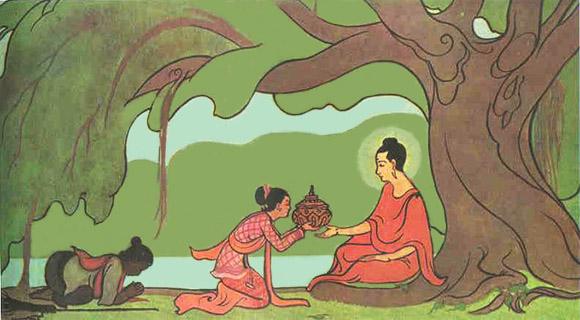
He set out for the village of Uruvela, but before he had walked even half-way, his strength failed him, and unable to catch his breath, he collapsed. He lay unconscious for some time before a young girl from the village appeared. Thirteen-year-old Sujata had been sent by her mother to carry rice-milk, cakes and lotus seeds to offer to the forest gods. When she saw the monk lying unconscious on the road, barely breathing, she knelt down and placed a bowl of milk to his lips. She knew he was an ascetic who had fainted from weakness.
When the drops of milk moistened his tongue and throat, Gautama responded immediately. After a few dozen breaths he was revived enough to sit up, and he motioned Sujata to pour him another bowlful of milk. It was remarkable how quickly the milk restored his strength.
That day he decided to abandon the practice of austerity and go to the cool forest across the river and practice meditation there. He did not himself or try to escape his feelings and perceptions, but maintained mindfulness in order to observe them as they arose. He abandoned the desire to escape the world of phenomenon, and as he returned to himself, he found he was completely present to the world of phenomena. One breath, one bird’s song, one leaf, one ray of sunlight — any of these might serve as his subject of meditation. He began to see that the key to liberation lay in each breath, each step, each small pebble along the path.
Beneath the pippala tree, the hermit Gautama focused all of his formidable powers of concentration to look deeply at his body. He saw that each cell of his body was like a drop of water in an endlessly flowing river of birth, existence, and death, and he could not find anything in the body that remained unchanged or that could be said to contain a separate self. Intermingled with the river of his body was the river of his feelings in which every feeling was a drop of water. These drops also jostled with one another in a process of birth, existence, and death. Some feelings were pleasant, some unpleasant, and some neutral, but all of his feelings were impermanent: they appeared and disappeared just like the cells of his body.
With his great concentration, Gautama next explored the rivers of perceptions which flowed alongside the rivers of body and feelings. The drops in the river of perceptions intermingled and influenced each other in their process of birth, existence, and death. If one’s perceptions were accurate, reality revealed itself with ease; but if one’s perceptions were erroneous, reality was veiled. People were caught in endless suffering because of their erroneous perceptions: they believed that which is without self contains self, that which has no birth and death, and they divided that which is inseparable into parts.
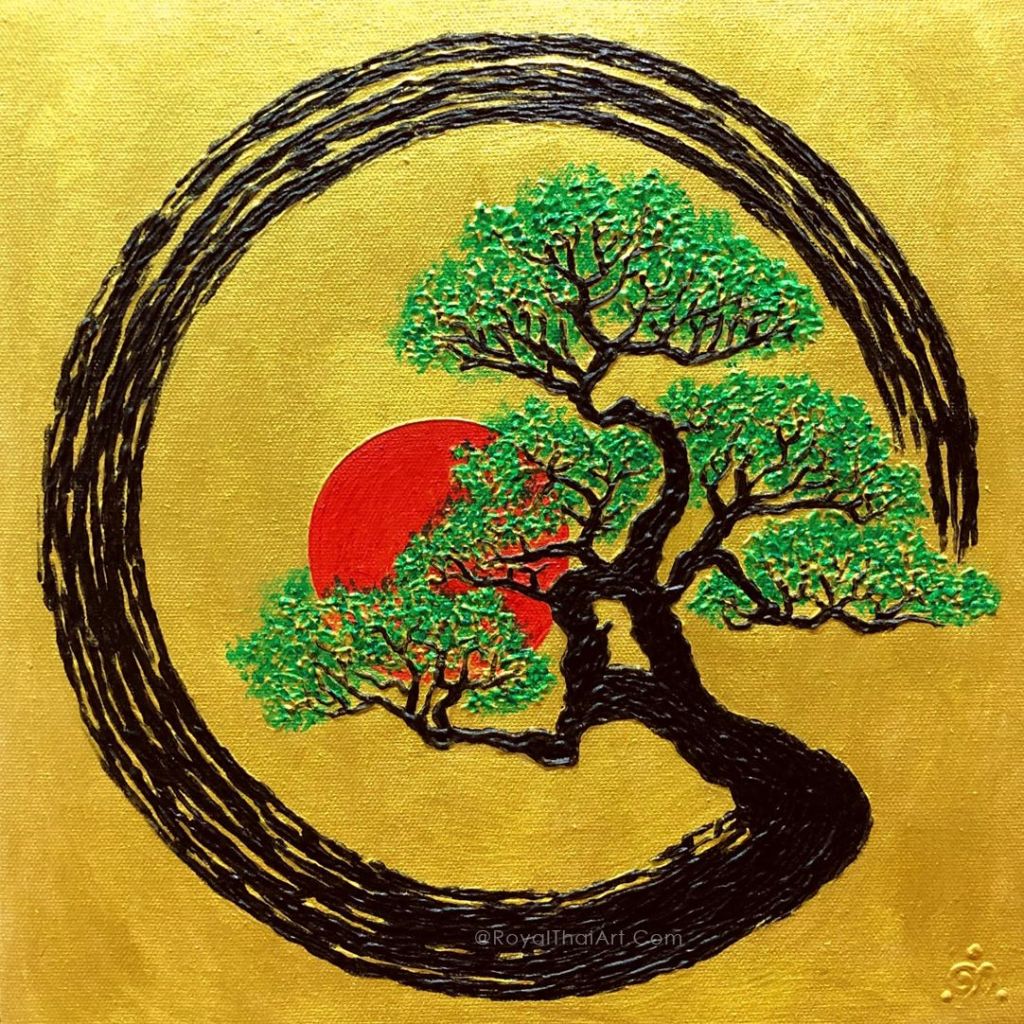
Gautama next shone his awareness on the mental states which were the sources of suffering — fear, anger, hatred, arrogance, jealousy, greed, and ignorance. Mindful awareness blazed in him like a bright sun, and he used that sun of awareness to illuminate the nature of all these negative mental states. He saw that they all arose due to ignorance. They were the opposite of mindfulness. They were darkness — the absence of light. He saw that the key to liberation would be to break through ignorance and to enter deeply into the heart of reality and attain a direct experience of it. Such knowledge would not be the knowledge of the intellect, but of direct experience.
In the past, he had looked for ways to vanquish fear, anger, and greed, but the methods he had used had not borne fruits because they were only attempts to suppress such feelings and emotions. Gautama now understood that their cause was ignorance, and that when one liberated from ignorance, mental obstructions would vanish on their own, like shadows fleeing before the rising sun. Gautama’s insight was the fruit of his deep concentration.
He smiled, and looked up at a pippala leaf imprinted against the blue sky, blowing back and forth as if calling him. Looking deeply at the leaf, he saw clearly the presence of the sun and stars — without the sun, without light and warmth, the leaf could not exist. This was like this, because that was like that. He also saw in the leaf the presence of clouds — without clouds there could be no rain, and without rain the leaf could not be. He saw the earth, time, space and mind — all were present in the leaf. In fact, at that very moment, the entire universe existed in that leaf. The reality of the leaf was a wondrous miracle.
Though we ordinarily think that a leaf is born in the springtime, Gautama could see that it had been there for a long, long time in the sunlight, the clouds, the tree, and in himself. Seeing that the leaf had never been born, he could see that he too had never been born. Both the leaf and he himself had simply manifested — they had never been born and were incapable of ever dying. With this insight, ideas of birth and death, appearance and disappearance dissolved, and the true face of the leaf and his own true face revealed themselves. He could see that the presence of any one phenomenon made possible the existence of all other phenomena. One included all, and all were contained in one.
The leaf and his body were one. Neither possessed a separate, permanent self. Neither could exist independently from the rest of the universe. Seeing the interdependent nature of all phenomena, Gautama saw the empty nature of all phenomena — that all things are empty of a separate, isolated self. He realised that the key to liberation lay in these two principles of interdependence and non-self. Clouds drifted across the sky, forming a white background to the translucent pippala leaf. Perhaps that evening the clouds would encounter a cold front and transform into rain. Clouds were one manifestation; rain was another. Clouds also were not born and would not die. If the clouds understood that, Gautama thought, surely they would sing joyfully as they fell down as rain onto the mountains, forests and rice fields.
Reference Books:


 Kalampedia