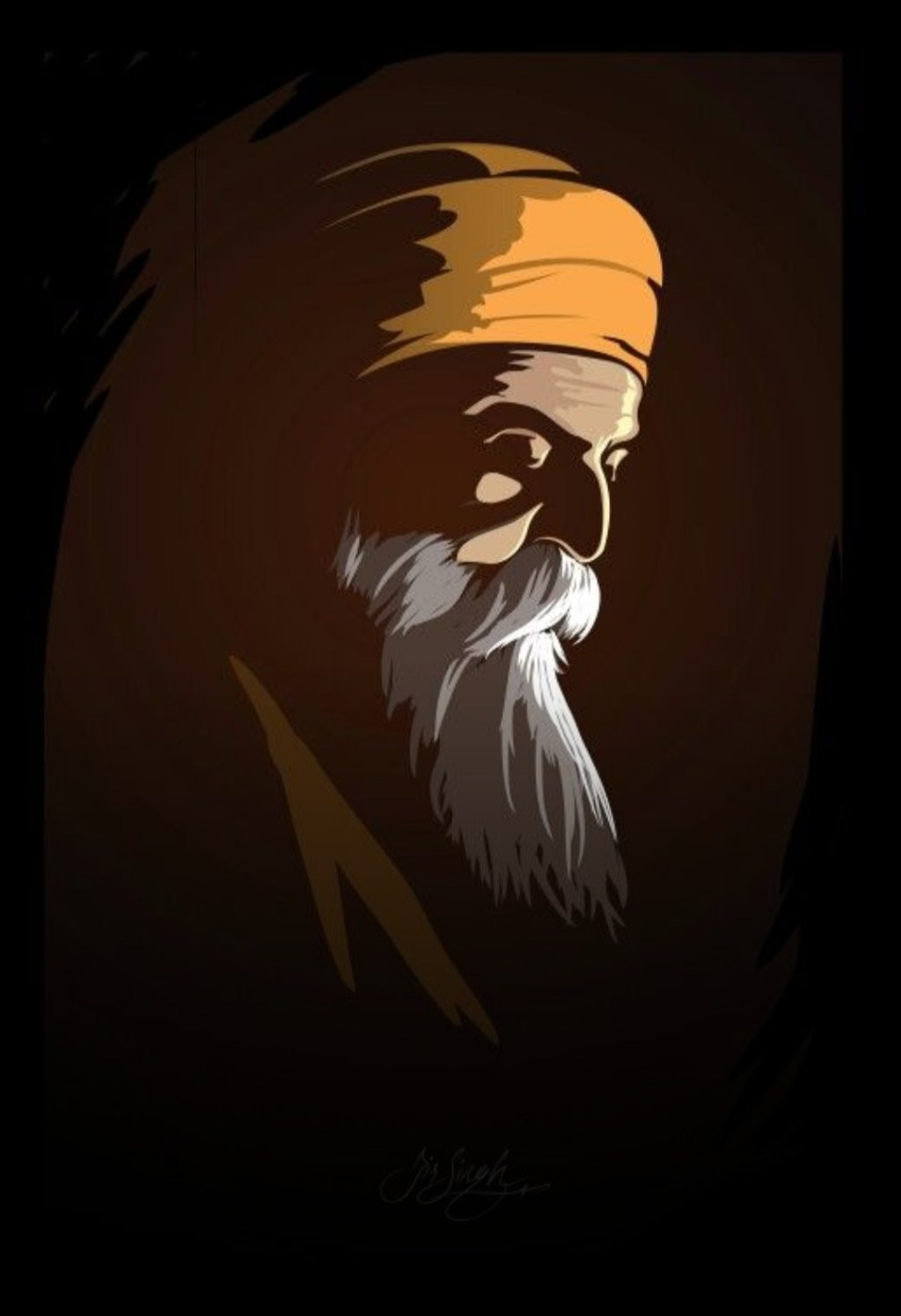
In medieval India, there were some who were trying to combine the elements of Hinduism and Islam. The Mughal emperor Akbar (1556–1605) was one. He wasn’t the first, though. Many spiritual movements were going on — poets were telling their stories, as they always had. In the middle of all this, Sikhism emerged. The founder of Sikhism, its first guru, was Guru Nanak, who lived from 1469 to 1539.
Born into a Hindu family in modern Pakistan, Nanak as a young man sought out the teachings of Muslim and Hindu mystics and holy men. At the age of thirty he began to wander through India searching for disciples who would accept his message of love and reconciliation between Hindus and Muslims. He taught that external religious acts such as bathing in the sacred Ganges or making a pilgrimage to Mecca are worthless before God unless inward sincerity and true morality accompany them. As a strict and uncompromising monotheist, he declared that love of God alone is sufficient to free a person of any caste from the law of Karma, bringing an end to the cycle of reincarnation and resulting in the absorption into the One.

The following poems come from the holy book of Sikhism, known as the Adi Granth, or Guru Granth Sahib. Compiled by Guru Arjan (1563–1606), the fifth guru, it consists mostly of hymns and poetry composed by Guru Nanak and other early gurus. It attained its final form in 1705–1706, when the tenth and last guru, Guru Gobind Singh (1666–1708), added a number of hymns and declared that from then on the Adi Granth itself, not an individual, was Sikhism’s true guru. The following excerpts are taken from poems of Guru Nanak as mentioned in The Guru Granth Sahib.
There is one God,
Eternal Truth is His Name;
Maker of all things,
Fearing nothing and at enmity with nothing,
Timeless is His Image;
Not begotten, being of His own Being;
By the grace of the Guru, made known to men.

***

It is not through thought that He is to be comprehended
Though we strive to grasp Him a hundred thousand times;
Nor by outer silence and long deep meditation
Can the inner silence be reached;
Nor is man's hunger for God appeasable
By piling-up world-loads of wealth.
All the innumerable devices of worldly wisdom
Leave a man disappointed; not one avails.
How then shall we know the Truth?
How shall we rend the veils of untruth away?
Abide thou by His Will, and make thine own,
His will, O Nanak, that is written in thy heart.

***

He cannot be installed like an idol,
Nor can man shape His likeness.
He made Himself and maintains Himself
On His heights unstained forever;
Honoured are they in His shrine
Who meditate upon Him.

***

Those who have inner belief in the Name,
Always achieve their own liberation,
Their kith and kin are also saved.
Guided by the light of the Guru
The disciple steers safe himself.
And many more he saves;
Those enriched with inner belief
Do not wander begging.
Such is the power of His stainless Name,
He who truly believes in it, knows it.

***

There is no counting men's prayers,
There is no counting their ways of adoration.
Thy lovers, O Lord, are numberless;
Numberless those who read aloud from the Vedas,
Numberless those Yogis who are detached from the world;

Numberless are Thy Saints contemplating,
Thy virtues and Thy wisdom;
Numberless are the benevolent, the lovers of their kind.

Numberless Thy heroes and martyrs
Facing the steel of their enemies;
Numberless those who in silence
Fix their deepest thoughts upon Thee.
Reference Books:


 Kalampedia