
Let’s discuss the origins of western philosophy.
Well… nobody will ever know who started it. It could be that some poor genius invented philosophy and then fell into the abyss of unwritten history before he could announce himself to posterity. There is no reason to think that there was such a person, but then there wouldn’t be. Happily, there are at least records of one start to philosophy, even if one cannot be certain that it was not preceded by other false starts.
Nowadays they are soberly studied in libraries and universities, but many of the earliest known philosophers made their first reputations in what could be regarded as a branch of show business. They appeared in public, often in resplendent clothes, and held discourses or recited poems. Such performances attracted passing audiences, devoted followers and sometimes ridicule. This was especially true in ancient Greece.
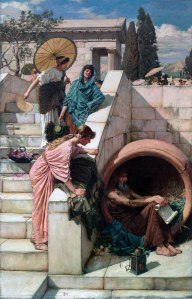
Some of these men were more outgoing than others. At one extreme is an itinerant poet, Xenophanes, who — purporting to be ninety-two at the time — apparently claimed to have spent ‘seven and sixty years… tossing my cares up and down the land of Greece’. At the other end is a contemptuous aristocrat, Heraclitus of Ephesus (variously known in antiquity as ‘the dark’, ‘the weeping’ and ‘the obscure’), who on his own proud admission loathed all sages and the mobs who listened to them, and presumably kept himself to himself. Most of the early philosophers fell somewhere between these two extremes. This was in the sixth and fifth centuries BC, in parts of what are now Greece, Turkey and Italy.
Today these people are generally called the ‘Presocratics’, which marks the fact that nearly all of them had what some historians in the nineteenth century regarded as the misfortune of being born before Socrates (469-399 BC). One might as well leave this label around their necks; but in fact they were far from being a mere overture to the Socratic opera. As Nietzsche said, they invented the archetypes of all later philosophy. They also invented science, which in those days came to much the same thing.
The fire of these miracle-men did not suddenly drop from the sky. Sixth-century Greece was not the dawn of time, and perhaps a case can be made for beginning even earlier, with rudimentary Babylonian geometry or early Greek religion. It may be said that the Presocratics, although fine thinkers, did not invent thinking itself, and that looking at some earlier efforts will help to clarify their ideas. But let’s just stick to the history of philosophy, not of everything. Besides, we have to start somewhere.

The place to begin is Miletus, one the Ionian city-states on the coast of Asia minor (now in Turkey). In the 6th-century BC, it was a rich sea power with many colonies to the north in Thrace and around the Black Sea, and commercial links with parts of southern Italy, the east and Egypt. It was a cultivated place, giving some people the leisure which Aristotle was later fond of claiming to be a prerequisite for philosophy. Writing two centuries afterwards, Aristotle divided early Greek thinkers into theologi, who saw the world as controlled by impetuous supernatural beings, and physici (naturalists), who tried instead to explain an apparently disordered world in terms of simpler and impersonal principles. He said that the Milesians were the first physici.
Many of the Presocratics wrote down their thoughts as well as holding forth in public, but you would hardly know it from what is left today. Their writings have been shattered by time and survive, if at all, only in tiny fragments. For some 2,000 years scholars have been poring over passages of little more than a few sentences, picking at a few words here and there, and depending heavily on secondary sources. Some ancient commentaries on these shards can be relied on at least to attempt accuracy. But even the best of them were written generations, or even hundreds of years, after the Presocratics lived. Other second and third hand sources, such as the writings of the often unreliable but most enjoyable biographer, Diogenes Laertius, need to be read with at least one eyebrow raised. Diogenes was an undiscerning whale of a historian who swallowed every story that floated by.
Despite all the confusion and complexity, we know that Presocratics were — little by little — building the foundations of what we today call as the western philosophy. The dreams those men saw are bearing fruits every single day wherever (and whenever) someone is thinking, writing or speaking reasonably.
***
The above excerpts are taken from Anthony Gottlieb’s book The Dream of Reason: A History of Philosophy from the Greeks to the Renaissance.
 Kalampedia