
Today, we will discuss some of the basics that will be helpful in your meditation journey. Hopefully they will address many of the questions that are lingering on your mind. Let’s start with the most basic question. How to sit in meditation sessions?
Sitting
Sit comfortably, with a posture as recommended below. Spend a few minutes settling your body and mind. Decide which meditation you will do and for you long, and determine not to do anything else for that period of time (yes, that means avoiding your phone as well).
It is traditional to prostrate three times before sitting down to meditate. Prostration counteracts pride. It expresses our acceptance that we have work to do, problems to solve, and a long way to go in our inner development. It is not necessarily an act of submission to something external (it could be that too), but a recognition that the potential for wholeness and perfection lies within us. We are prostrating to our own nature, which we want to awaken through meditation.
Posture
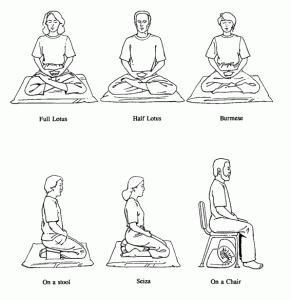
Legs
The best position for meditation is the vajra, or full-lotus, position, where you sit cross-legged with each foot placed, sole upward, on the thigh of the opposite leg. It gives the best support to the body, but since it could be slightly difficult for the beginners, one could go for the alternative — the half-lotus position. Here, the left foot is on the floor under the right leg and the right foot on top of the left thigh. You can also sit in a simple cross-legged posture with both feet on the floor. If you are not comfortable with this position either, then you can use a chair too.
Arms
Place your hands loosely on your lap, about two inches below the navel, right hand on top of the left, palms upward, with the fingers aligned. The two hands should be slightly cupped so that the tips of the thumbs meet to form a triangle. Shoulders and arms should be relaxed. Your arms should not be pressed against your body but held a few inches away to allow circulation of air: this helps to prevent sleepiness.
Back
Your back is most important. It should be straight, held relaxed and lightly upright, as if the vertebrae were a pile of coins. It might be difficult in the beginning, but in time it will become natural and you will notice the benefits: your energy will flow more freely, you won’t feel sluggish, and you will be able to sit comfortably in meditation for increasingly longer periods.
Eyes
New meditators often find it easier to concentrate with their eyes fully closed. This is quite acceptable. However, it is recommended that you leave your eyes slightly open to admit a little light, and direct your gaze downward. Closing your eyes maybe an invitation to sluggishness, sleep, or dream-like images, all of which hinder meditation.
Jaw
Your jaw should be relaxed and teeth slightly apart, not clenched. Your mouth should also be relaxed, with the lips together lightly.
Tongue
The tip of your tongue should touch the palate just behind the upper teeth. This reduces the flow of saliva and thus the need to swallow, both of which could be distracting as your concentration increases and you sit in meditation for longer periods.
Head
Your neck should be bent forward a little so that your haze is directed naturally towards the floor in front of you. If your head is held too high, you may have problems with mental wandering and agitation, and if dropped too low, you could experience mental heaviness or sleepiness.
This seven-point posture is most conducive to clear, unobstructed contemplation. You might find it difficult in the beginning, but it is a good idea to check every point at the start of your session and try to maintain the correct posture for a few minutes. With familiarity it will feel more natural and you will begin to notice its benefits.
Click here to read about the common problems that you might experience during meditation.
 Kalampedia