
Over ten years ago, one of my disciples in Vietnam had a Stupa — a Buddhist shrine — built for my ashes. I told her, I didn’t need a stupa for my ashes; I don’t want to be stuck in a stupa; I want to be everywhere.
“But,” she protested, “it’s already built.”
“In that case,” I said, “you’ll have to put an inscription on the front saying — I am not in here.”
It’s true. I won’t be there in the stupa. Even if my body is cremated and my ashes are put in there, they aren’t me. I won’t be in there. Why would I want to be in there, when outside it’s so beautiful? But, in case some people misunderstand, I told her that they might need to add another inscription, saying — I am not out there, either. People won’t find me inside or outside or outside the stupa. Yet, they may still misunderstand. So, there may need to be third inscription, that reads — If I am to be found anywhere, it is in your peaceful way of breathing and walking. That is my continuation. Even though we may never have met in person, if, when you breathe in, you find peace in your breathing, I am there with you.
~ Thich Nhat Hanh (The Art of Living)
It’s hard to find words when someone, who never believed in death, dies. Thich Nhat Hanh believed in continuation. Like the rain is the continuation of the cloud, and the cloud is the continuation of water vapours. There is no birth or death of the cloud, he would say. And so is with us.
Perhaps, it is a good time to reflect on the life he lived. It’s rare to find a peace activist, who is not angry, but at peace with himself/herself — he was one. A gentle, humble monk, Dr. Martin Luther King, Jr. called him “an Apostle of peace and nonviolence” when nominating him for the Nobel Peace Prize. Exiled from his native Vietnam for almost four decades, he was a pioneer bringing Buddhism and mindfulness to the West, and establishing an engaged Buddhist community for the 21st Century.
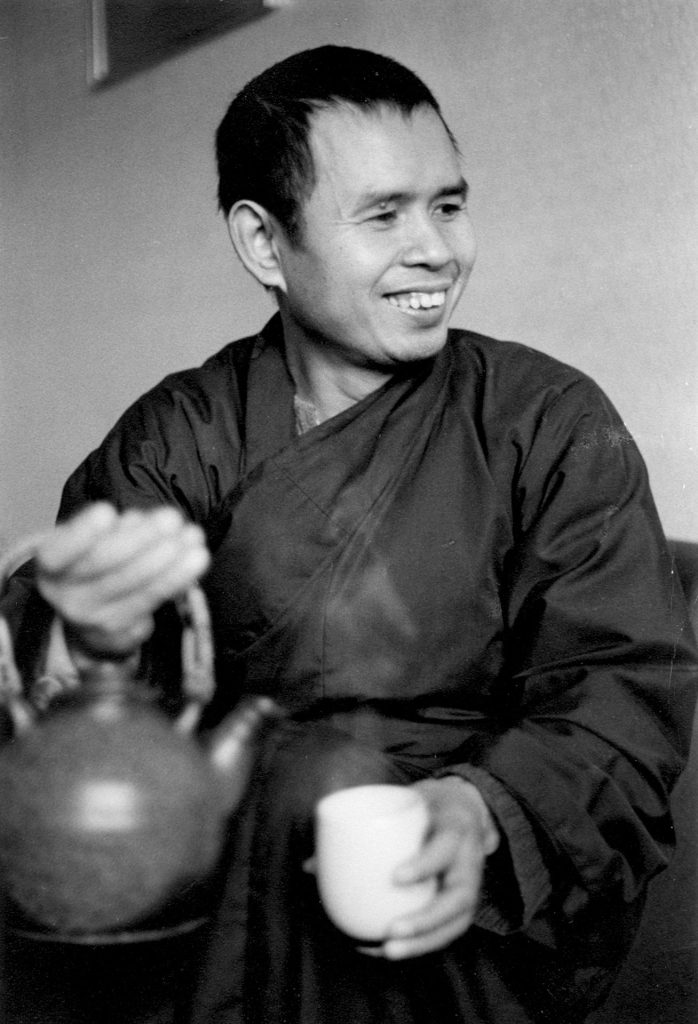
Thich Nhat Hanh published over 100 titles in English, ranging from classic manuals on meditation, mindfulness and Engaged Buddhism, to poems, children’s stories, and commentaries on ancient Buddhist texts.
Whichever element (or aspect) you would want to study in Buddhism, you would find Thich Nhat Hanh’s writings most helpful there. If you wish to know about Buddha’s life, read Old Path White Clouds. If you wish to learn Buddha’s teachings, read The Heart of the Buddha’s Teaching. If you wish to understand mindfulness, pretty much any book of his would do that job (reccommended: The Miracle of Mindfulness). If are looking for How-To guides (How to Love, How to Walk, How to Sit, How to Eat, etc., etc.), there are separate books for each one of those tasks. If you are going to meditate on death, read No Death, No Fear. The list goes on.
In all these works, he converses with you as a good teacher would converse with a student. He teaches the simplest of life skills, with great love and care. For instance, in his book How to Eat, he reminds us — how something as simple and ordinary as drinking a cup of tea can bring us joy and help us feel our connection to the earth. Through these simplest of life events or actions, he guides us towards the most profound wisdom one can attain; one can seek spirituality in every ordinary thing that one does every day. Sweeping the floor, watering the vegetables, and washing the dishes — they all have the potential to nourish our souls.
In his book The Art of Living, Thich Nhat Hanh tells us about life and death and everything in between. He reminds us that we are not separate beings but inter-beings. That we are children of the earth, made of all the same elements and minerals. That we contain mountains, rivers, stars, and black holes. That in every moment of our life the cosmos is going through us, renewing us, and we are returning ourselves to the cosmos.
That’s where he is… in the cosmos! In the breath. In the peace that surrounds us. Go well, Master!
 Kalampedia