
Our brains are extraordinary. The typical brain consists of some 100 billion cells, each of which connects and communicates with up to 10,000 of its colleagues. Together they forge an elaborate network of some one quadrillion (1,000,000,000,000,000) connections that guides how we talk, eat, breathe, and move. James Watson, who won the Nobel Prize for helping discover DNA, described the human brain as “the most complex thing we have yet discovered in our universe.” (Woody Allen, meanwhile, called it “my second favourite organ.”)
Yet for all the brain’s complexity, its broad topography is simple and symmetrical. Scientists have long known that a neurological Mason-Dixon Line divides the brain into two regions. And until recently, the scientific establishment considered the two regions separate but unequal. The left side, the theory went, was the crucial half, the half that made us human. The right side was subsidiary — the remnant, some argued, of an earlier stage of development. The left hemisphere was rational, analytic, and logical — everything we expect in a brain. The right hemisphere was mute, nonlinear, and instinctive — a vestige that nature had designed for a purpose that humans had outgrown.
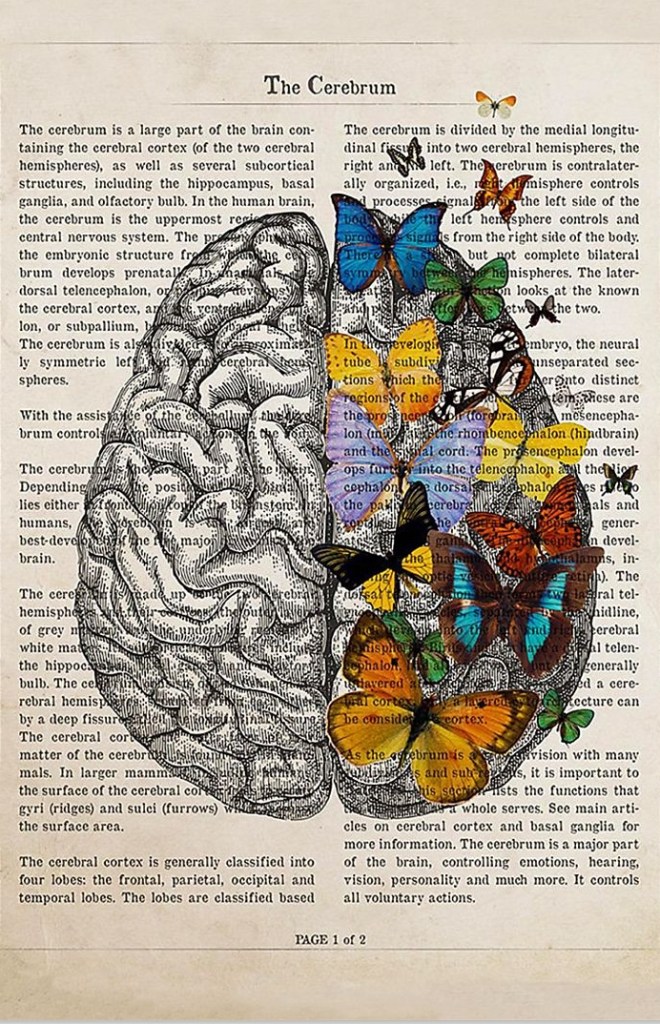
This view prevailed for much of the twentieth century — until a soft-spoken Caltech professor named Roger W. Sperry reshaped our understanding of our brains and ourselves. In the 1950s, Sperry studied patients who had epileptic seizures that had required removal of the corpus callosum, the thick bundle of some 300 million nerve fibers that connects the brain’s two hemispheres. In a set of experiments on these “split-brain” patients, Sperry discovered that the established view was flawed. Yes, our brains were divided into two halves. But as he put it, “The so-called subordinate or minor hemisphere, which we had formerly supposed to be illiterate and mentally retarded and thought by some authorities to not even be conscious was found to be in fact superior cerebral member when it came to performing certain kinds of mental tasks.” In other words, the right wasn’t inferior to the left. It was just different. “The appear to be two modes of thinking,” Sperry wrote, “represented rather separately in the left and right hemispheres, respectively.” The left hemisphere reasoned sequentially, excelled at analysis, and handled words. The right hemisphere reasoned holistically, recognised patterns, and interpreted emotions and nonverbal expressions. Human beings were literally of two minds.
The Mistake
These two misconceptions are opposite in spirit but similar in silliness. One considers the right brain a saviour; the other considers it a saboteur.
The truth is, these two hemispheres play a role in nearly everything we do. “We can say that certain regions of the brain are more active than others when it comes to certain functions,” explains one medical primer, “but we can’t say those functions are confined to particular areas.” Still, neuroscientists agree that the two hemispheres take significantly different approaches to guiding our actions, understanding the world, and reacting to events. With more than five decades of research on the brain’s hemispheres, it’s possible to distill the findings to four key differences.
1. The left hemisphere controls the right side of the body; the right hemisphere controls the left side of the body.
2. The left hemisphere is sequential; the right hemisphere is simultaneous.
3. The left hemisphere specialises in text; the right hemisphere specialises in context.
4. The left hemisphere analyses the details; the right hemisphere synthesises the big picture.

However tempting it is to talk of right and left hemispheres in isolation, they are actually two half-brains, designed to work together as a smooth, single, integrated whole in one entire, complete brain. The left hemisphere knows how to handle logic and the right hemisphere knows about the world. Put the two together and one gets a powerful thinking machine. Use either on its own and the result can be bizarre or absurd. In other words, leading a healthy, happy, successful life depends on both hemispheres of your brain.
But the contrast in how our cerebral hemispheres operate does yield a powerful metaphor for how individuals and organisations navigate their lives. Some people seem more comfortable with logical, sequential, computer-like reasoning. They tend to become lawyers, accountants, and engineers. Other people are more comfortable with holistic, intuitive, and nonlinear reasoning. They tend to become inventors, entertainers, and counsellors. And these individual inclinations go on to shape families, institutions, and societies.
Call the first approach L-Directed Thinking. It is a form of thinking and an attitude to life that is characteristic of the left hemisphere of the brain — sequential, functional, textual, and analytical. Ascendant in the Information Age, exemplified by computer programmers, prized by hardheaded organisations, and emphasised in schools, this approach is directed by left-brain attitudes, towards left-brain results.
Call the other approach R-Directed Thinking. It is a form of thinking and an attitude to life that is characteristic of the right hemisphere of the brain — simultaneous, metaphorical, aesthetic, contextual, and synthetic. Underemphasised in the Information Age, exemplified by creators and caregivers, shortchanged by organisations, and neglected in schools, this approach is directed by right-brain attributes, towards right-brain results.
The world today is changing — and it will dramatically reshape our lives. Left-brain-style thinking used to be the driver and right-brain-style thinking the passenger. Now, R-Directed Thinking is suddenly grabbing the wheel, stepping on the gas, and determining where we’re going and how we’ll get there. L-Directed aptitudes — the sorts of thing measured by the SAT and deployed by CPAs — are still necessary. But they are no longer sufficient. Instead, the R-Directed aptitudes so often disdained and dismissed — artistry, empathy, taking the long view, pursuing the transcendent — will increasingly determine who soars and who stumbles. It’s a dizzying, but inspiring, change.
***
The above excerpts are taken from Daniel H. Pink’s book A Whole New Mind: Why Right-Brainers Will Rule the Future.
 Kalampedia