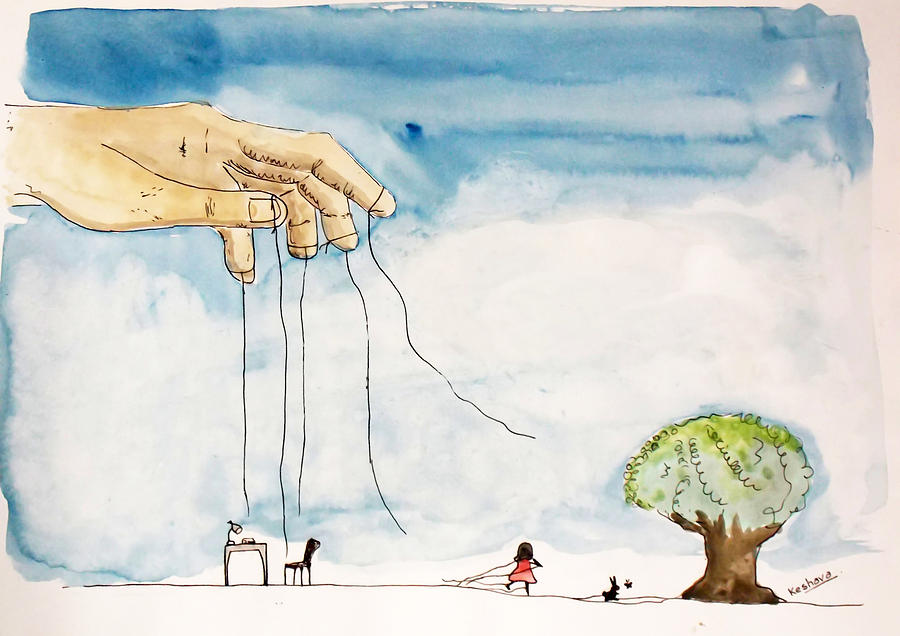
Free will is an illusion. Our wills are simply not of our own making. Thoughts and intentions emerge from background causes of which we are unaware and over which we exert no conscious control. We do not have the freedom we think we have.
Free will is actually more than an illusion (or less), in that it cannot be made conceptually coherent. Either our wills are determined by prior causes and we are not responsible for them, or they are the product of chance and we are not responsible for them. If a man’s choice to shoot the president is determined by a certain type of neural activity, which is in turn the product of prior causes — perhaps an unfortunate coincidence of bad genes, an unhappy childhood, lost sleep, and cosmic-ray bombardment — what can it possibly mean to say that his will is “free”? No one has ever described a way in which mental and physical processes could arise that would attest to the existence of such freedom. Most illusions are made of sterner stuff than this.
The popular conception of free will seems to rest on two assumptions: (1) that each of us could have behaved differently than we did in the past, and (2) that we are conscious source of most of our thoughts and actions in the present. As we are about to see, however, both of these assumptions are false.
But the deeper truth is that free will doesn’t even correspond to any subjective fact about us — and introspection soon proves as hostile to the idea as the laws of physics are. Seeming actions of volition merely arise spontaneously ( whether caused, uncaused, or probabilistically inclined, it makes no difference) and cannot be traced to a point of origin in our conscious minds. A moment or two of serious self-scrutiny, and you might observe that you no more decide the next thought you think than the next thought I write.
The Unconscious Origins of the Will
We are conscious of only a tiny fraction of the information that our brains process in each moment. Although we continually notice changes in our experience — in thought, mood, perception, behaviour, etc. — we are utterly unaware of the neurophysiological events that produce them. In fact, we can be very poor witnesses to experience itself. By merely glancing at your face or listening to your tone of voice, others are often more aware of your state of mind and motivations than you are.

I generally start each day with a cup of coffee or tea — sometimes two. This morning, it was coffee (two). Why not tea? I am in no position to know. I wanted coffee more than I wanted tea today, and I was free to have what I wanted. Did I consciously choose coffee over tea? No. The choice was made for me by events in my brain that I, as the conscious witness of my thoughts and actions, could not inspect or influence. Could I have “changed my mind” and switched to tea before the coffee drinker in me could get his bearings? Yes, but this impulse would also have been the product of unconscious causes. Why didn’t it arise this morning? Why might it arise in the future? I cannot know. The intention to do one thing and not another does not originate in consciousness — rather, it appears in consciousness, as does any thought thought or impulse that might oppose it.
***
The above excerpts are taken from Sam Harris’s book Free Will.
 Kalampedia