
John Lang (1816-1864), a lawyer and Australia’s first native novelist, was born at Parramatta, Sydney. He later went to Cambridge in 1837 only to qualify as a barrister and return to his home country.
In India, John Lang is known for his career as a solicitor, particularly, when he was defending the Rani of Jhansi against the East India company’s policy of land seizures under the Doctrine of Lapse. He was also a journalist and had established a paper, The Mofussilite, at Meerut. As a novelist, he was associated with books like Too Clever by Half, Clever Criminals, The Ex-Wife, among others.
John Lang spent his final years in Landour, a place close to Mussoorie. Below excerpts, taken from his book Wanderings in India: And Other Sketches of Life in Hindustan, tell us about the life as he experienced in the Himalayas, particularly around Mussoorie.
***
I have already spoken of a German Baron and a French gentleman whom I met at Agra, and I have said that they, like myself, were travelling in search of the picturesque, and with a view to become acquainted with Oriental character from personal observation.
While staying with my friend at Barnapore, I received a letter from the former, proposing that we should meet on a certain day at Mussoorie, in the Himalaya mountains, and travel into the interior together. I agreed with all my heart; and my friend, the assistant magistrate, was tempted to apply for six weeks’ leave, in order that he might accompany us.
Let me describe these foreign gentlemen. They were respectively about my own age — thirty-two — had seen a great of the world, and of the society at every court and capital in Europe. They were both possessed of considerable abilities, and of the most enviable dispositions; always good-natured and good-tempered; patient and cheerful under those innumerable little difficulties that almost invariably beset a wanderer in the East, or, in fact, a wanderer in any part of the world. They had, moreover, a keen sense of humour; and, each in his own peculiar way, could relate a story, or an incident in his life, in such a manner as to make it wonderfully mirth-provoking. They were men of refined understanding and of very refined manners: take them all in all, they were the most charming companions I ever encountered. They were utterly devoid of vulgar nationalities — of any enthusiastic admiration of their own fatherlands, and would just as soon ridicule the foibles peculiar to their own countries, respectively, as the foibles of a man of any other country. My friend, the assistant magistrate, was also a desirable companion. He, too, was a good-tempered, good-humoured being, with a keen sense of humour, and some wit. He had read a great deal of late years, in that out-of-the-way station to which he had been appointed, and he had profited by his reading.
It was beginning to be very hot in the plains, and my friend and myself were not a little glad when we found ourselves on the road to a colder clime. We drove as far as Deoband in the buggy; and, at three P.M. threw ourselves into our palanquins (palkees), bound for Dehra Dun at the foot of the hills; at which place we arrived at abpit nine o’clock on the following morning, and were deposited — both of us fast asleep — in the verandah of the hotel, kept by a Mr. William Johns, who had been formerly a professional jockey in the North-Western Provinces of India.
So much has been written of Dehra Dun and Mussoorie, that even a brief sketch of these places would be unwarranted in this narrative.
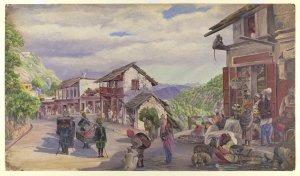
As soon as we arrived at Mussoorie, we began to collect coolies (hill-men), to carry our baggage and stores. We required in all about one hundred and fifty for the expedition, and by the time that we had got these people together, and made arrangements with them, and the guides whom we required, and had laid in our stock of provisions, the foreign gentlemen joined us, and expressed their readiness to start at any given moment. We lingered, however, for two days, in order that they might take some rest, and make the acquaintance of the gentlemen at the club, who, at the instance of my friend, had made them as well as myself honorary members of the institution.
On the third morning, in the front of the clubhouse, our marching establishment was collected, and the one hundred and fifty men of whom it was composed were laden with the baggage and stores. There were tents, the poles thereto belonging, camp tables, chairs, beds, bedding, leather boxes of every kind, containing our clothing, deal chests, containing all sorts of provisions, dozens of cases of wine — port, sherry, claret — beer, ducks, fowls, geese, guns (rifles and others), umbrellas, great-coats, etc., etc., etc. Having seen this train fairly off, we, the four of us, followed shortly after on foot, and overtook them at the Landour Hill, a mountain above nine thousand feet above the level of the sea. We were all in high spirits — including my friend, the assistant magistrate — notwithstanding he put on his lady love’s cloak as soon as we were out of sight of the club, and began to quote in a melancholy but very loud voice, which reverberated through the valleys on either side of us, those glorious lines of the poet Thomas:–
“There is a power
Unseen that rules th’illimitable world —
That guides its motions, from the brightest
Star to least dust of this sin-tainted mould;
While man, who madly deems himself the lord
Of all, is nought but weakness and dependence.
This sacred truth, by sure experience taught,
Thou must have learnt, when wandering all alone:
Each bird, each insect flitting through the sky,
Was more sufficient for itself than thou!”

Our first halting-place was about nine miles from Mussoorie. It was a flat piece of ground, some distance down the southern face of the peak over which the road wound. The place was called Sowcowlee, and here and there were to be seen a few patches of cultivation and a cow-shed. Our course lay in the direction of Almorah, another Hill Sanatorium for the English in India. The tents pitched, and all made snug and comfortable, we threw ourselves down upon our beds, not to sleep, but to take some rest after a long walk. Meanwhile our servants busied themselves in preparing the dinner, for which the exercise and the change of air had given us all a keen appetite.
“Well!” exclaimed my friend (whom in future we will call Mr. West), raising to his lips a bumper of claret, and quoting from the Sentimental Journey, “the Bourbon is not such a bad fellow, after all.”
Neither the Frenchman nor the German understood the allusion; but when it was explained they relished it amazingly. We were rather a temperate party; and after the second bottle of wine was emptied, we caused the glassed to be removed from our small table, and a green cloth spread over it. We then began to play at whist — a game of which we were all equally fond; and, what was of great consequence, we were all equal as players. We did not gamble exactly; bit the stakes were sufficiently high to make either side attend very carefully to the game. The whist over, we each took a tumbler of warm drink, and turned in for the night, and slept, as the reader may imagine, very soundly.
On the following morning, at sunrise, we were awakened, and informed that upon a hill opposite to our encampment there were several large deer. We arose, and went in pursuit of them. After dodging them for some time we came within range, and each of us, selecting his animal, fired. One shot only took effect, and that was from the Baron’s rifle. During our ramble we discovered that there were plenty of pheasants in the locality, and so we agreed to remain for the day, and, after breakfast, see what we could do amongst them. Under the circumstances we should have been compelled to halt, for, as is usual on such occasions, our servants had forgotten several little matters essential for our comfort, if not necessary for our journey, namely, the pickles and the sauces, the corkscrew, the instrument for opening the hermetically sealed tins containing lobsters, oysters, and preserved soups. Amongst other things that had been left behind was the Baron’s guitar, and without it he could not, or would not, sing any of his thousand and one famous German songs. And such a sweet voice as he had! So, while we were amongst the pheasants, five coolies were on their way back to Mussoorie, to bring up the missing articles above enumerated.
***
Note: If you’re looking to read beyond what John Lang experienced and explore more about the British India, click here.
 Kalampedia