India’s earliest teachers were the Gurus who taught in gurukulas and ashrams located far away from the hustle and bustle of towns. It is no surprise that the Vedas, which are the earliest known oral books containing the thoughts of a highly civilised society, are replete with exquisite references to Nature and the concept of inter-dependence of living organisms. To these Gurus, it was important for humans to realise their humble status in the infinite universe before embarking on the long journey of learning.
There is a poignant story in the Chandogya Upanishad which illustrates how a Guru would let a student arrive at fundamental truths by simply observing Nature:
The boy was often times left alone, to his own thoughts, and had frequent opportunities of holding communion with nature from whom he sometimes learned great truths. While tending his teacher’s cattle or gathering fuel in the forest, he felt the influence of deep solitude, which not infrequently matured his ideas and ripened his judgment. It is said of Satyakama Jabala… that he learned truths from the bull of the herd he was tending, from the fire he had lighted and from flamingo and a diver-bird which flew near him. One day in the evening, when he had penned his cows and lain wood on the evening fire, his teacher met him and said, ‘Friend, you shine like one who knows Brahmana (Supreme Consciousness). Who Has taught you?’ The young man replied, ‘not men. I have learnt from nature that the four quarters, and the earth, the sky, the heaven, and the ocean, the sun, the moon, the lightning, and the fire and the organs and minds of living beings, yea, the whole universe was Brahmana.’
Not all gurukulas were in forests, though. Many were in villages and towns, since the Gurus were usually householders with families. However, secluded locations were preferred.

Over time, the systems of transmission of learning to newer generations got institutionalised and gave birth to famous universities such as Takshshila, Nalanda and the temple-universities of which the remains are still found in southern India. A sizeable number of foreign students came to study in India from China, Korea, Japan, Indonesia and West Asia. While the most famous names are Fa-Hien and Xuanzang (Hieun Tsang), who left behind detailed accounts, there were thousands of others who made difficult journeys by foot, on pack animals, and on ships just to imbibe knowledge from Indian professors. India was perceived as a ‘mystical land inhabited by civilised and sophisticated people’. Many of the foreign students copied texts and commentaries to carry back to their countries. The rush for gaining education from the scholars of India could well be considered similar to today’s rush to study in or be certified by American and European universities.
Yijing mentioned 56 students from China, Japan and Korea who studied in Nalanda in the interim period of 40 years between Xuanzang’s visit and his own. It is interesting that many scholars from China first visited Indonesia where they spent some years learning Sanskrit and other subjects in order to gain enough competency to seek admission in famous Indian universities. Indonesia was like a mini India. Yijing has noted the presence of more than 1,000 scholars in one city in Indonesia where they studied all the subjects that were taught in India.
It must be noted that there was no hard distinction between Hinduism and Buddhism in ancient India. Given the tradition of pluralism in India, Buddha’s teachings were regarded as knowledge being shared by yet another guru with ever-growing number of followers. Buddha was a Kshatriya by upbringing, having been born and raised in a royal family. He renounced his family in the manner of a sanyasi which was also an existing tradition of the land.
Historian Koenraad Elst points out that the ideas Buddha developed were already present in the Vedic tradition. Concepts such as karma, reincarnation, yoga and dhyana have been a part of Vedic tradition from time immemorial. Buddha never claimed that he was inventing anything new, rather he said he was walking on the path laid by earlier seers. Many Vaishnava sects believed that Buddha was an avatara of Vishnu himself. Accordingly, many educational institutes of the time offered Buddha’s teachings as one of the disciplines alongside the philosophies expounded by other famous gurus. Also, the monks who transmitted the teachings of Buddha to China, Japan and other countries in East and Southeast Asia were often called Brahmana or Baramon, and even their gotra was noted. In China, the word Brahmana itself had become a synonym for knowledge and scientific books from India were called Brahmana books.
There is a curious hesitation among modern historians to refer to India’s multi-disciplinary centres of traditional learning as universities. This comes from the excessive importance given to the written word, to solid buildings with well established pedagogy and rigid systems of certification. Thus, the talented but bare-chested and dhoti-clad engineers and architects of ancient India who built incredible irrigation canals, rainwater harvesting structures, palaces, forts, roads, dams, and aqueducts are barely acknowledged as professionals. Similarly, medical practitioners of yore who developed an elaborate system of diagnosing disease and combined indigenous pharmacopeia with spiritual advice towards proper lifestyle and wellness are yet to get their due. They developed treatises on general medicine and surgery that still stand validated. They too are worthy but forgotten progenitors of today’s science.
Ancient Indians were deeply invested in gaining perspectives about ‘the material and the moral, the physical and the spiritual, the perishable and the permanent’. During the process of gaining these perspectives, they made important discoveries in the sciences, mathematics and applied medicine. The sacredness of learning is evident from the large number of Sanskrit shlokas that deify the Guru such as ‘Acharya devobhava‘.
Dedicating oneself to gaining education and shunning ignorance was regarded as the foremost duty of every individual. It was valued more than any other distinction. The following lines attributed to Chanakya are echoed in many Indian texts:
Despite having beauty, youth and good lineage, a person without education will not be respected just as a beautiful Kinshuka flower having no fragrance is not admired.
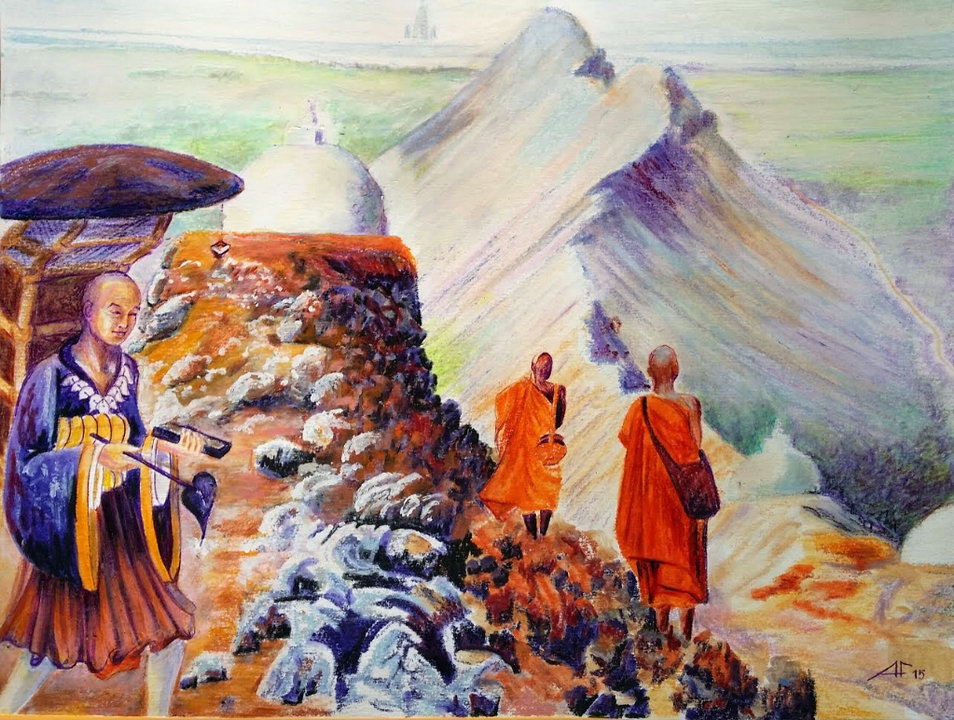
Chinese student Xuanzang has left a touching account of the love of learning in India. It was not forced but came naturally from the seeds of curiosity planted in childhood. He found ascetics who developed their entire lives to learning and teaching simply for the love of knowledge, be it in sciences or philosophy and to the exclusion of every comfort. Such men, who also adhered to high moral standards, were held in great esteem by the State but did not care for the honour bestowed on them. Xuanzang mentions that dedicated scholars preferred poverty to affluence and disregarded domestic ties. They knew no fatigue and travelled across the country to lecture and share their knowledge. Thus, there was a system that ensured a steady supply of qualified persons who gave themselves up to a life of learning and service to the land while keeping their needs to a minimum.
The culture of the times was such that a seeker of knowledge could not just interrogate a Guru and get instant answers. The methods of learning and knowledge dissemination were different. The seeker developed attitudes of humility by serving the Guru and his household. He sat at the Guru’s feet and led a simple, austere lifestyle. The Guru was the judge of adequacy of the student’s preparation to receive knowledge, while the student could gain insight into the Guru’s genuineness as his guide to wisdom.
In the Parshnopanishad, an ancient Sanskrit text, six outstanding students make their way to the Ashram of Guru Pippalaada. They were troubled by burning questions for which they wanted amswers. But Pippalaada was not one to be hurried. He said:
Stay here for yet another year with Tapas (ausyerity), Brahmacharya (celibacy with Sadhana) and Shraddha (faith); then you may ask as you please your questions; and if I know the answers, I will surely explain everything to you.’
Since education was a sacred activity, there were many ancient rites of passage called Samskara that were associated with it. Initiation of children (both male and female) into the alphabets for the first time was done ceremonially in most parts of India. Even today, the ceremony survives in the Haathekhori in Bengal (performed during Saraswati Puja) and the Vidyarambha in southern India (when children are asked to trace alphabets on rice).
The Upanayana ceremony (often called the scared thread ceremony) performed for children between the ages of eight and twelve customarily marked the beginning of education in the Vedic tradition. Such was the significance of this ceremony that it was regarded as the second birth of a human being — a discarding of the old, irregular way of life and the first step towards becoming a disciplined, self-realised being. In the Vedic period, it was performed for both girls and boys at the onset of higher education.
According to Pandharinath H Prabhu: The elaborate rituals and ceremonies centering round the Upanayana have a great social significance which is worth noting in this connection. .. They create an atmosphere of dignity and seriousness about the particular occasion. It has been pointed out that the primitive tribes also had noted the social importance of ceremonials of which they took advantage when they initiated their young folk in the art of archery or hunting. Speaking of the elaborate ceremonials of this nature, Dr Nunn observes: ‘The value of these consists not in themselves, but in what they symbolise. In brief, their biological utility lies in their power of arousing in actors and spectators, as often as they are repeated, states of feeling and emotion that are frequently of great social importance.’ Both of them feel the weight and importance of the particular duties and responsibilities entrusted to the initiated young; and the interest shown by the spectators is an index of the social significance of the occasion.
***
The above excerpts are taken from Sahana Singh’s book Revisiting the Educational Heritage of India.
 Kalampedia